Candidate Fitness Assessment Score Calculator
Estimate a practical candidate readiness score from aerobic fitness, muscular endurance, core capacity, agility, power, body metrics, and recovery context.
📌Presets
Presets load complete candidate profiles and recalculate instantly. This is a training estimate, not an official agency score sheet.
⚙Calculator
Candidate score snapshot
Enter your test events to calculate the assessment score.
📊Assessment Metrics
📋Event Score Table
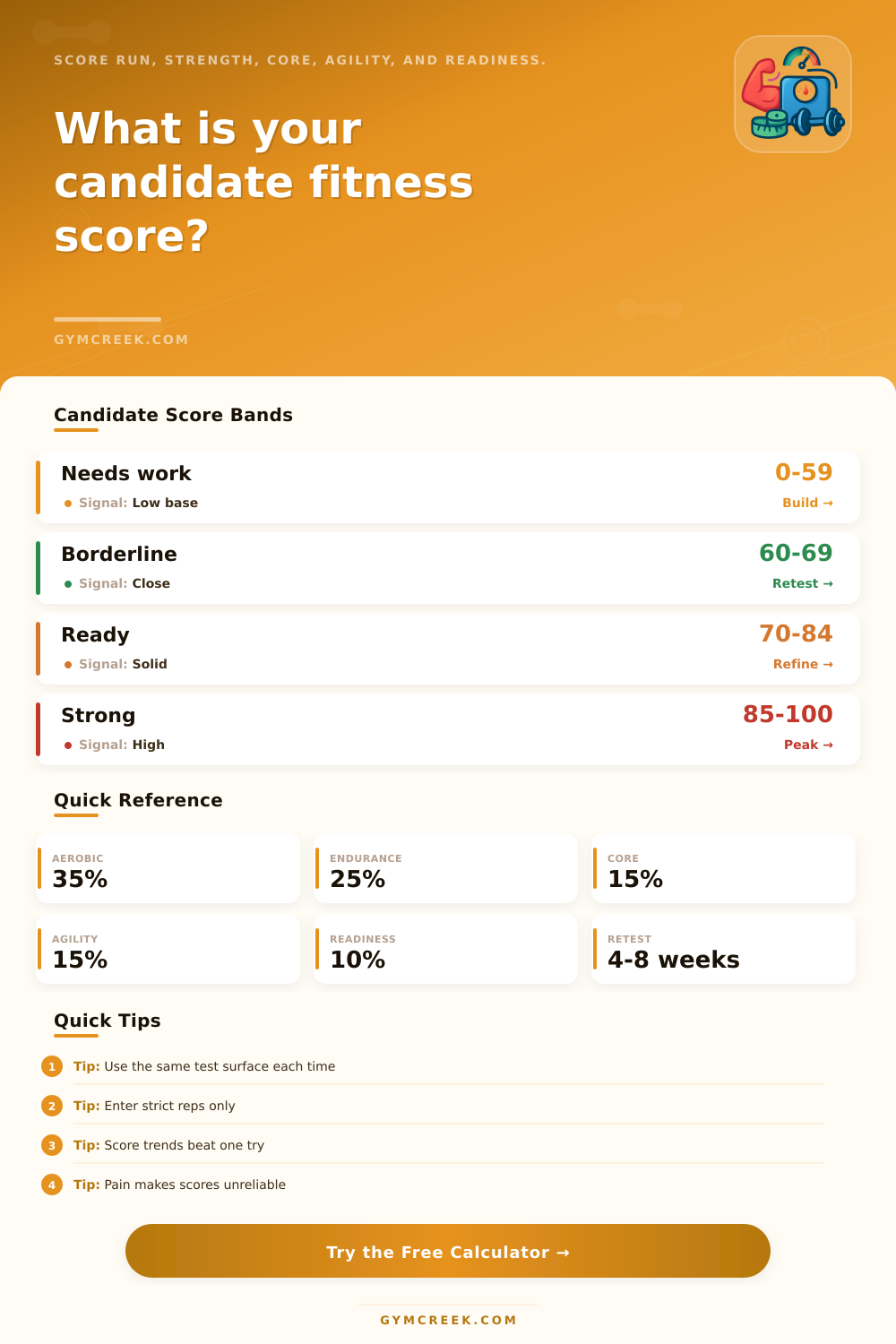
| Area | Result | Score | Weight | Signal |
|---|---|---|---|---|
| Aerobic | --- | --- | 35% | --- |
| Muscular endurance | --- | --- | 25% | --- |
| Core | --- | --- | 15% | --- |
| Agility and power | --- | --- | 15% | --- |
| Readiness context | --- | --- | 10% | --- |
📑Reference Tables
| Score band | Meaning | Typical action | Retest cue |
|---|---|---|---|
| 0-59 | Needs work | Build base | 6-8 weeks |
| 60-69 | Borderline | Fix weak event | 4-6 weeks |
| 70-84 | Ready | Maintain and sharpen | 3-5 weeks |
| 85-100 | Strong | Peak carefully | 2-4 weeks |
| Component | Weight | Formula cue | What it reflects |
|---|---|---|---|
| Aerobic | 35% | VO2 field estimate | Run capacity |
| Muscular endurance | 25% | Rep scoring | Upper and trunk work |
| Agility and power | 15% | Time plus jump | Change of direction |
| Readiness | 10% | RHR, sleep, fatigue | Test-day context |
| Run test | Field estimate | Best use | Watch |
|---|---|---|---|
| 1.5-mile | VO2 from pace | Most candidates | Pacing errors |
| 1-mile | Converted pace | Short retests | Overestimates some |
| 12-minute | Cooper formula | Track testing | Distance accuracy |
| Beep test | Level estimate | Indoor groups | Turn skill |
| Readiness marker | Good | Watch | Why it matters |
|---|---|---|---|
| Sleep | 7-9 hr | Under 6 hr | Output and recovery |
| Resting HR | 50-65 bpm | 75+ bpm | Stress signal |
| Weekly training | 150-300 min | Under 90 min | Consistency |
| Fatigue | 1-4 | 7-10 | Retest quality |
💡Tips
A fitness assessment calculator will give a person an number that indicates there level of physical fitness. While not a replacement for performing an official physical fitness tests, a fitness assessment calculator can indicate which aspect of an individual’s physical training are working and which aspects isnt working. Many individuals opt for using a fitness assessment calculator to determine how they compare than the fitness requirements of military, fire, and academy tracks.
Formal fitness assessments includes six different areas of fitness. A fitness assessment calculator calculates an individual’s score for each of these area using an individual’s fitness numbers. Aerobic capacity is the largest component of physical fitness, and the fitness assessment calculator calculates an individual’s VO2 level using a run test.
How a Fitness Assessment Calculator Works
If an individual’s aerobic score on the fitness assessment calculator is low, it indicates that their aerobic capacity need to be increased. Two other component of fitness are muscular endurance and core strength. Muscular endurance can be tested using push-ups and sit-ups, which measure an individual’s ability to perform a physical task until fatigue.
Core strength is a test of an individual’s ability to hold there body in a plank for a certain length of time. The fitness assessment calculator often assigns a higher weight to muscular endurance because many formal fitness assessments use muscular endurance tests. Agility and power is two components of fitness that are also assessed.
Agility tests an individual’s ability to change the direction of their body quick, often measured in a 300-yard shuttle run test. Power assesses an individual’s strength in a specific burst of exertion, often in the form of a vertical jump. An individual’s agility score and power score may come to a lower result then their score for the run test.
In this case, the fitness assessment calculator indicates that the individual need to increase there interval training. For body composition and recovery context, measurements such as an individual’s waist to height ratio are collected. Additionally, the fitness assessment calculator collects an individual’s resting heart rate, sleep score, and training minute.
While resting heart rate and sleep score do not directly provide an individual with points during the fitness assessment day, these scores will impact their performance on the day of the test. If an individual has a high resting heart rate and sleeps poorly during the week, their fitness test score on the day will likely be more lower than their fitness scores while training. Use a fitness assessment calculator to track fitness scores over time.
By entering your fitness numbers every four to six weeks, you can monitor your trend line. A trend line will show you whether your training is increasing your fitness. If your aerobic score increases but your agility score remains the same, you can adjust your training to include more focus on agility.
If your core strength score increases but your muscular endurance score decreases, you can adjust your training to include more muscular endurance exercise. A fitness assessment calculator assigns ranges instead of pass or fail grade to fitness assessments because different organizations has different standards for fitness. A score that is high for one fitness agency may be low for another.
A fitness assessment calculator focuses on the measurable number for an individual. However, there are some variable that a fitness assessment calculator cannot assess. A fitness assessment calculator cannot determine the temperature of the fitness location on the day of the assessment, the order of the assessments, and the psychological pressure that the individual feel during the assessment.
An individual should not view a low score within the fitness assessment calculator as a personal failure. Instead, it may indicate areas for an individual’s training to improve. If an individual score low on the agility test, they can focus on increasing there agility by performing specific agility exercises.
If an individual scores low on the run test, they can focus on threshold or long run tests to increase there endurance. Additionally, if an individual notes their body metrics such as waist measurement and resting heart rate, they can measure the improvement in these variables. An individual’s small improvement in either waist measurement or resting heart rate will lead to an increase in there overall fitness score.
A fitness assessment calculator is a tool for providing feedback. An individual enters their fitness numbers, the fitness assessment calculator provides the individual with a snapshot of their fitness, and the individual decide on the next phase of their training program. By using the fitness assessment calculator regularly, an individual will be able to determine which aspects of their fitness can be improved quick and which aspects require more time to improve.
By monitoring their fitness scores, an individual will be prepared for fitness test days and will have a better understanding of your current physical fitness.