Fitness Age Calculator
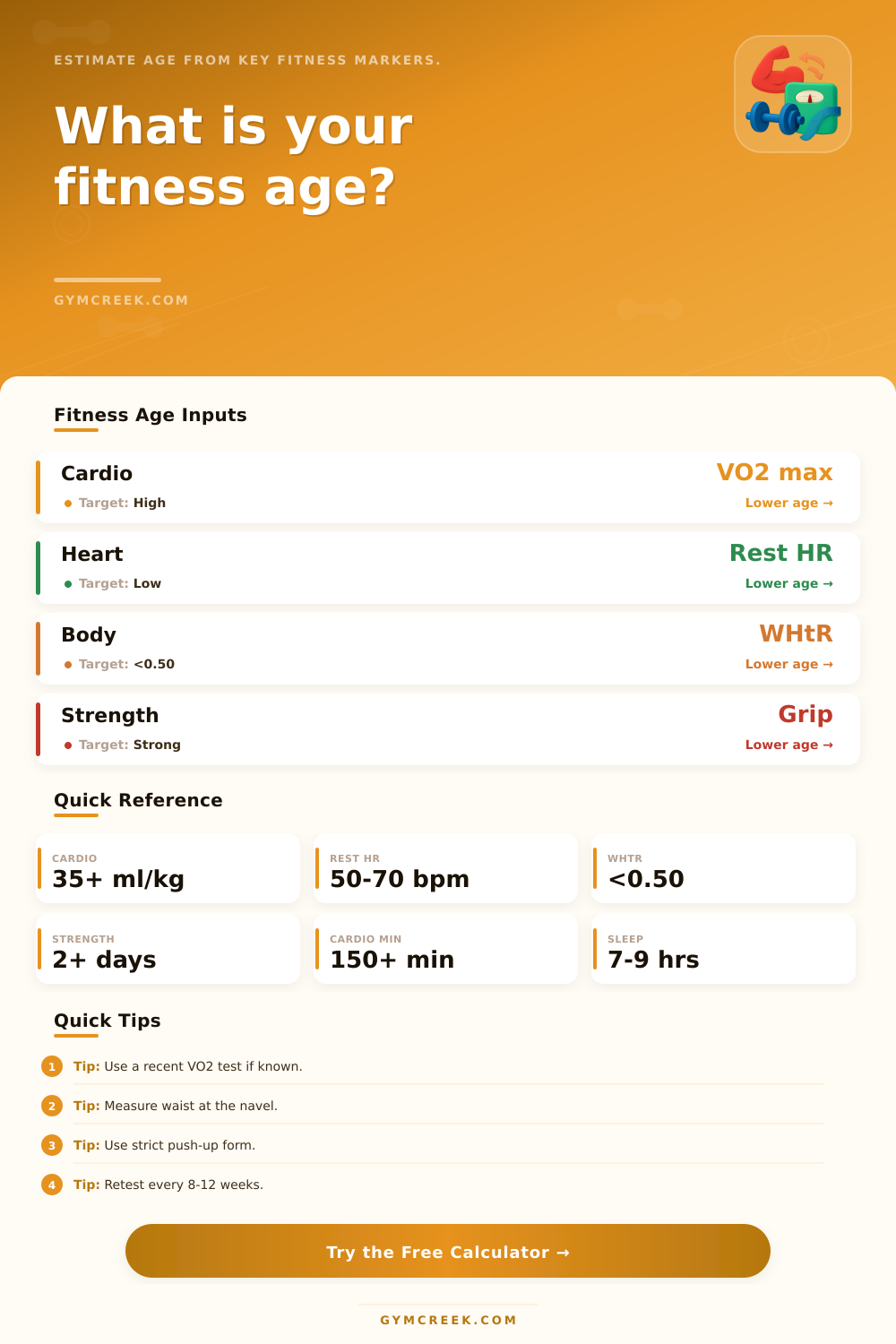
Estimate your fitness age from cardiorespiratory fitness, resting heart rate, body composition, strength, weekly training, and recovery habits.
📌Presets
Presets show how the same chronological age can score differently when cardio, strength, waist ratio, and recovery change.
⚙Calculator
Fitness age snapshot
Enter your current markers to estimate your fitness age.
📊Fitness Metrics
📑Reference Tables
| Component | Inputs | Weight | Why it matters |
|---|---|---|---|
| Cardiorespiratory fitness | VO2 max and resting HR | 45% | Strong predictor of fitness capacity |
| Body composition | BMI, waist ratio, body fat | 20% | Captures size and central adiposity context |
| Strength capacity | Grip, push-ups, plank | 15% | Reflects muscle function and resilience |
| Training habits | Cardio minutes and strength days | 12% | Shows current behavior driving adaptation |
| Recovery context | Sleep and stress load | 8% | Helps interpret whether habits are repeatable |
| Age | Men Low | Men Good | Women Good |
|---|---|---|---|
| 20-29 | Under 35 | 44-52 | 39-45 |
| 30-39 | Under 33 | 42-49 | 35-42 |
| 40-49 | Under 30 | 39-47 | 32-38 |
| 50-59 | Under 27 | 36-43 | 29-36 |
| 60+ | Under 24 | 33-40 | 27-33 |
| Marker | Lower-risk band | Watch band | Calculator effect |
|---|---|---|---|
| Waist-to-height ratio | Under 0.50 | 0.50+ | Raises body-age estimate when higher |
| BMI context | 18.5-24.9 | 30+ | Moderate adjustment, not a diagnosis |
| Resting heart rate | 50-70 bpm | 80+ bpm | Lower values improve cardio index |
| Sleep | 7-9 hours | Under 6 | Short sleep reduces recovery index |
| Score | Fitness age gap | Retest | Focus |
|---|---|---|---|
| 85-100 | Much younger | 10-12 weeks | Maintain and refine |
| 70-84 | Younger or even | 8-10 weeks | Keep volume consistent |
| 55-69 | Near age | 6-8 weeks | Improve weakest marker |
| 40-54 | Older | 4-6 weeks | Build baseline habits |
| Under 40 | Much older | 4 weeks | Use conservative progression |
| Formula | Variables | Output | Best use |
|---|---|---|---|
| Cooper VO2 | 12-min distance | VO2 max | Field cardio estimate |
| 1.5-mile VO2 | Run time | VO2 max | Simple run test estimate |
| BMI | Weight and height | kg/m² | Body-size context |
| WHtR | Waist and height | Ratio | Central-size context |
| Lean mass | Weight and body fat | Mass | Muscle-size context |
💡Tips
Fitness age use a number to represent the state of the bodys functioning. While chronological age use a number to represent how many years an individual have been alive, fitness age use a number that represents the bodys functioning to determine an individuals fitness age. Because chronological age and fitness age provide two different measurement of the age of an individual, the gap between those two ages can help to determine the strength of an individuals physical body.
For instance, if the gap between chronological age and fitness age for an individual are small, it means that the individual finds it easier to perform the activity that they perform each day, and that the individual can recover from those physical activities more quickly. However, if the gap between those two ages is wide, the individual may develop health problem over time, and may discover that it is more difficult to perform the activities that they perform each day. Calculating fitness age use different biological trait of an individual to calculate the age of that individuals body.
What Is Fitness Age and How to Improve It
For instance, one of the primary traits that is use is the cardio fitness of an individual, as that trait can help to indicate how long an individual will live. Additionally, another biological trait that can be used to calculate fitness age is the resting heart rate of an individual; those with lower resting heart rate are indicated to have stronger hearts. Another trait is the body composition of the individual, particularly the amount of body fat that exist in individuals in the waist area.
Furthermore, the strength and training habits of an individual can also factor into the determination of fitness age; those with higher levels of strength and fewer training habit may be indicated to have more physical issues than individuals that has higher levels of strength and similar training habits. Finally, the recovery age of an individual can also be factored in to calculate the fitness age of an individual; those with higher recovery rank will adapt more to the physical training that the individual performs. To calculate the fitness age of an individual with the fitness age calculator, several measurement are obtained from the individual of the factors described above.
Those measurements are provided to the fitness age calculator, which utilize the information from those measurements to calculate the fitness age and readiness score for the individual. The readiness score reflect the strength of each biological system within the body of the individual. Additionally, because the fitness age calculator does not require laboratory equipment to receive the measurements of the individual, the calculator can be used with a field test, a pulse check, a tape measure, and a weekly schedule.
Furthermore, because the fitness age calculator is easy to use, an individual can utilize this calculator every few month to determine their changing fitness age. The fitness age that the calculator calculates for each individual will tell the individual whether the habits that they use each day are allowing the individual to keep up with the bodys normal aging process, or if those habits are falling behind the aging process. For instance, if an individuals fitness age is lower than their chronological age, it means that their body is functioning good; their cardiovascular system, body composition, and strength are all functioning.
However, if an individuals fitness age is higher than their chronological age, it means that one or more biological system of the individual is not functioning in comparison to the rest of the body. While the fitness age does not provide a diagnosis for any diseases of the individual, it does indicate the strength of the body and the ability of the individuals bodys to function accordingly. Therefore, if an individual discovers which component of the body is contributing to their higher fitness age compared to their chronological age, the individual can begin to take action to improve that component.
For instance, if the individual discovers that their cardio system is the weakest system of their body, they can begin to perform activities that increase their cardio system. Furthermore, if the waist to height ratio of the individual is weak, they can begin to change their habits regarding the nutrition of their diet and the amount of activity that they perform each day. Many individuals may believe that the fitness age of an individual is based upon the amount of exercise that they perform each day.
However, this is not true of the calculation of fitness age. For instance, two individuals that perform the same amount of exercise each week may have different fitness ages; one individual may have better recovery habits than the other individual. An individual that sleeps for only six hour per night and experiences high levels of stress each day will adapt to the exercise that they perform less than an individual that sleeps eight hours per night and avoids stress in their lives.
Furthermore, factors like body composition and strength require an individual to perform those physical measurements themselves to adapt to the amount of movement that they perform each day. Therefore, retaking the fitness age calculator every eight to twelve weeks will allow an individual to recognize any trends within the body composition or strength of an individual. The reference tables within the fitness age calculator contain information regarding the fitness ages of individuals of different age groups, specifically with respect to their VO2 max and waist-to-height ratios.
These tables are not strict requirements of the body and strength of an individual, but they are reference tables that allow an individual to understand where their fitness age compared to others of the same chronological age. For instance, if an individual has a value for any given parameter that is outside of the normal range for individuals of their age, it indicates that improving that strength or component of the body will result in more change in their fitness age than improving another component of their body. Though each fitness age measurement is an individual snapshot of their health, changing an individuals habits will result in changes in their fitness age.
Furthermore, while the fitness age is an essential component of evaluating the strength and health of an individual, the individual component of their body are more useful in recognizing the changes that can be made to each component. For instance, if the strength of an individual is high, but the individual has low cardiovascular strength, they should increase the amount of aerobic activity that they perform each week. Furthermore, if the body composition component of the body is weak, the individual can begin to alter their diet or the amount of activity that they perform each day.
Finally, monitoring the long-term trend of the fitness age of an individual is more important than attempting to gain a perfect score on the calculator. Small changes to an individuals resting heart rate, waist circumference, or strength can lead to changes in their fitness age over time. Thus, the fitness age calculator allow an individual to monitor their habits and see if those habits are providing support to their body and allowing it to function the way that they would like it to.
While the chronological age of an individual will always be increasing with time, the fitness age can be decreasing or increasing according to the number of action that an individual takes to improve their body.