5x5 Powerlifting Program Calculator
Build a squat, bench, and deadlift 5x5 cycle from current maxes, training max percentage, weekly jumps, fatigue, deload timing, and plate rounding.
📌Presets
Each preset loads a complete 5x5 powerlifting setup and recalculates the weekly loading plan.
⚙Calculator
5x5 cycle snapshot
Enter current maxes to calculate weekly 5x5 loads.
📊Program Metrics
📋Weekly Program Table
| Week | Focus | Squat | Bench | Deadlift | Tonnage |
|---|---|---|---|---|---|
| 1 | Base | --- | --- | --- | --- |
📑Reference Tables
| Phase | Intensity | Volume Cue | Use |
|---|---|---|---|
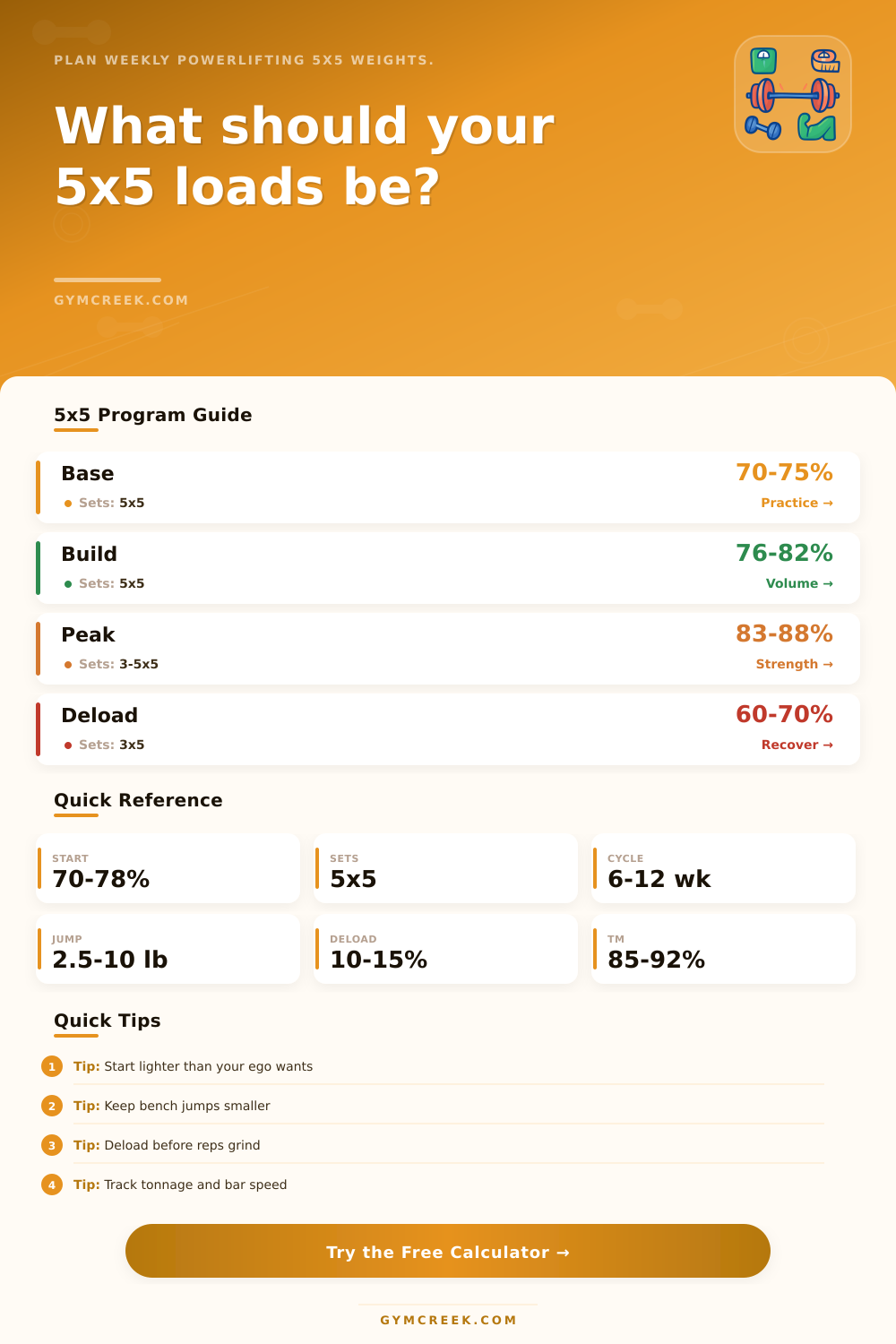
| Base | 70-75% TM | Clean 5x5s | Technique |
| Build | 76-82% TM | Hard 5x5s | Work capacity |
| Peak | 83-88% TM | Reduced grind | Strength |
| Deload | 60-70% TM | Easy 3x5 | Recovery |
| Experience | TM Range | Jump Style | Watch |
|---|---|---|---|
| Novice | 85-90% | Linear | Technique |
| Early intermediate | 87-92% | Small jumps | Recovery |
| Intermediate | 82-90% | Waves | Fatigue |
| Advanced | 78-87% | Blocks | Specificity |
| Focus | Squat | Bench | Deadlift |
|---|---|---|---|
| Balanced | 2 days | 2 days | 1 day |
| Squat priority | 3 days | 2 days | 1 day |
| Bench priority | 2 days | 3 days | 1 day |
| Deadlift priority | 2 days | 2 days | 2 days |
| Formula | Inputs | Output | Purpose |
|---|---|---|---|
| Training max | 1RM x TM% | TM load | Cap work |
| 5x5 load | TM x intensity | Bar weight | Weekly plan |
| Tonnage | Load x sets x reps | Volume | Stress check |
| Ratio | Total / BW | Strength | Context |
💡Tips
The 5×5 powerlifting program is a method of lifting weight that relies upon a specific structure. The structure of the 5×5 powerlifting program require that the weight that is lifted is a specific weight for five sets of five repetition, and that the weight lifted increases by a small amount each week for a period until the body can no longer effectively perform those sets of movements. The 5×5 powerlifting program provides enough volume for lifters to practice the movements that are required of them, it provides enough load to force their bodies to adapt to the loads that they lift, and it includes enough structure for lifters to effectively track their progress in the program.
The calculator that is included with the 5×5 powerlifting program help the lifters to manage the mathematics that must be performed to calculate the loads that they should lift within the program, utilizing their current maximum lift, their training max percentage, and their desired increases in the loads that they lift each week. The starting weight for the 5×5 powerlifting program is more important than the maximum weight that are lifted with the program eventually. It is important to start with a weight that allow the lifter to move the weight for every repetition, instead of selecting a starting weight that is too heavy for there strength levels.
How the 5×5 Program and Calculator Work
By starting with a lighter weight, lifters will be able to perform more sets of five repetitions before their weights become too heavy to move effective. By providing extra room for lifters to perform the required sets of movements with the 5×5 program, the body of those lifters will be able to make the necesary progress. The training max for the 5×5 powerlifting program is a ceiling for the amount of weight that is lifted during the training sessions.
Instead of lifting the absolute one-repetition maximum weight for each lifting session, lifters will use a percentage of that maximum weight. Many lifter use a training max that is between eighty-five and ninety-two percent of their absolute one-repetition maximum weight. The calculator use this percentage to determine the weights that should be lifted during each session for the 5×5 program.
By using a training max that is too close to the absolute maximum weight for each lift, the lifters may find that they are unable to recover in time between session. By using a training max that is too low for the lifters strength levels, however, the lifters will be able to perform more sets of five repetitions before fatigue begin to impact their ability to lift the weights. The weekly jump in the weights that are lifted for the 5×5 program will determine whether or not the 5×5 program is sustainable for those lifters, or whether the lifter will fail in there attempt to lift the weights.
The size of the weights that are jumped will determine how many week it will take for the lifters to take a break from lifting those weight. Bench press will typically require smaller jump in weights to be lifted compared to squat or deadlift exercise. The calculator automatically applies a smaller jump in weights for the bench press exercise for the 5×5 program to ensure that the smaller muscle group are not over-exercised with the program.
While the lifter can change the jump in weights if they choose to modify the 5×5 program, the default jump in weights for each exercise is incorporated as a means of protecting the muscle groups that has the slowest rate of recovery from over-exercising. Fatigue for the lifters will have an impact upon the ability of the lifters bodies to handle the 5×5 program. The fatigue level for each lifter will be incorporated into the calculator to determine the starting intensity for each lifter.
By incorporating the fatigue level for each lifter, the program will automatically reduce the starting intensity if the lifter feel tired. If fatigue is ignored for any lifter, that lifter may require a deload week for their muscle to rest that the 5×5 program does not account for. The timing of the deload week for the 5×5 powerlifting program can be determined by each lifter himself.
While most 5×5 program cycle include a planned deload week during either week five or six of the training cycle, other training cycle may include the ability for lifters to train longer without a deload week. The 5×5 program calculator allow for lifters to set a deload week and a percentage of the jumps in the weight that must be lifted during that deload week. The 5×5 program should not be followed blindly according to the calculator, but the calculator allow lifters to view the 5×5 program with and without the inclusion of a deload week.
Volume for the 5×5 powerlifting program is a variable that the lifter can change. The standard volume for the program is five sets of five repetitions. If the volume increase, the tonnage and stress that is placed upon the body will increase as well.
If the volume decreases, the tonnage and stress that is placed upon the body will decrease. The 5×5 program calculator incorporate volume modifier to allow lifters to model either high volume of weights or low volumes of weight into the program. The changes to the volume for any lift will impact the stress score of the body that is calculated by the 5×5 powerlifting program calculator.
Frequency for the 5×5 powerlifting program is another variable that can be alter by the lifter. For example, a lifter that trains with a squat priority may train four time each week with the squat exercises, while a deadlift priority lift may only include one session each week with deadlifts. These frequency can be selected in the calculator to determine the amount of tonnage that must be lifted by each lifter each week.
The calculator allow lifters to see how much tonnage their body will have to recover from each week. The ratio between the total strength of the lifters and their body weight is one of the output that is provided by the 5×5 powerlifting program calculator. That ratio is not of their strength, but the relation of their strength to their body weight.
Beginners will typically experience an increase in that ratio more quick than lifters that are more experienced and advanced in the weight lifting program. The calculator cannot measure the strength of the lifters feel of the weight in their hands, or the feel of their joint when performing the exercises. Other factor like bar speed and sleep will impact the ability of the lifters to handle the jumps in the weights that they are required to lift for the 5×5 powerlifting program.
If any lifter feel that their bar speed slow or their technique change during the performance of the exercises, they should continue to use the same weight for those sets. The 5×5 program allow for the lifters to continue to increase the weight that they lift, but only if they can continue to maintain the quality of those lift. By running the numbers for the 5×5 powerlifting program in advance, lifters will be able to view the training cycle in advance of actualy beginning to perform the exercise.
The lifters will be able to determine whether or not the increases in weight will be too rapid to allow for adequate recovery for their muscle, if a deload week is required in the training cycle, how to adjust the starting intensity of the 5×5 program, and how to adjust the jump in the weights that are lifted with the program. Once these variable have been set to the parameter that best match the strength and bodies of each lifter, the plan is simple to follow and execute.