Powerlifting Peaking Calculator
Turn a recent top set into a meet-day projection, attempt plan, peak single, and week-by-week taper targets.
📌Presets
Each preset loads a realistic powerlifting peaking setup and immediately recalculates attempt choices and taper loads.
⚙Calculator
Powerlifting peak snapshot
Enter a recent top set to estimate meet-day attempts.
📊Peaking Metrics
📑Reference Tables
| Weeks out | Main focus | Heavy exposure | Volume cue |
|---|---|---|---|
| 12-9 | Accumulation | 70-82% | High work capacity |
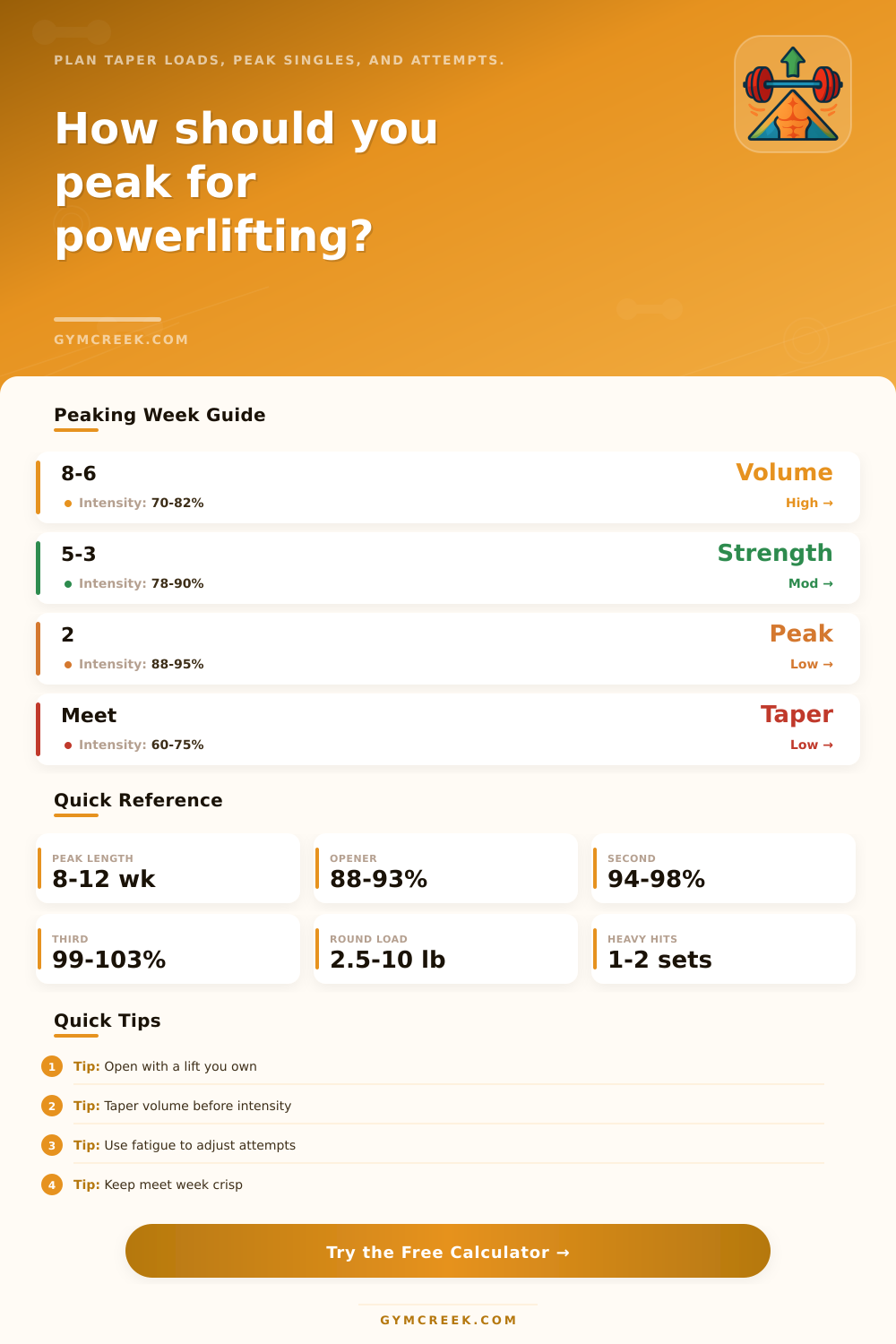
| 8-6 | Specific strength | 78-86% | Moderate sets |
| 5-3 | Peak strength | 84-92% | Reduced volume |
| 2-1 | Taper | 60-88% | Low fatigue |
| Attempt | Typical range | Purpose | Decision cue |
|---|---|---|---|
| Opener | 88-93% | Secure total | Fast and familiar |
| Second | 94-98% | Build total | Matches training max |
| Third | 99-103% | PR attempt | Based on second speed |
| Reach | 103%+ | Big swing | Only if locked in |
| Lift | Peak single | Last heavy | Common note |
|---|---|---|---|
| Squat | 90-95% | 7-12 days | Practice commands |
| Bench | 90-97% | 5-10 days | Keep frequency |
| Deadlift | 88-94% | 10-14 days | Limit fatigue |
| Total | 88-93% | 7-14 days | Protect recovery |
| Formula | Use | Input | Notes |
|---|---|---|---|
| Epley 1RM | e1RM | Load and reps | Best at low reps |
| RPE reserve | Adjustment | Top set RPE | Adds small buffer |
| Fatigue trim | Projection | 1-10 score | Reduces peak max |
| Attempt % | Meet plan | Projection | Round to plates |
💡Tips
Peaking is the training process that an athlete utilize when preparing for a competition. Peaking is not the same as lifting heavy weights throughout the preparation period for the competition. Rather, the act of peaking suggest that an athlete should be lifting specific amount of weight at specific times during the preparation period.
The goal of the peaking process is to ensure that an athlete feels strong and prepared for competition day, while also feeling full recovered and with no sign of fatigue. The calculator utilize several different inputs to project the athlete’s performance on competition day. An athlete input information regarding there most recent top set load and number of reps to calculate their current strength levels with the Epley Formula.
How to Peak for Competition Day
Additionally, the athlete rates their reserve with an RPE loading system for that specific set. Other factor include the type of equipment that the athlete typically use, the number of weeks until the competition is to occur, and the style of taper that the athlete intend to use. Factors like fatigue are also incorporate into the calculator.
An athlete who feels recovered will have a higher projected maximum strength for competition day then an athlete who feels exhausted after competing in several other lifting event during the current week. An athlete’s fatigue levels, along with the number of weeks until the competition and the planned volume drop for the training program, will be incorporate into a readiness score that indicate whether the athlete should compete in a third attempt or protect there total number of lifted repetitions. For many athletes, peaking is believed to be the process of adding more weight to the lift each and every week.
However, the truth of the matter is that the body must absorb the work that are performed during the training phase of the program. More intense training is performed in the early week of peaking, the middle phase of the cycle, and the final two weeks of the cycle. Another important factor for athletes to consider during the peaking phase is the attempts that they will make during competition day.
The opening attempt can be a weight that an athlete can easy lift in the gym. The second attempt can be a training program maximum or personal record for that lift. The third attempt will depend upon the performance during the second attempt and the feeling of recovered strength after performing the second attempt.
An individual mistake during the peaking phase is to attempt to perform a personal record for the lift rather than focusing on the total number of repetitions that can be performed. Additionally, the last heavy single that is performed is important to consider. If performed too close to the competition day, fatigue may result.
If performed too far from the competition day, the athlete may lose the neural sharpness that is required for mastering heavy weights. A heavy exposure between seven and fourteen day prior to the competition day is often the most successful plan for the athlete to develop a total while allowing time for recovery. Body weight is another variable within the calculator that the athlete can adjust.
For those who are cutting body weight to compete in a specific weight class, the calculator will set the body weight to a higher level of fatigue to account for an additional stress that is placed upon the body during weight cutting. For those who are competing at a comfortabley body weight for the athlete, the projected maximum strength will be higher. Finally, there are some common mistake that lifters make.
For instance, many lifter fail to account for the effects that high volume can have upon the athlete during the training phase. Additionally, equipment may be ignored in favor of raw squat numbers. Finally, the type of lift can have an effect upon the ability to peak in each lift; bench and deadlifts will peak at different time in the cycle.
The reference tables provide an overview of the variables in each lift competition and the projected performance of the athlete. While these tables cannot be followed precisely, they can provide an athlete with the necessary knowledge to make informed decisions during the competition day. The calculator is used to gather information about the athlete, their training, their fatigue, and the number of week until the competition.
Through the use of mathematics within the calculator, guesswork can be eliminated for the athlete. On competition day, the athlete can use the calculator to decide whether the weights feel heavy due to fatigue or whether they must lower their attempt. Thus, this calculator can help an athlete transform their training phase into a successful competition day.