Schwartz Formula Calculator for Powerlifting
Convert a meet bodyweight and powerlifting total into Schwartz or Malone points, then compare totals across bodyweight classes.
📌Presets
Each preset loads a plausible meet scenario and calculates from the same coefficient table interpolation.
⚙Calculator
Schwartz score snapshot
Enter bodyweight and total to calculate points.
📊Score Snapshot
📑Reference Tables
| Score | Common read | Meet use | Notes |
|---|---|---|---|
| Under 300 | Developing | Local start | Technique matters |
| 300-399 | Solid | Class competitive | Good base total |
| 400-499 | Strong | Best lifter mix | High local score |
| 500+ | Elite range | Ranked field | Compare carefully |
| Bodyweight | Men coeff | Women coeff | Use |
|---|---|---|---|
| 132 lb | 0.8146 | 0.8628 | Light class |
| 165 lb | 0.6656 | 0.7230 | Middle class |
| 198 lb | 0.5861 | 0.6317 | Common class |
| 242 lb | 0.5367 | 0.5700 | Large class |
| Input | Formula | Meaning | Output |
|---|---|---|---|
| Bodyweight | Table lookup | Coefficient | Factor |
| Total | Total x coeff | Relative strength | Score |
| Target | Score / coeff | Required total | Total |
| Change | New coeff | Same total test | Score |
| Unit | Bodyweight | Total | Internal |
|---|---|---|---|
| Imperial | Pounds | Pounds | Pounds |
| Metric | Kilograms | Kilograms | Pounds |
| Full power | Meet BW | S+B+D | Total |
| Single lift | Meet BW | Best lift | Lift score |
💡Tips
Powerlifting is a sport that requires a great deal of strength. Yet, powerlifting also presents a problem in that lifter of different bodyweights compete against one another. A powerlifter who weigh 300 pounds will be able to lift more total weight than a powerlifter who weighs 150 pound.
But, the 150 pound powerlifter may have more strength relative to their bodyweight than the 300 pound powerlifter. To even the playing field for powerlifters of different weights, they were create the Schwartz formula and the Malone formula. Each of these formula calculates a score for each powerlifter based off their bodyweight and total weight lifted.
Compare Powerlifters by Body Weight
With this score, powerlifters can easy compare themselves to other powerlifters of any bodyweight class. The Schwartz formula uses a coefficient that was derived from historical data about powerlifting competitions. The coefficient multiplies the total weight that a powerlifter lift to determine their score.
As a powerlifter’s bodyweight increases, the coefficient decrease. Thus, powerlifters with higher bodyweights need to lift more total weight to recieve the same score as a powerlifter with a lower bodyweight. This formula allow for a more even competition between powerlifters of any bodyweight.
Without such a formula, the 242 pound powerlifter that lifted 1700 pounds may appear to have a higher level of strength than the 165 pound powerlifter that lifted 1200 pounds. The bodyweight of a powerlifter at the time of the meet is one of the variables that is use in the formula. The coefficient change with each change in bodyweight.
Use your official scale reading (not your walking around weight) in the calculation. Many powerlifting lifters are surprised at how much the coefficient jump when they drop a few pounds to compete in another class. While 197 pounds may seem close to 198 pounds, the difference in coefficient between these two weight can be significant.
Yet, such difference in coefficient do add up over the career of a powerlifter. The total weight lifted can be entered as a single number or the sum of the three individual lift for squat, bench press, and deadlift. The total can be entered as a full power total or a bench only total.
Use full power total for the most complete picture of strength. A bench only total is acceptable if you wish to evaluate only bench press strength. Ensure that the same type of total is use each time the calculation is performed or the results will be misleading.
The calculator will convert the individual lifts to a total once the user chooses the type of total. While age is not a variable within the formula, the calculated points for powerlifting competitions will have some relationship to the age of the lifter. The formula does not have a variable for masters or teen lifter.
Thus, the lifter will use the age of the lifter to interpret the results. A total of 480 points for a 52 year old powerlifter have a different meaning than 480 points earned by a 24 year old powerlifter. Thus, the age of the powerlifter does not change the calculation, but the age of the powerlifter does change the standard that is to be use to compare their strength.
The compare feature within the powerlifting calculator allow a powerlifter to view the impact of changing their bodyweight on their calculated points. This feature can help a powerlifter to decide if they wish to cut weight or bulk up to reach a certain bodyweight for a powerlifting competition. Dropping five pound may help with the coefficient, but dropping five pounds may also lower the total weight lifted.
This feature allow a powerlifter to view both possibilities on the same screen. You can also use this logic to figure out what your target score would be if you lifted a total weight equal to your current bodyweight. Tables of score are provided to help you understand where a given score falls in comparison to other weightlifters.
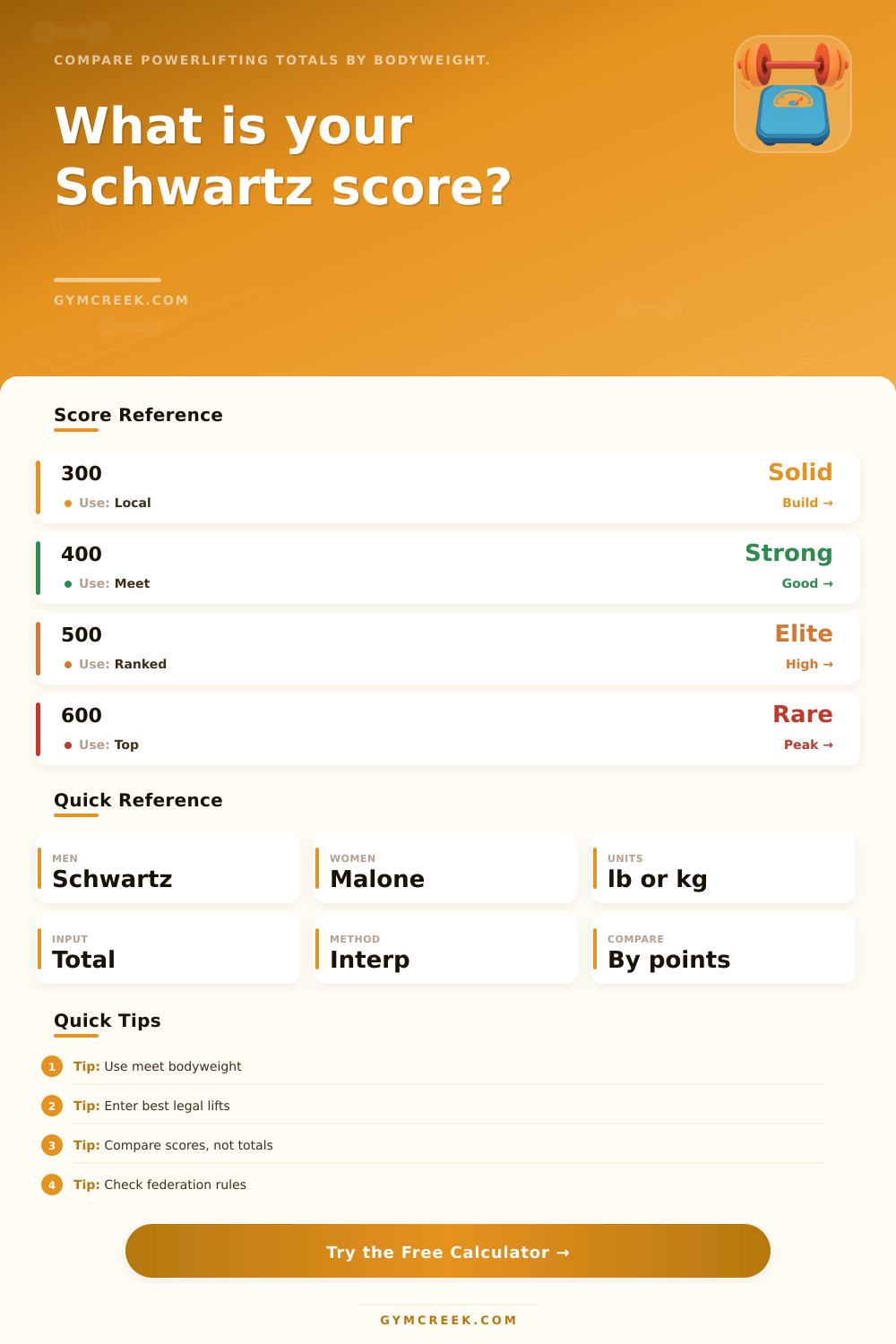
Scores in the range of 300 points are respectable for new weightlifters, but scores of 500 points or higher are typically seen in nationally competitive lifters. These score are not exact, but they can help lifters to understand that points between, say, 410 and 430 are of the same category as one another. As with many things in weightlifting, the lifter tend to focus on the final score that is calculated, but often forget the actual meaning of that score.
The coefficient is calculated as an average of an athlete’s performance in many different meets. Thus, the coefficient reward the lifter who is able to lift the most weight relative to their body weight. For instance, adding 50 lbs of weight to a total weight at 165 lbs of body weight is more significant than adding the same 50 lbs of weight to a total weight of an athlete who weigh 242 lbs.
In some weightlifting federations, the body weight is rounded in specific ways. For instance, some organization round the body weight down to the nearest pound, while other organizations use the actual body weight of the lifter. In the calculator, which utilizes linear interpolation, the difference between these two weights is negligible.
However, each specific competition may have specific rules regarding body weight, so lifters is encouraged to review those rules prior to competition. The formula can be used to make training decisions without becoming overly devoted to the formula itself. If an athlete desire to increase their points, they should increase their strength while maintaining their body weight.
This path may be slower than increasing body weight and total strength through increasedcaloric intake, but the outcome to the athlete will be better points. Importantly, the formula does not care how much weight the lifter lift in the gym; the formula only cares about the relationship between the body weight and the total strength of the lifter. The true value of the formula is that it provide feedback to the lifters as to the effectiveness of their training program.
If a lifter’s points are increasing while their body weight is stable, training is working. If their points are not increasing despite an increasing total weight, then the lifter may need to change their body weight or their weightlifting technique. Another way in which the formula can be utilized is in reviewing the performance of other weightlifters.
By translating their total weight into points, it is possible to compare their performance to an athlete who has different body weights. Because the formula eliminate the impact of body weight on the points total, it is easier to compare the relative performance of other lifters. Thus, a total of 450 points is a similar level of achievement for any body weight, which is why the formula is so useful for the majority of lifter.
The Schwartz and Malone system for calculating weightlifting points exist as a means of allowing lifters to compare their strength to that of others in the weightlifting world. Though lifter train alone in the gym, they desire a means of comparing their strength to others. Thus, such a formula is essential for providing a means of comparing the strength of each lifter to the others.
This formula can be used to help set goals for lifter, to provide feedback as to how well the lifters are meeting those goals, and to provide each lifter with perspective regarding their raw strength. Thus, the points will not lift the weight for the lifter, but the points will inform the lifter as to whether or not their training efforts are leading them in the right direction.