Work to Rest Ratio Calculator
Convert interval timing into a clean work-to-rest ratio, density score, total session time, and recovery match for HIIT, conditioning, strength, and sprint sessions.
📌Presets
Presets cover common timing patterns so you can compare aerobic density, anaerobic recovery, power quality, and weekly load without rebuilding the form.
⚙Calculator
Interval density result
Enter your timing and training context to estimate ratio, density, total session length, and recovery fit.
📊Ratio Metrics
📘Reference Tables
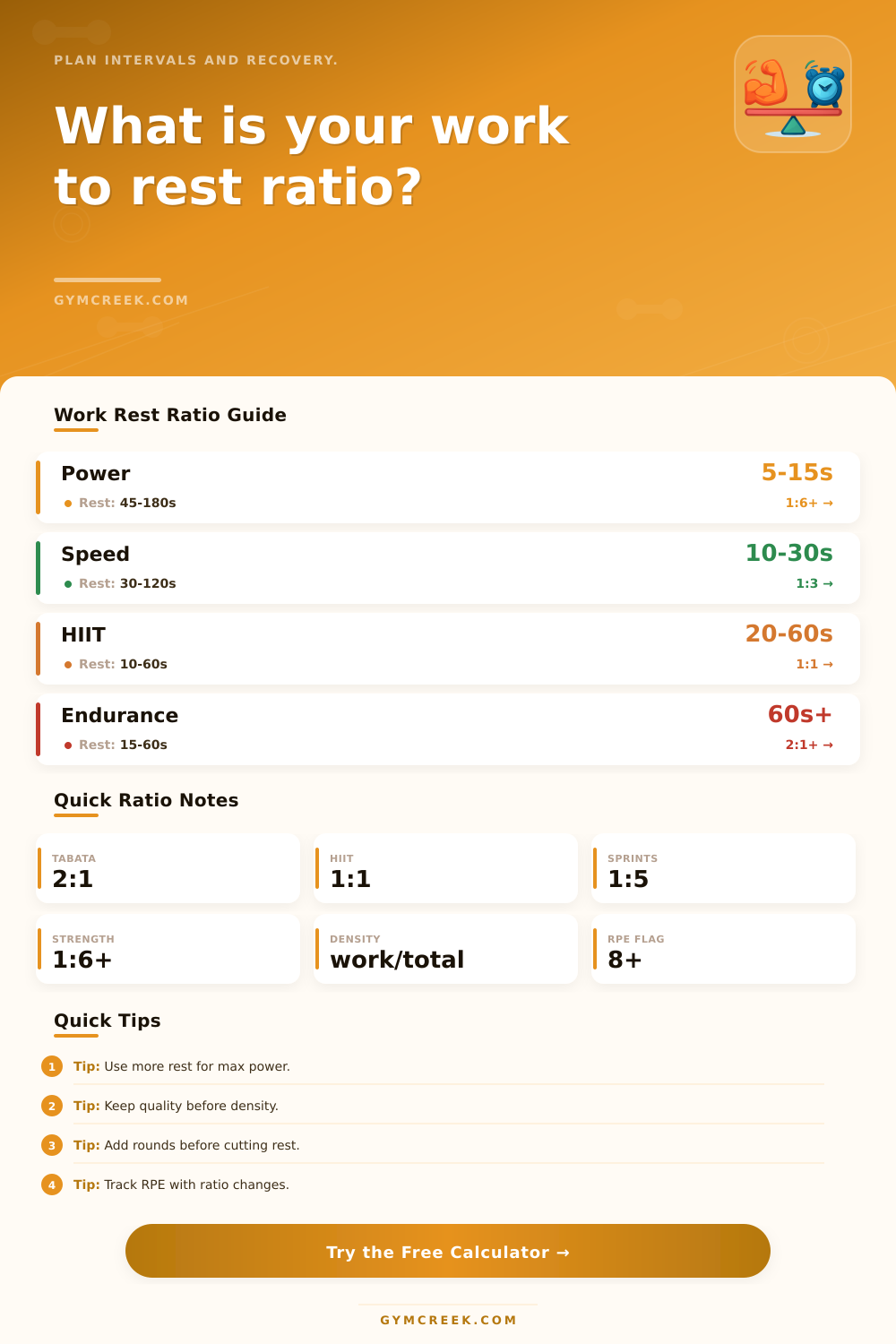
| Goal | Typical Ratio | Best Use |
|---|---|---|
| Maximum power | 1:6 to 1:12 | Sprints, jumps, heavy lifts |
| Speed endurance | 1:3 to 1:5 | Repeated fast efforts |
| HIIT conditioning | 1:1 to 2:1 | Hard metabolic intervals |
| Aerobic intervals | 2:1 to 4:1 | Tempo repeats and circuits |
| Recovery work | 1:1 or easier | Low intensity skill practice |
| Density | Session Feel | Planning Note |
|---|---|---|
| Under 25% | Low density | Quality and power emphasis |
| 25% to 45% | Moderate | Balanced hard intervals |
| 46% to 65% | High | Strong conditioning stress |
| 66% to 80% | Very high | Short blocks work best |
| Over 80% | Continuous | Use lower intensity or fewer rounds |
| Format | Example | Ratio |
|---|---|---|
| Tabata | 20 sec on, 10 sec off | 2:1 |
| Classic HIIT | 30 sec on, 30 sec off | 1:1 |
| Track sprint | 10 sec on, 50 sec off | 1:5 |
| Boxing round | 3 min on, 1 min off | 3:1 |
| Heavy lift set | 30 sec set, 3 min rest | 1:6 |
| Input | How It Changes Output | Why It Matters |
|---|---|---|
| Rest seconds | Directly lowers density | More recovery preserves speed |
| Rounds | Raises total work | More volume without changing ratio |
| Block rest | Lowers session density | Useful between high-output blocks |
| RPE | Raises fatigue flag | Harder efforts need more recovery |
| Readiness | Adjusts recommendation | Sleep and soreness affect tolerance |
💡Calculation Tips
A work-to-rest ratio is the specific relationship between the amount of time that an individual spend performing work and the amount of time that they take to rest. Many individuals attempt to perform interval training without a work-to-rest ratio. When individuals dont utilize a work-to-rest ratio in their intervals, they are essentially guessing as to whether the interval is meant to develop their explosive strength or their ability to perform activities of high endurance.
The work-to-rest ratio is one means of providing control over the amount of stress that is placed upon the body during that period of training. By increasing the amount of work that is performed and decreasing the amount of time for rest, an individual is increasing the density of the intervals performed. Increased density of the intervals force the heart and the lungs to adapt to conditions of lacking oxygen to the body.
How Work and Rest Times Affect Your Training
However, by increasing the amount of time for rest and decreasing the amount of work performed, an individual is placing an emphasis upon the nervous system and the quality of their movement. Many individuals attempt to increase the amount of work performed and decrease the amount of time for rest at the same time, which typically result in an interval session that is too slow for individuals that aim to develop explosive strength, and too easy for those that aim to develop endurance. The energy system that an individual utilize during their interval training session depends upon the work-to-rest ratios that are utilized during those intervals.
One of the most common work-to-rest ratios for individuals that perform interval training is a ratio of one to one, which indicates that the intervals are utilized to keep an individual’s heart rate elevated during those periods of training. For individuals that aim to develop raw strength, however, ratios that utilize a large amount of rest is required for those intervals. This is due to the need for the phosphagen system to recharge after the use of strength; if enough time isnt provided for the phosphagen system to recharge, the individual is no longer performing intervals that develop raw strength, but rather endurance with heavy weight.
Density is a metric that can be used to indicate the percentage of an individual’s training session that utilize performance of work. An individual that performs intervals with high densities will spend most of their session performing work, whereas those with low densities will spend the majority of their training session resting. High densities are utilized to develop endurance, but can be difficult to incorporate into the training of beginner.
High densities may cause an individual’s form to collapse during their training session. An individual should gradually increase their density to avoid injuries. One way to increase an individual’s training density is to increase the number of rounds that must be performed, and then decrease the number of seconds for rest periods between rounds.
Variables such as age and readiness for intense training must be considered. An individual’s readiness to increase their density and strength can vary; for instance, a twenty year old may be more ready to perform high densities of work than a forty year old individual. Thus, readiness score can be used to adjust the demands placed upon the body; readiness scores can take into account factors like sleep and soreness.
An individual that is feeling fatigued is more likely to develop exhaustion during sessions with moderate work-to-rest ratio than an individual that feels ready for training. The rate of perceived exertion (RPE) is a measurement of the amount of effort that an individual feels that their training session requires. While a stopwatch can be used to measure the length of time that an individual is performing work, the rate of perceived exertion is a measurement of the strength of that effort.
An individual that feels that their effort rate is high is likely to require longer periods of rest than an individual that feels that their RPE during training is low. For instance, if an individual feels that they are working at the rate of nine or ten on the RPE scale, performing intervals with a one-to-one work-to-rest ratio may not be enough to allow for the body to recover for the next round of work. Thus, an individual must be honest with themselves regarding the amount of effort that is required for their particular skills to develop to their goal.
One of the mistake that many athletes make is to provide more priority to the timer than to the quality of their movement. If the goal for an athlete is to increase their speed, then speed is the priority, and the timer is the non-priority. If any athlete finds that their speed drop significantly during any period of training, the athlete should make an adjustment to the amount of rest between intervals.
An interval training session that has a lower density yet high quality of the movements is more valuable than one with high density yet low quality of the movements. A structured planner for training will allow athletes to audit their training sessions. By knowing how many intervals of work and rest the athlete requires to manipulate the work-to-rest ratio to achieve specific goal, the athlete is more able to achieve those goals.