Atlas Stone Weight Calculator
Estimate an atlas stone from diameter, material density, core void, moisture, shell coating, and bodyweight ratio so training loads match the stone you actually have.
📌Presets
Presets load realistic atlas stone scenarios and recalculate diameter, volume, weight, and bodyweight ratio immediately.
⚙Stone Inputs
Atlas stone estimate
Enter a diameter and density to estimate stone weight.
📊Stone Metrics
📑Reference Tables
| Diameter | Concrete | Granite | Typical Use |
|---|---|---|---|
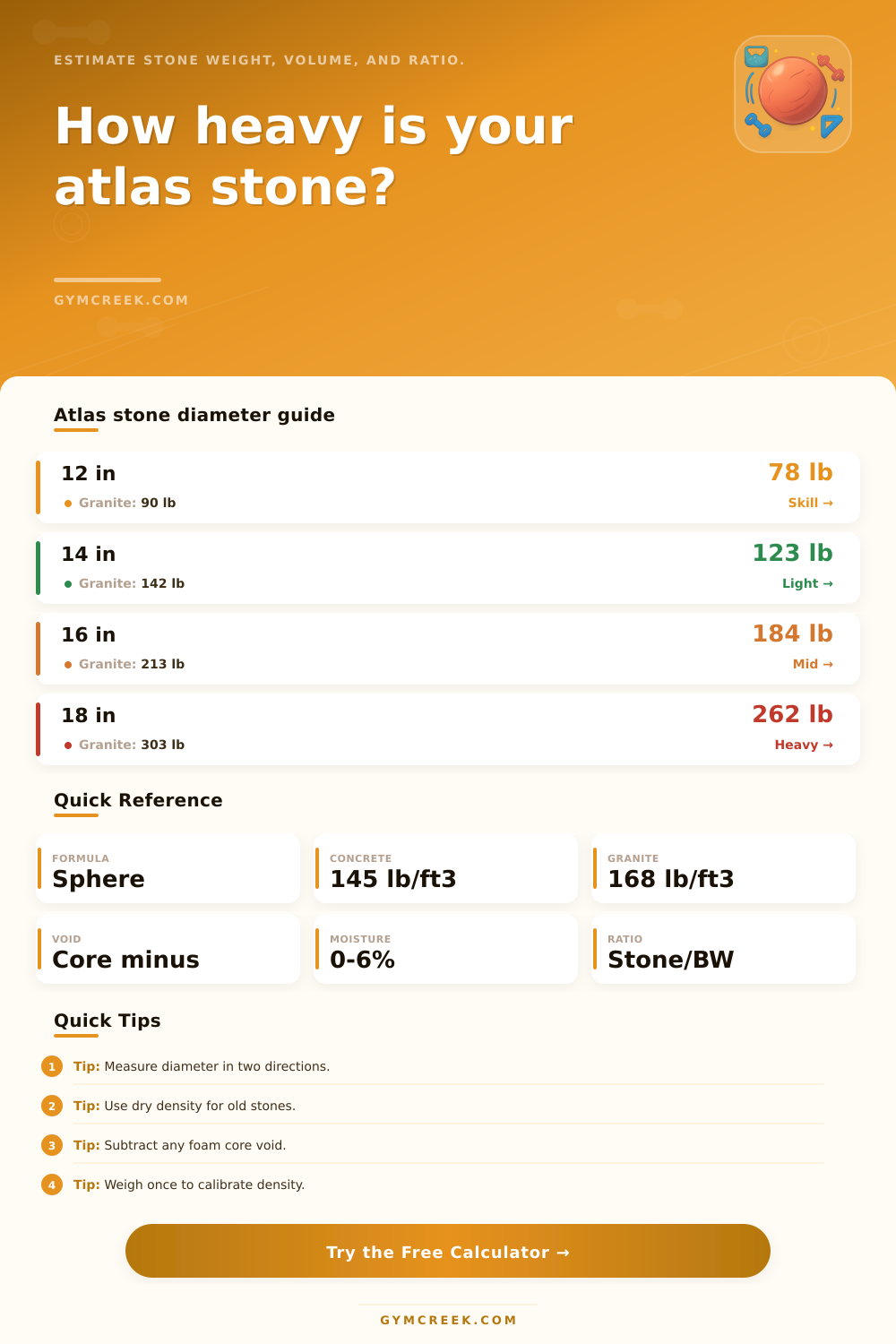
| 12 in / 30.5 cm | 78 lb / 35 kg | 90 lb / 41 kg | Skill work |
| 14 in / 35.6 cm | 123 lb / 56 kg | 142 lb / 64 kg | Light loads |
| 16 in / 40.6 cm | 184 lb / 83 kg | 213 lb / 97 kg | Middle stones |
| 18 in / 45.7 cm | 262 lb / 119 kg | 303 lb / 137 kg | Heavy series |
| 20 in / 50.8 cm | 379 lb / 172 kg | 439 lb / 199 kg | Max loading |
| Material | Density | kg/m3 | Use |
|---|---|---|---|
| Light concrete | 125 lb/ft3 | 2002 | Training molds |
| Standard concrete | 145 lb/ft3 | 2323 | Common estimate |
| High-density concrete | 155 lb/ft3 | 2483 | Small heavy stone |
| Granite | 168 lb/ft3 | 2691 | Field stone |
| Basalt | 188 lb/ft3 | 3011 | Very dense stone |
| Ratio | Category | Typical Feel | Goal Fit |
|---|---|---|---|
| <0.55x BW | Skill | Fast reps | Technique |
| 0.55-0.85x BW | Volume | Repeatable | Conditioning |
| 0.85-1.15x BW | Contest | Demanding | Event prep |
| 1.15-1.45x BW | Heavy | Slow load | Peak strength |
| 1.45x+ BW | Max | Limit attempt | Advanced |
| Formula | Variables | Output | Use |
|---|---|---|---|
| Sphere volume | radius | ft3 or m3 | Stone size |
| Net volume | outer minus void | usable mass | Hollow cores |
| Weight | volume x density | lb or kg | Main estimate |
| Ratio | stone / bodyweight | loading class | Training fit |
| Allowance | moisture, coating | adjusted lb | Real-world error |
💡Tips
Being able to estimate the weight of a training stone is a necesary process for anyone who train with stones. Many stones may appear similar to another stone, but the weight of a stone can vary based off a variety of factors. For instance, stones may appear to be similar in size, but the weight of those stones can be different due to the materials from which the stones are made, or the diameters of the stones.
Should an individual guess the weight of a stone incorrectly, that individual may find themselves unable to lift that stone, potentially leading to injury to themselves or there central nervous system. Thus, it is necesary for an individual to understand the various factors that can impact the weight of a training stone. One of the factor that contributes to the weight of a training stone is the diameter of the stone.
How to Estimate the Weight of a Training Stone
Generally, the more larger the diameter of a stone, the more massive the weight of that stone. The weight of a stone with a diameter of 16 inches will be significantly heavier than a stone that has a diameter of 14 inches. The volume of a sphere are calculated using the radius of that sphere, cubed.
Thus, each time the diameter of a stone increase, the weight of that stone will increase at a rapid rate. As such, an individual can use a training stone calculator to calculate the weight of a stone based upon the diameter of that stone. Using such a calculator will ensure that an individual doesnt underestimate the weight of the stone that they will be lifting.
Another of the factors that can impact the weight of a training stone is the density of the materials of which that stone is made. Stones are often made of concrete. There are different type of concrete, however, and some types of concrete are more dense than other types.
For instance, some types of concrete may contain air within the structure of that type of concrete, while other types may include dense aggregate materials to increase the density of the stone. Natural granite stones are also common training stone materials, and granite is much more denser than concrete. Thus, a granite stone will have a different weight than a concrete stone of the same diameter.
Should an individual assume that the weight of a granite stone is the same as a concrete stone of the same diameter, the individual will be surprised at the weight of the granite stone when attempting to lift it. In addition to the material of a training stone, the amount of moisture and any coatings placed upon the training stone will impact the weight of that stone. Training stones are stored outdoors, and the concrete from which they are made is porous to water.
As a result, a damp stone will weigh more than a dry stone. Additionally, stones may be coated with paint, sealers, or other types of residue. While the additional weight of these materials may be minimal, there is an importance to the consideration of the weight of these stones.
The stone builder may hollow out some training stones in the center to make that stone easier to lift. For instance, the hollow center of a training stone may be filled with a sphere made of foam or plastic. The plastic or foam within the stone doesnt contribute to the weight of the stone, but instead reduces the weight of the stone.
Thus, an individual can use a stone that has a hollow center to practice lifting technique without the risk of injury to themselves. The calculator that is used to calculate the weight of a stone can also account for the hollow center of a stone. By accounting for the hollow center, the weight of the stone can be accurately calculate.
Once an individual knows the weight of the training stone that they will be lifting, they must also understand the stone-to-body weight ratio of that stone. The stone-to-body weight ratio will help an individual to understand the role that that stone will play within there training plan. For instance, some individuals use stones that weigh half of their body weight.
Others, however, utilize stones that weigh more than the individuals body weight. The height of the platform upon which the stone is to be lifted can also impact the difficulty of the lift. Training lifts can be performed onto platforms of low, mid, or high height.
Placing a stone upon a low platform is easier than placing the stone upon a high platform. High platforms require more explosive strength to move the stone. The height of the platform may be compared to an individual’s own height to determine if the load that is to be lifted is of high, medium, or low difficulty.
Finally, an individual should track there performance with the stones. By tracking the performance data of the individual with the stones, a training plan can be created that incorporate actual data regarding the weight and the volume of the stones.