Training Stress Score Calculator
Estimate session TSS from power, pace, heart rate, or RPE, then see intensity factor, weekly load, ramp context, and recovery demand.
📌Presets
Presets use different measurement methods so you can compare how the same TSS framework changes across cycling, running, rowing, swimming, and gym conditioning.
⚙Calculator
Your TSS Results
Results appear after calculation.
📊Training Metrics
📘Reference Tables
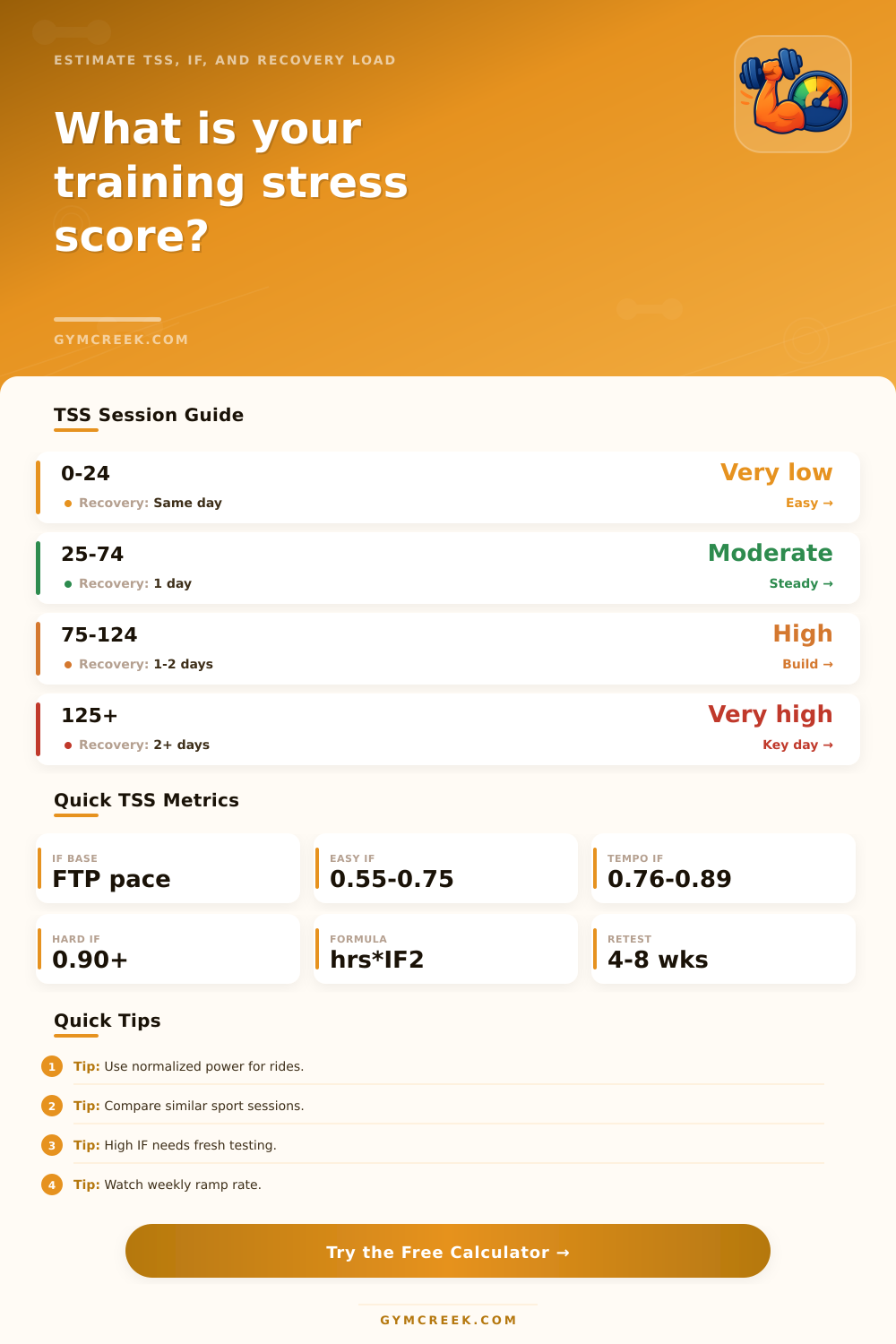
| Session TSS | Load | Typical Recovery |
|---|---|---|
| 0 to 24 | Very low | Often same day |
| 25 to 74 | Moderate | Usually next day |
| 75 to 124 | High | One to two easy days |
| 125 to 199 | Very high | Two or more easy days |
| 200+ | Extreme | Plan extra recovery |
| IF Range | Zone Feel | Common Use |
|---|---|---|
| 0.50 to 0.69 | Easy | Recovery and base volume |
| 0.70 to 0.79 | Endurance | Long steady sessions |
| 0.80 to 0.89 | Tempo | Durable aerobic work |
| 0.90 to 1.04 | Threshold | Hard intervals or races |
| 1.05+ | Severe | Short intervals only |
| Method | Best Input | Best Sport |
|---|---|---|
| Power | FTP and normalized power | Cycling, rowing, ski erg |
| Pace | Threshold and normalized pace | Running and swimming |
| Heart rate | Rest, threshold, average HR | Steady endurance sessions |
| RPE | Whole-session effort | Mixed gym conditioning |
| Weekly Change | Signal | Planning Note |
|---|---|---|
| -20% or lower | Deload | Useful during recovery weeks |
| -5% to +5% | Stable | Good maintenance range |
| +6% to +10% | Build | Manage sleep and easy days |
| +11% to +20% | Aggressive | Watch fatigue closely |
| +21% or higher | Spike | Consider reducing later sessions |
💡Calculation Tips
The training stress score, or TSS for short, allow people to measure the physiological cost of an exercise. People can measure the volumes of their exercise to determine how much time they spend exercising, but it dont account for the intensity of their exercises. TSS is an attempt to find a number for the exercise that takes into account both the volume and intensity of that exercise.
TSS calculates the workout by determining how hard the individual is working relative to there threshold. An individuals threshold is the amount of effort they can exert for approximately one hour. If an individual exercise for one hour at their threshold, their TSS will be 100.
What is the Training Stress Score?
However, if they exercise for one hour at half of their threshold, their TSS will be more lower than 50 since the intensity scale is exponential. To calculate the TSS for an exercise, an individual must calculate their threshold. Their threshold is also known as functional threshold power or threshold pace.
Individuals must use their current threshold for the most accurately measurement of their training stress. Using their old threshold will result in an inaccurate training stress score. If an individual use an old threshold that is lower than their current threshold, their training stress score will be artificially inflated.
This is because their old threshold does not account for their increased fitness. If their old threshold is higher than their current threshold, their training stress score will underestimate the stress place upon their body. There is a variety of ways to calculate training stress, and each method may be specific to the type of equipment that an individual use.
Power meters is considered the most accurate method of measuring training stress. This is because a power meter measures the amount of work that an individual is putting into their pedals. For runners, the best measurement of training load is an individuals pace.
However, pace is only accurate when the runner is running on flat terrain. For individuals who do not have a means of measuring pace or using a bicipital sensor to determine training load, heart rate and RPE can be used to calculate training load. Heart rate is a useful measurement of training load, but it is inaccuracy.
For instance, caffeine and lack of sleep will result in an elevated heart rate. RPE is also a helpful measurement of training load because it is based off the individuals awareness of their total systemic fatigue. The training stress score for an individuals workouts is less important than the trend of that training stress score over time.
A high TSS score for a single workout will not be an issue for the individual, but if a single high training stress score is recorded for a variety of workouts in a period of time, the individual may experience excessive fatigue. Individual should monitor the ramp rate for the individuals training stress score. Ramp rate is the percentage that an individuals training stress score increase each period.
If an individual increases their training load by 20% each week, their body will not be able to adapt to this increased load. If an individual increases their training load to quickly, they will not be able to increase their strength or improve there endurance. An individuals TSS score can help them to understand when they need to take time to recover from their workouts.
A high training stress score indicate that an individual has placed a significant amount of biological debt upon their body. This biological debt cannot be repaired through napping or shakes with protein. An individuals age and level of fatigue can indicate how long they need to recover from high TSS scores.
For instance, a twenty-year-old may recover in 24 hours from a high training stress score, while a masters athlete may require forty-eight to seventy-two hours to recover from the same score. The use of training stress scores allows individuals to find the minimum effective dose for their workouts. The minimum effective dose allow an individual to work out enough to force their body to adapt to their training, but not so much that they experience crashes in their energy and focus after those workouts.
By tracking and using the training stress score, an individual can plan their training and avoid guesswork. However, they should also listen to their body with regard to their TSS scores. For instance, if their TSS score says that they are fresh and ready to train, but their body feel tired, they should trust their body over their training stress score.
They could of avoided more fatigue by listening to there body. It is a moddern way to track things, and it works better then guesswork.