Full Body Workout Calories Burned Calculator
Estimate calories burned from a full body workout using body size, session length, active work, rest density, training style, load, and effort.
📌Presets
Presets load realistic full body training sessions and calculate automatically so you can compare strength, circuit, bodyweight, and hybrid workouts.
⚙Calculator
Full body workout calorie estimate
Enter a session to estimate calories burned.
📊Fitness Metrics Grid
📑Reference Tables
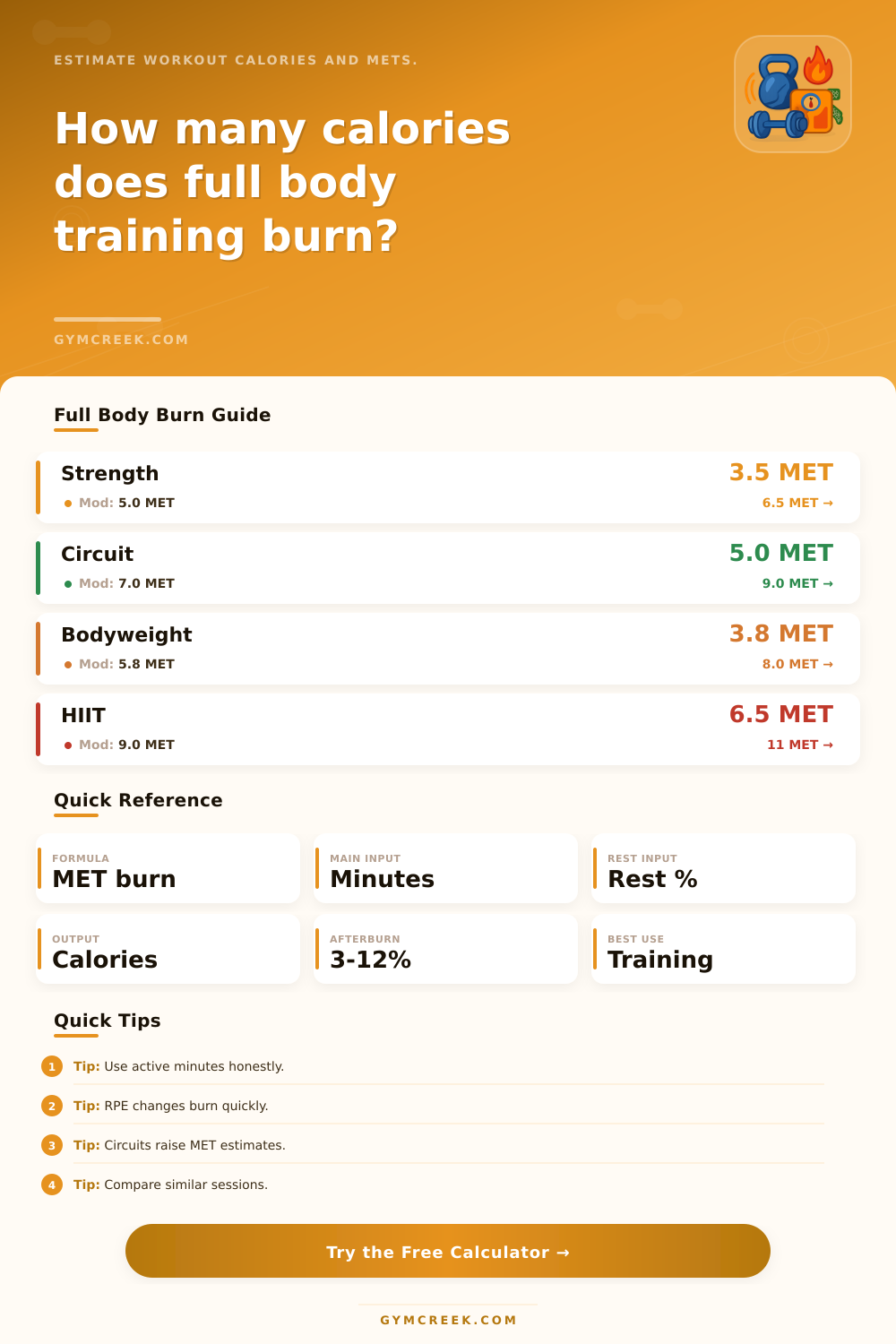
| Full body style | Base MET | Typical session | Burn driver |
|---|---|---|---|
| Traditional strength | 3.5-6.5 | Sets with rests | Load and effort |
| Full body circuit | 5.0-9.0 | Short-rest rounds | Training density |
| Bodyweight conditioning | 3.8-8.0 | Calisthenics | Continuous movement |
| HIIT strength hybrid | 6.5-11.0 | Intervals and lifts | RPE and pace |
| Modifier | Lower burn | Middle | Higher burn |
|---|---|---|---|
| Active share | 35-50% | 55-70% | 75%+ |
| RPE | 3-5 | 6-7 | 8-10 |
| Rest pattern | Long rests | Moderate | Short intervals |
| Movement type | Machines | Free weights | Complexes |
| Scenario | Weight | Minutes | Likely burn |
|---|---|---|---|
| Beginner circuit | 160 lb | 35 | 180-290 kcal |
| Strength session | 185 lb | 60 | 300-520 kcal |
| Hybrid conditioning | 175 lb | 45 | 430-680 kcal |
| Muscle building | 200 lb | 70 | 430-700 kcal |
| Formula | Variables | Best use | Limit |
|---|---|---|---|
| MET calories | MET, kg, min | Session burn | Estimate |
| Mifflin BMR | Age, sex, size | Daily context | Not workout-specific |
| EPOC estimate | Intensity, kcal | Afterburn range | Variable |
| Density score | Sets, active min | Session comparison | Self-reported |
💡Tips
The numbers provided by fitness trackers regarding the number of calories that are burned by an individual after performing exercise are often not in agreement with how that individual feel their body burned calories after that exercise. For instance, a fitness tracker may indicate that the individual burned 300 calorie during that exercise. However, that same tracker may also show how the individual walked to a water fountain and burned calories during that activity.
Furthermore, the way that the calories are burned during a full-body exercise is not typically the same as the way that the fitness trackers monitor calories. For instance, during a full-body exercise, an individual may perform a few sets of squats for two minutes, but then stand still for three minutes while their heart rate return to that after the set of squats. It is difficult for fitness trackers to accurately track the number of calories that are burned during a full-body workout session.
Why Fitness Trackers Are Wrong About Calories
For instance, a sixty-minute strength training session may include numerous rest periods during those sixty minutes, but a sixty-minute strength training session may burn a more different number of calories than a forty-minute strength training session. Furthermore, those forty minutes may include numerous exercises performed in sequence without rest, indicating that that forty-minute session act as a cardiovascular exercise. Despite the fact that both types of exercise may include full-body strength training sessions, the body burns fuel at a different rate during each type of session.
The calorie calculator that is included on the page includes a few different variable in its calculation of the calories that will be burned. For instance, the calculator considers the body mass of the individual performing the exercise, as well as the type of exercise that they are performing. Body mass is one of the variables that are used in the calculation, since moving a more massive body requires more energy than moving less mass.
Thus, two individuals who perform the same workout will burn a different number of calories, because their body masses is different. The more mass that is moved, the more energy is required, and the body burns more calories. MET values indicate the number of times more energy that is required for the activity to occur than if that individual were sitting on a couch.
For instance, performing a HIIT session may have a higher MET value than performing a strength training session, because during a HIIT session the individual’s heart rate remain high for longer periods of time. Thus, many individuals that focus upon the amount of time that they spend in the gym is ignoring an important variable: the active share of the time in the gym. Active share refers to the amount of time that the individual is actually performing the exercise.
For instance, an individual who spends sixty minutes in the gym but performs no exercises may have an active share of fifteen minutes. Thus, the average intensity of the exercise are low. Introducing rests into the exercise can alter the intensity of the exercise.
For instance, taking short rests in a circuit exercise will raise the metabolic rate, while taking long rests will allow the metabolic rate to decline. Thus, an individual can alter the ratio of exercise to rests to better monitor the activity and intensity of their exercise sessions. The types of exercise that are performed will also impact the calories that are burned.
For instance, performing compound lifts will burn more calories than performing exercises that use only a small portion of the muscles of the body. Compound lifts include exercises like squats, deadlifts, or lunges, while isolation exercises may include performing bicep exercises on a machine. Compound lifts require more energy because more muscles is activated and more joints are used in performing those exercises.
Finally, an intense exercise that ends with a “finisher” will burn more calories than an exercise that does not include a finisher. For instance, an exercise that ends with rowing or sled pushes will burn more calories than an exercise that does not include these types of “finishers,” because the additional exercise will increase the intensity of the exercise. Even after the exercise is completed, the body will continue to burn calories.
This process is known as Excess Post-exercise Oxygen Consumption, or EPOC. After exercise, the body does not return to its resting state; the body is repairing the muscle tissue that was torn during the exercise, and performing the activity that replenish the oxygen stores of the body. These processes require energy to occur.
Thus, the higher the intensity of the exercise session, or the more lifting of heavy masses that is performed, the more calories that the body will burn during its resting periods after that workout session. The reference table on the page indicates the type of exercise that is to be performed and how many calories that may be burned by the individual during that exercise. For instance, a table may indicate that a beginner performs circuit training sessions will burn a different number of calories than a session that is dedicated to muscle building.
Thus, an individual may burn the same number of calories during a short but intense session as they may during a longer but less intense session. The intensity of the exercise should be matched to the objectives of the individual for performing those exercises. Despite the accuracy of the calorie calculators on the page, the figures are not likely to be exact for each individual.
Factors like body composition, hydration, and rest periods will affect the exact number of calories that are burned after exercise. Having an estimate of the calories that will be burned after exercise is still helpful, however. For instance, knowing that a certain type of exercise will burn a certain number of calories can allow an individual to avoid the mistake of eating too many calories during the day.
Thus, having an estimate for the calories that are burned during exercise may help the individual to better control their nutrition and their body composition.