Inseam Crank Length Calculator
Estimate bike crank length from cycling inseam, height, leg proportions, cadence preference, mobility, riding discipline, and your current crank setup.
📌Fit Presets
Presets load common rider dimensions and goals, then calculate a proportional crank length, nearest standard size, and setup changes.
⚙Rider And Bike Inputs
Crank length recommendation
Enter your inseam and fit details to calculate a starting crank size.
📊Fit Metrics Grid
📑Reference Tables
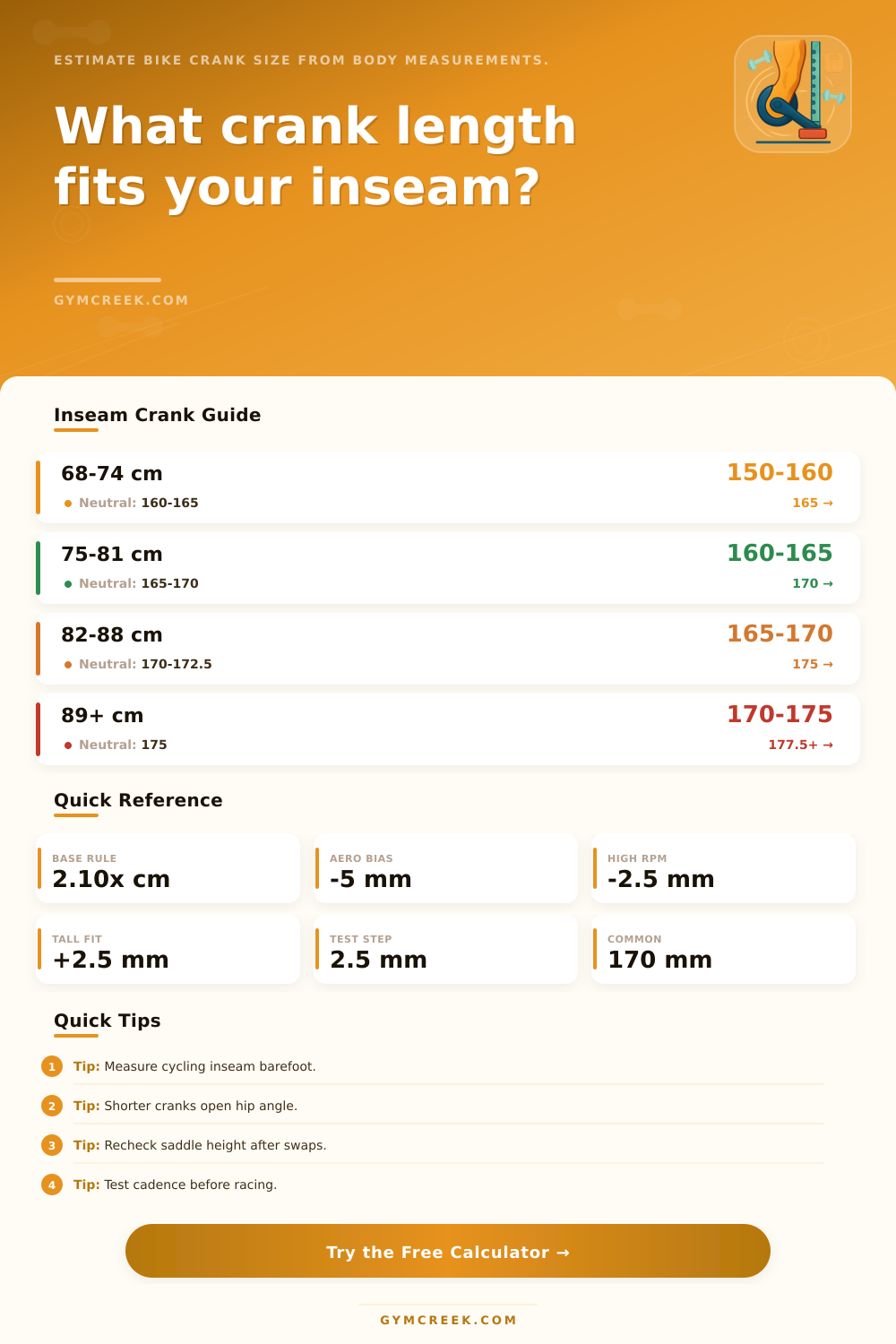
| Inseam | Short bias | Neutral | Long bias |
|---|---|---|---|
| 68-74 cm | 150-160 mm | 160-165 mm | 165 mm |
| 75-81 cm | 160-165 mm | 165-170 mm | 170 mm |
| 82-88 cm | 165-170 mm | 170-172.5 mm | 172.5-175 mm |
| 89-96 cm | 170-175 mm | 175 mm | 177.5-180 mm |
| Signal | Move | Why | Retest |
|---|---|---|---|
| Aero position | -2.5 to -7.5 | Hip angle | Power |
| High cadence | -2.5 to -5 | Smaller arc | Rpm |
| Front knee load | -2.5 to -5 | Less flexion | Comfort |
| Toe overlap | -2.5 | Clearance | Handling |
| Size | Common use | Frame clue | Notes |
|---|---|---|---|
| 150-155 | Very small | XXS/XS | High rpm |
| 160-165 | Small to mid | XS/S | Aero fit |
| 170 | Medium | M | Stock road |
| 172.5 | Mid-large | M/L | Stock road |
| 175-180 | Tall riders | XL | Leverage |
| Layer | Input | Adjustment | Purpose |
|---|---|---|---|
| Inseam | Leg length | 2.10x cm | Main size |
| Height | Stature | 9.55% | Proportion |
| Segments | Femur/tibia | Bias | Leverage |
| Fit goal | Use case | Shift | Comfort |
💡Fit Tips
Crank arms are a component of a bicycle that can cause physical discomfort for a cyclist whose crank arms are not of the correct length for there anatomy. Many cyclists may believe that the position of their bike saddle or the cleats on their bicycle shoe causes discomfort in there knees or hips. However, the actual cause of such discomfort may be the length of the crank arms that is attached to their pedals.
The bicycle manufacturer typically provides the cyclist with standard crank arms that are pre-installed onto the bicycle, so the crank arms are often ignored when purchasing a bicycle. However, the manufacturer typically selects those standard crank arms to be of a length that suits the height of the average cyclist, and may not be appropriately for the individual cyclist. An individual’s leg length is not necessarily the same as their height; two individual of the same height may have different leg lengths.
How to choose the right crank arm length
An individual with longer legs and shorter torsos will have a different leg length than an individual with shorter legs and longer torso. If an individual has crank arms that are too long for their inseam (the distance between the floor and their knees when standing on their toes), then their knee will be forced to reach an extreme angle when cycling, which may lead to inflammation of their knee joints. Alternatively, an individual with crank arms that are too short may feel as if they dont have enough leverage to efficienty move their bicycle.
Thus, an individual must find a balance between selecting a crank arm length that provides comfort for their joint and provides the necessary leverage to efficiently cycle. To determine the appropriate length for the crank arms that will be fitted to an individual’s bicycle, the inseam of the individual must first be determined. The inseam for cycling isnt the same as the inseam for clothing.
Clothing inseam measurements are made for the purpose of fashion and style; however, the inseam for cycling is measured from the floor to an individual’s sit bones. To determine inseam, an individual can use a hard object (like a book) to press against their pelvic floor. Once the inseam is determined, an individual can use a calculator to determine the length of the crank arms that will be appropriate for that individual; the calculator may use mathematical coefficients to calculate a length that is proportional to the length of the individual’s leg.
In addition to leg length, the type of cyclist that an individual is also a factor that will influence the length of the best crank arms for that individual. An individual’s preferred cycling cadence (the rate at which they move their legs while cycling) is one factor that will influence the length of their crank arms. For individuals who prefer to cycle at higher cadences (spinning their legs at a high rate of revolutions per minute), shorter crank arms will allow for the individual to cycle at those high rates with less effort.
In contrast, individuals who prefer to cycle at lower cadence rates may have longer crank arms that provide the individual with the leverage necessary to move their bicycle at those lower rates. Thus, an individual must find a balance between cardiovascular efficiency and muscular force when determining their best crank arm length. An individual’s hip angle is another factor to consider when determining their best crank arm length.
For example, an individual who desires to cycle in an aerodynamic position must have their thighs in closer proximity to their torso; this aerodynamic position reduce the hip angle for the cyclist. If an individual has long crank arms, their knees may move too close to their chest when cycling at maximum speeds. Many triathletes, whose races require them to cycle in an aerodynamic position for long distance, use shorter crank arms to provide their hips with more angle for them to maintain that aerodynamic position.
An individual’s mobility is yet another factor to consider when selecting the appropriate length for the crank arms for that individual’s bicycle. For individuals with limited mobility in any joint in their body (especially the hips), shorter crank arms provide the same function as the mobility of that individual’s joints; shorter crank arms provide more space for individuals with limited mobility to comfortabley cycle their bicycles. Many individuals attempt to deal with limited mobility by performing physical stretch for those joints; however, the limited mobility may be a result of the crank arms that the individual uses.
If an individual decides to change the length of the crank arms that are attached to their bicycle, it is also necessary to adjust the height of the individual’s saddle. The length of the crank arms can change the diameter of the circle that is traced by the bicycle’s pedals. The change in diameter of that circle will change the length at which an individual’s saddle height is appropriate.
If an individual changes to shorter crank arms, their saddle will have to be adjusted upward. If they change to longer crank arms, however, they’ll have to adjust the saddle downwards. Thus, changing the length of the crank arms can create a domino effect in relation to the adjustment of the height of the individual’s saddle.
The type of cycling that an individual performs can also influence that individual’s best crank arm length. For instance, individuals who cycle on mountain bikes may desire shorter crank arms; this provides better clearance for the pedals to avoid striking rocks on the ground. However, road racers may not require the same length of crank arms.
Thus, there is no “perfect” length of crank arm for each individual. Instead, an individual desires to find a length of crank arms that will prevent any strain on their knees and allow them to breathe efficient while cycling. If the math determines that an individual should of had shorter crank arms yet the individual feels strain in their knees, then the math is likely five correct.
Cycling with the proper length of crank arms will allow the bicycle to feel as if it is an extension of the individual’s leg.