Appleman Crank Length Calculator
Estimate a crank length using Appleman-style tibia and inseam rules, knee-angle limits, riding style, cadence preference, and fit-change guidance.
📌Presets
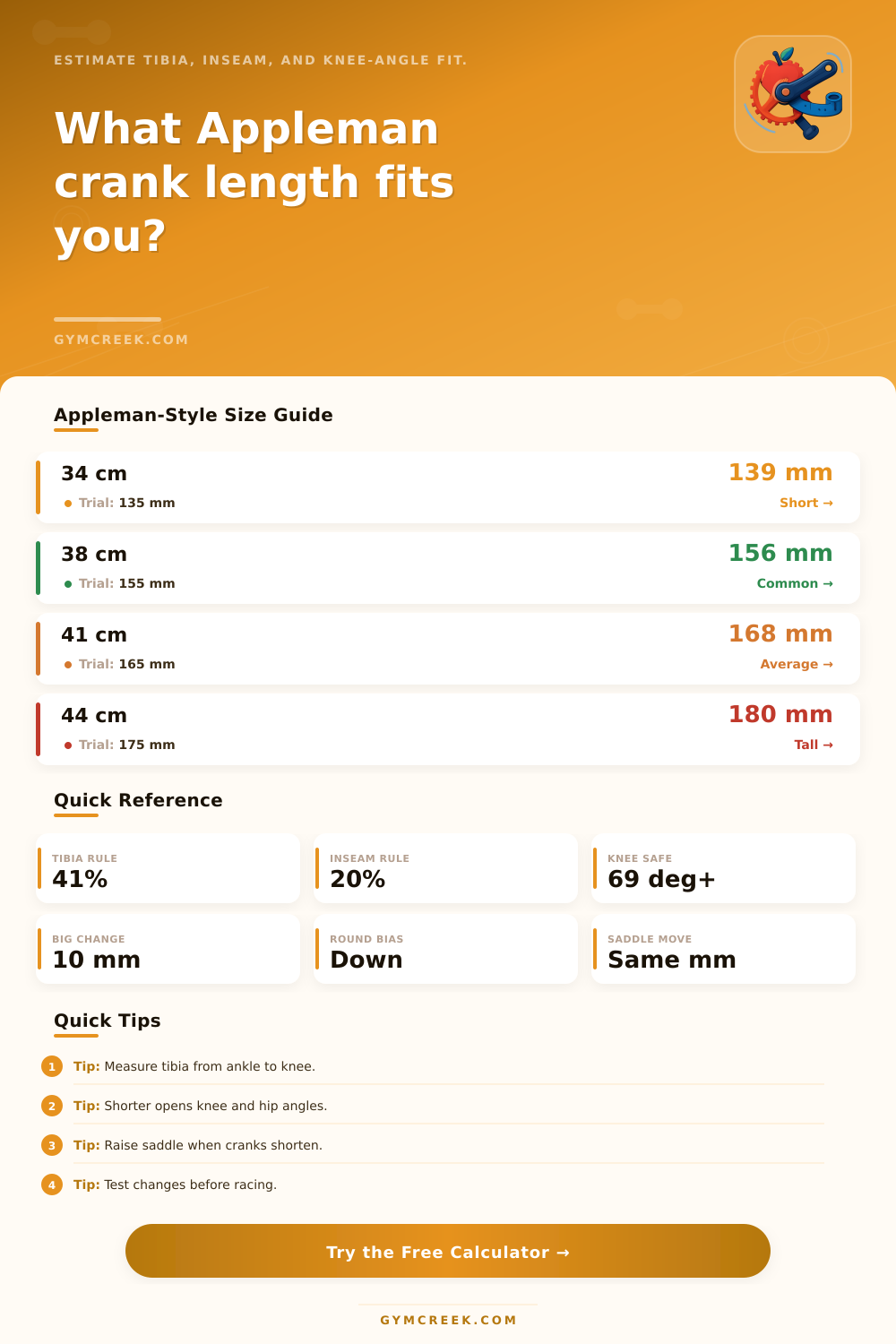
Presets load realistic fit cases and calculate a tibia-based recommendation, rounded trial size, knee-angle change, saddle move, and gearing signal.
⚙Rider And Fit Inputs
Appleman-style crank length recommendation
Enter tibia length, inseam, and knee angle to calculate a starting point.
📊Fit Metrics Grid
📑Reference Tables
| Method | Measurement | Math | Use |
|---|---|---|---|
| Tibia | Ankle to knee | 41% | Main input |
| Inseam | Crotch to floor | 20% | Backup input |
| Knee angle | Top stroke | 3.5 deg/10 | Limit check |
| Fit trial | Ride test | 5-10 mm | Final choice |
| Knee angle | Signal | Likely move | Priority |
|---|---|---|---|
| Under 66 deg | High stress | Shorter | Comfort |
| 66-69 deg | Borderline | Check fit | Monitor |
| 69-73 deg | Clearer | Stable | Normal |
| 73 deg+ | Open | Preference | Style |
| Tibia | 41% result | Round down | Common note |
|---|---|---|---|
| 33-35 cm | 135-144 mm | 135-140 | Very short |
| 36-38 cm | 148-156 mm | 145-155 | Short average |
| 39-41 cm | 160-168 mm | 155-165 | Average |
| 42-44 cm | 172-180 mm | 170-175 | Tall range |
| Style | Bias | Reason | Retest |
|---|---|---|---|
| Tri or TT | Shorter | Hip room | Aero power |
| MTB | Shorter | Ground room | Low gears |
| High cadence | Shorter | Less arc | Spin feel |
| Track power | Neutral | Leverage | Gear choice |
💡Tips
Many attempts is made to adjust the saddle height of an bicycle by adjusting the saddle up or down by small increment. However, many people finds that adjusting the saddle do not solve the problem of there knees getting pinched at the top of the pedal stroke. This is due to the fact that the crank arm are essentially a lever that dictate how much a persons joints need to fold in relation to the pedals.
For years, bicycle manufacturer have given taller individuals longer crank arm. However, crank arms that are too long for a taller individual may not be compatible with they body structure. The Appleman method use an individual’s tibia to determine the best length for their bicycle crank arm.
Measure your shin to find the right crank length
The tibia is the bone that is in between the knee and ankle. If an individual has a shorter tibia, they is going to have a limited range of motion in their legs. If the crank arm are too long for an individual with a short tibia, it can force their knee to reach an acute angle, which can result in knee pains.
Therefore, using the tibia to calculate the length of an individual’s crank arm will give them a more accurate measurement than their total height. To calculate the length of an individual’s tibia, they can measure the distance between the ankle bone and the knee joint. This will give them a measurement of the range of motion that their legs can produces.
Along with the inseam, this can be used to calculate the best length for their bicycle crank arm. Additionally, many individuals will discover that they need shorter crank arms than those that comes on their bikes as standard. By using shorter crank arms, their hips will be in an open angle that allow them to produce more aerodynamic movement when cycling.
Their knees will also not come as highly towards their chest, which will allow them to lower the handlebars of their bicycle without hitting their stomach. Shorter crank arms do mean that they have less leverage when riding the bicycle. However, individuals can compensate for this by adjusting the gearing of their bicycle.
Depending on the individual’s cycling style, their legs may requires different lengths of crank arm. For instance, a triathlete will require a different length of crank arm than a mountain biker. Triathletes will likely want the crank arms to be shorter for more aerodynamic movements.
Additionally, shorter crank arms will allow their knees to not have to elevate as high towards their chest, which will allow them to lower their handlebars. Mountain bikers will want shorter crank arms so that their pedals does not hit any rocks on the ground. Additionally, individuals who want to cycle at a high cadence will need shorter crank arms so that their legs do not have to produce as much movement to complete one revolution of the bicycle.
The Appleman method do consider these different cycling styles because the calculations will have to relate to the way the individual cycles. If an individual changes the length of their crank arms, they will need to adjust their saddle height. If they shorten their crank arms, the bottom of the pedal stroke will go up by the same amount.
Therefore, they will have to raise their saddle by the same amount of measurement so that their legs will not be overextending. Individuals should also ensure that their knee angle at the top of the pedal stroke is comfortable for them. If they find that their knee angle when cycling is leading to any discomfort for them, it may mean that their crank arms are too long for their anatomy.
The Appleman method include tables that provide reference samples of an individual’s knee angle to determine if any adjustment are needed for their health and cycling comfort. Individuals who cycle for many hour each week will need to ensure that their knees remains in an open angle to avoid any injuries. Maintaining an open angle of the knee will be achieved with the use of the appropriate length of crank arms for the individual.
The Appleman method may not provide an individual with a perfect measurement of the length of the crank arms that they should of have on their bicycle. However, an individual’s body will be the final judge of whether or not the crank arm length is correct for there body structure. Additionally, an individual may have to ride their bicycles a few times before there muscles and the body adjusts to shorter crank arms from the bicycle manufacturer for their standard bike model.