Specialized Saddle Height Calculator
Estimate bike saddle height from inseam, crank length, shoe and pedal stack, riding posture, flexibility, and current-fit feedback using cycling fit formulas and knee-angle checks.
📌Fit Presets
Presets load common bike-fit situations and immediately calculate a starting height, adjustment range, and fit-check notes.
⚙Rider and Bike Inputs
Saddle height snapshot
Enter rider and bike measurements to calculate a starting saddle height.
📊Fit Metrics Grid
📑Reference Tables
| Method | Formula | Measure To | Use |
|---|---|---|---|
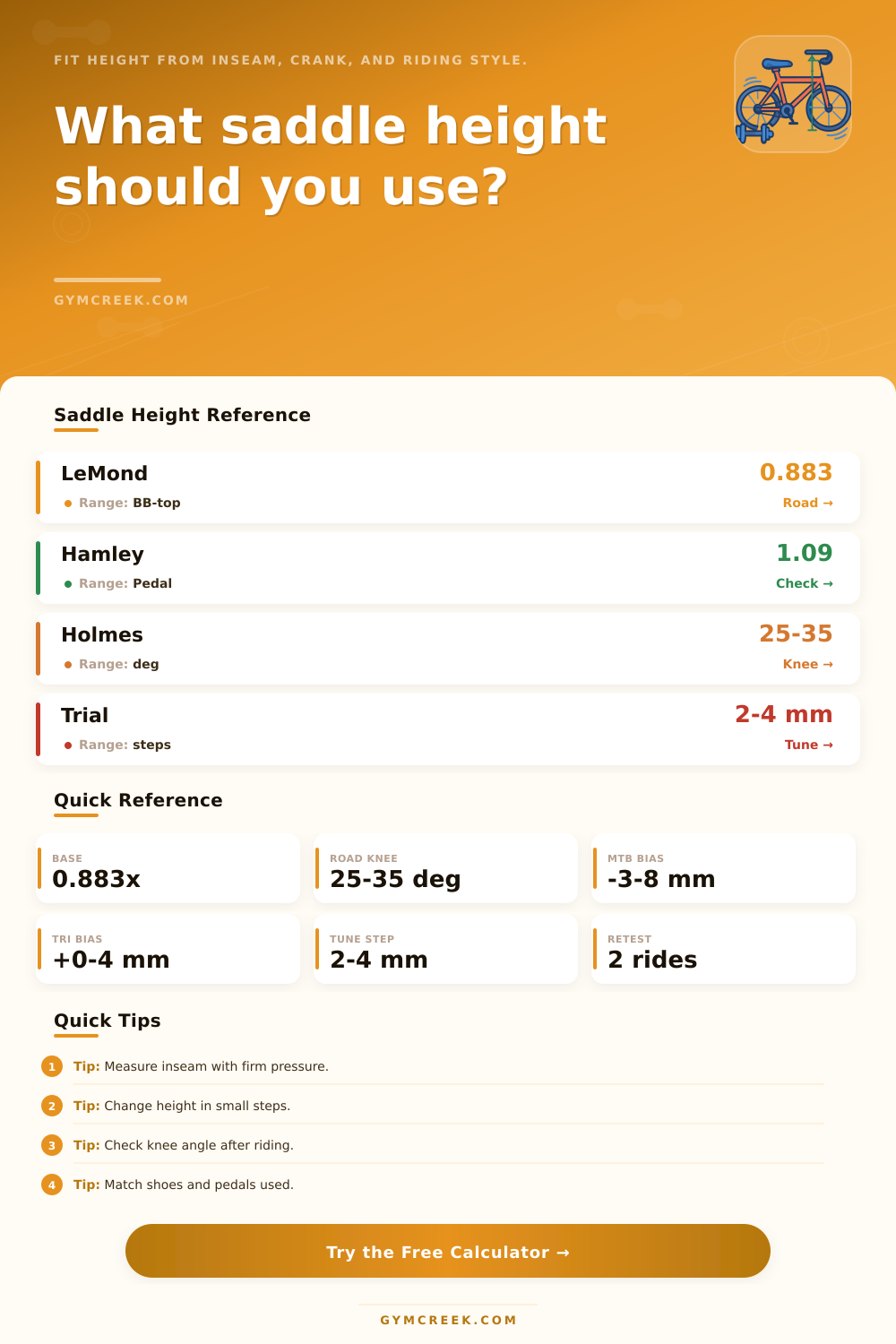
| LeMond | Inseam x 0.883 | Saddle top | Road start |
| Hamley | Inseam x 1.09 | Pedal axis | Cross-check |
| Holmes | 25-35° | Knee angle | Video check |
| Heel method | Straight leg | Pedal bottom | Quick check |
| Bike Use | Bias | Knee Angle | Reason |
|---|---|---|---|
| Endurance road | 0 mm | 28-34° | Balanced |
| Race road | +1 mm | 26-32° | Extension |
| Gravel | -2 mm | 30-36° | Control |
| Tri / aero | +2 mm | 28-34° | Open hip |
| MTB trail | -5 mm | 32-38° | Handling |
| Feedback | Often Means | Height Move | Check |
|---|---|---|---|
| Hips rock | Too high | Lower 3-5 mm | Cadence |
| Toe reach | Too high | Lower 2-4 mm | Ankle |
| Front knee | Low/fore-aft | Raise small | Setback |
| Back knee | High/reach | Lower small | Hamstring |
| Quad burn | Often low | Raise 2-3 mm | Gearing |
| Item | Typical | Effect | Calculator Use |
|---|---|---|---|
| Crank | 165-175 mm | Extension | Height trim |
| Shoe stack | 5-10 mm | Foot reach | Stack trim |
| Pedal stack | 8-18 mm | Foot reach | Stack trim |
| Cleat rearward | Small drop | Ankle path | Bias check |
| Inseam | 44-49% height | Main input | Ratio flag |
💡Fit Notes
Saddle heights is one of the most critical measurements for a cyclist. Saddle height play a significant role in how a cyclist move on a bicycle. If the saddle height isnt correct, a cyclist may develop pain in there knee or their hips may rock from one side of the bicycle to the other when cycling.
Many cyclist dont adjust their saddle height very often. However, there are reasons why a cyclist must adjust their saddle height; their bodies changes over time, and the shoes that they use may wear down over time. Thus, saddle height is a measurement that manages two different factors for a cyclist.
How to Set Your Saddle Height
The first step in calculating the appropriate saddle height for a cyclist is to measure the inseam of the cyclist. The inseam for cycling is different than the inseam of clothing measurements. For cycling, a person must apply pressure to their leg against a wall to determine their inseam.
By using a relaxed inseam measurement rather than a firm measurement, a cyclist will have a saddle height that is too low. A low saddle height can cause strain on the quadriceps and cause excess pressure on the patella. Once the cyclist establishes the inseam, they must take into account the equipment that they use.
A cyclist should take into account the height of the pedals that they use and the height of the shoes. Even if a cyclist ignores the measurements of the height of the pedals and shoes, the height of the pedals and shoes will ultimately change the length of the leg of a cyclist. By taking into account the height of the pedals and shoes, a cyclist can establish the correct inseam and ensure that the cyclist will set the saddle height at the appropriate measurement.
The length of the cranks that a cyclist uses will also play a role in the measurement of the saddle height. For example, if a cyclist has 175mm cranks on their bicycles, their legs will travel a different distance then if they have 165mm cranks on their bicycles. For this reason, cyclists with longer cranks will need to have a lower saddle height to avoid overextending their legs.
Overextending their legs can cause them to dip their hips or point their toes to reach the pedals, compensating for the incorrect saddle height. The riding style and the purpose for which a cyclist rides can determine the correct saddle height. For example, a cyclist who rides for endurance may require a different saddle height than a cyclist who ride mountain bikes.
The angle of a cyclists ankle can play a role in their saddle height. Cyclists whose ankles are pointed downwards may have a higher saddle height than cyclists with pointed toes. However, it is possible that this angle of the ankle may indicate that their saddle height is too high in comparison to the body strength and ankle angle that they have.
A cyclists flexibility impacts their saddle height. The flexibility of a cyclist impacts the extension of their leg. If a cyclist has tightness in any of the muscles that relate to extending the leg, such as hamstrings, then their leg will not be able to extend as far as a cyclist with high levels of flexibility.
Thus, if a cyclist has limited flexibility, they should of a lower starting point for their saddle height. A saddle height that is too high for a cyclist with limited flexibility can lead to the strain of one of the tendons of the cyclists leg. Using the information that can be gathered about a cyclists inseam, equipment, crank length, riding style, ankle angle, and flexibility will provide a cyclist with a starting point for their saddle height.
From this starting point, a cyclist can use various tables to determine the appropriate saddle height. These tables include the LeMond method and the Hamley method. The results from both of these methods should be similar to one another.
If the results are significantly different, there is an error in the measurements gathered from the cyclist. Saddle height should be adjusted in increments of two to four millimeters. Making large adjustments to the saddle height can make it difficult for a cyclist to understand how their body is responding to the change.
The first few rides with the new saddle height will allow a cyclist to adjust their saddle height to their body. During these rides, pay attention to the muscles of the cyclists legs to determine if they feel effort in any given area. A pinch in the front of the knee indicates the saddle height is too low.
A pull in the back of the knee indicates that the saddle height is too high. By using these observations and the calculation of the saddle height, a cyclist can fine-tune their saddle height according to their own body anatomy.