Inseam Saddle Height Calculator
Estimate bike saddle height from measured inseam, crank length, riding style, mobility, shoe stack, and comfort notes using LeMond and 109 percent cross-check formulas.
📌Fit Presets
Presets load common bike-fit scenarios and immediately calculate a starting saddle height plus a practical tuning range.
⚙Saddle Height Inputs
Saddle height snapshot
Enter your inseam and equipment details to estimate a starting saddle height.
📊Fit Metrics Grid
📑Reference Tables
| Method | Measurement | Formula | Best use |
|---|---|---|---|
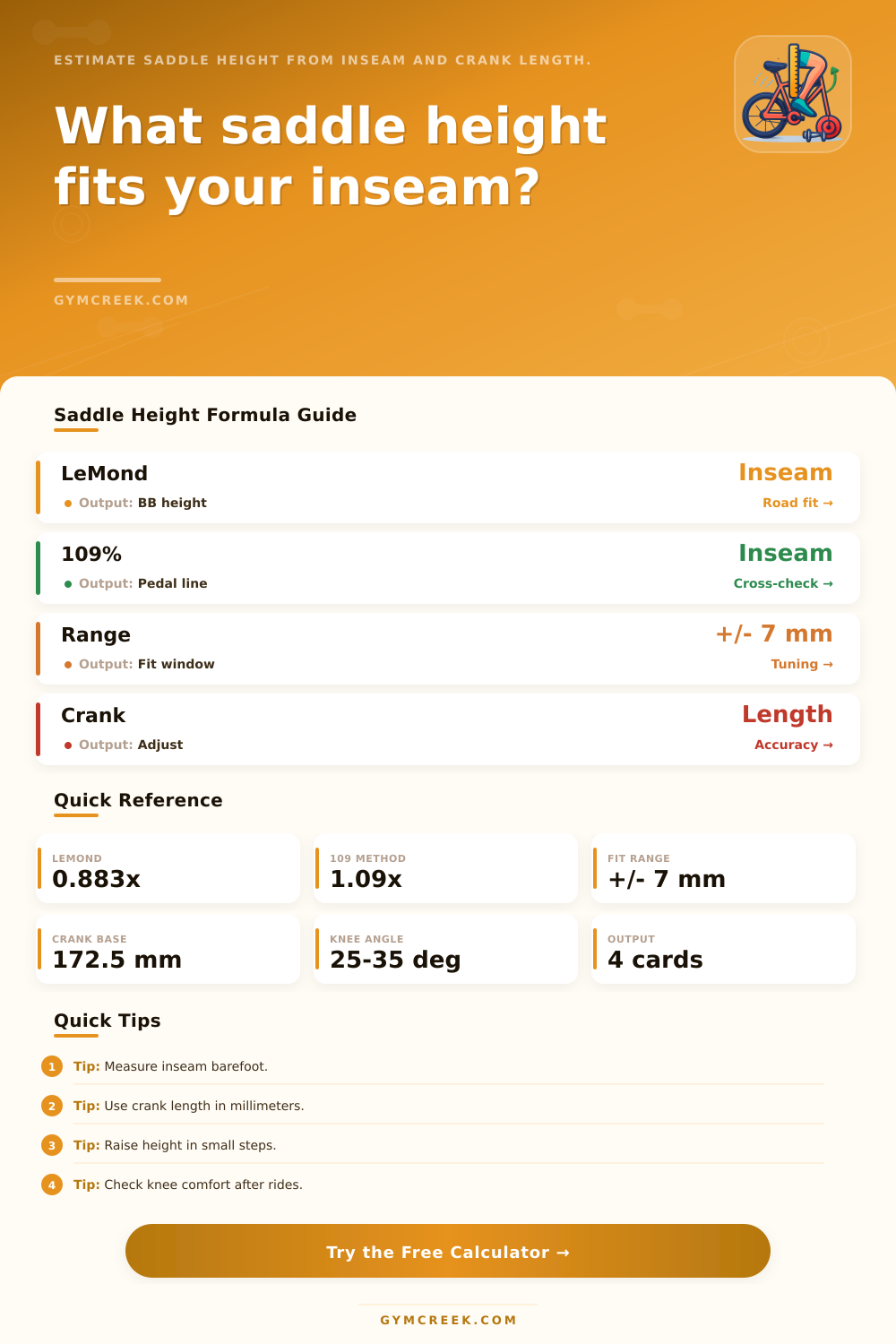
| LeMond | BB to saddle | Inseam x 0.883 | Road start |
| 109 percent | Pedal axle line | Inseam x 1.09 | Cross-check |
| Heel check | On-bike | Leg nearly straight | Sanity check |
| Knee angle | Video or fitter | About 25-35 deg | Fine tune |
| Signal | Likely height | Change | Check |
|---|---|---|---|
| Front knee load | Often low | Raise 2-3 mm | Cleat too |
| Back knee pull | Often high | Lower 2-3 mm | Hamstrings |
| Hip rocking | Too high | Lower 3-5 mm | Cadence |
| Toe reaching | Too high | Lower 2-4 mm | Ankle style |
| Setup | Typical bias | Reason | Range |
|---|---|---|---|
| Road race | Slightly high | Power line | +1 to +3 mm |
| Gravel | Neutral-low | Stability | -2 to 0 mm |
| MTB | Lower | Handling | -3 to -8 mm |
| Tri aero | Position-led | Hip angle | -1 to +2 mm |
| Layer | Input | Adjustment | Purpose |
|---|---|---|---|
| Base | Inseam | 0.883 and 1.09 | Start height |
| Equipment | Crank, stack | Millimeters | Pedal reach |
| Rider | Mobility, ankle | Small bias | Comfort |
| Symptoms | Knee or hips | Caution flag | Fine tune |
💡Fit Tips
Saddle height are a critical measurement for a cyclist. The correct saddle height will ensure that the cyclist is able to ride without experiencing joint pain in there body. However, if the saddle height is incorrect, the cyclist may experience aching in their knee or rocking in their hips.
An incorrect saddle height usually result from the saddle being only a few millimeter from the correct position of the saddle. Therefore, cyclists must find the precise height for their saddle to avoid injury to their body. Every person have a different body structure.
How to Find the Right Saddle Height
Therefore, there is no perfect saddle height for every cyclist. There is no perfect saddle height for every person due to the different height of each individual. Furthermore, no one can solely rely on their height measurement to determine the perfect saddle height.
Instead, individuals have to find the perfect starting point for their saddle height using mathematical calculations, then adjust the height according to the physical mobility of their body. The first step in finding the perfect saddle height is to determine the inseam that the cyclist has. The inseam that is used for cycling is not the same than the inseam that is used for jeans.
In order to find the inseam for cycling, a cyclist’s leg has a hard book placed between it and pressed firmly against their groin area. This mimics the effect that the saddle will have on the body. If the book is not pressed firmly against the body, the cyclist’s inseam will be too large, which will make the saddle height too low for the cyclist.
Once the cyclist determine the inseam, there are other mechanical variable that have to be accounted for in the calculation of the perfect saddle height. The length of the crank that is used on the bicycle can change the length of the distance that the cyclist’s foot travel when cycling. Cranks that are longer will require a lower saddle height for the cyclist to avoid overextending their knee.
Additionally, the height of the shoe that the cyclist wear will have an effect on the perfect saddle height for that individual. Any thick sole will raise the height of the leg that is used for cycling, thus changing the saddle height that should be used for that cyclist. Mathematical calculations will determine the starting point for the perfect saddle height for the individual.
However, the physical mobility of the cyclist will play a key role in determining the perfect saddle height. Cyclists with tight hamstrings will have a different mobility than individuals with flexible hamstrings. If the cyclist’s hips rock from side to side while they are cycling, the saddle height is set too high.
When the saddle height is too high, the cyclist waste their energy when cycling. Therefore, cyclists should monitor the movement of their hips while cycling to ensure that the height of the saddle is correct. The type of cycling that is performed also have an effect on the perfect saddle height.
Mountain biker may have a different saddle height requirement than road racer. Mountain bikers need to have their center of gravity lower than road racers so that they have better stability while descending mountains. Additionally, the cycling pedal that are used will also have an effect on the perfect saddle height for the cyclists.
Flat pedals have a different height than clipless pedals. Thus, changes in pedals will change the perfect saddle height for each cyclist by several millimeter. After the perfect saddle height is established, it must be adjusted.
The cyclist should make the adjustments in increments of only two or three millimeter in height. After adjusting the height of the saddle, the cyclist should ride the bicycle for twenty minute. During this twenty-minute time period, the cyclist can assess their body to determine if the saddle height is correct.
A pull on the back of the knee indicate the saddle height is too high. A pinch on the front of the knee indicate the saddle height is too low. By using these measurement, the cyclist can fine-tune the height of their saddle to ensure that it is correct for their body.