LeMond Saddle Height Calculator
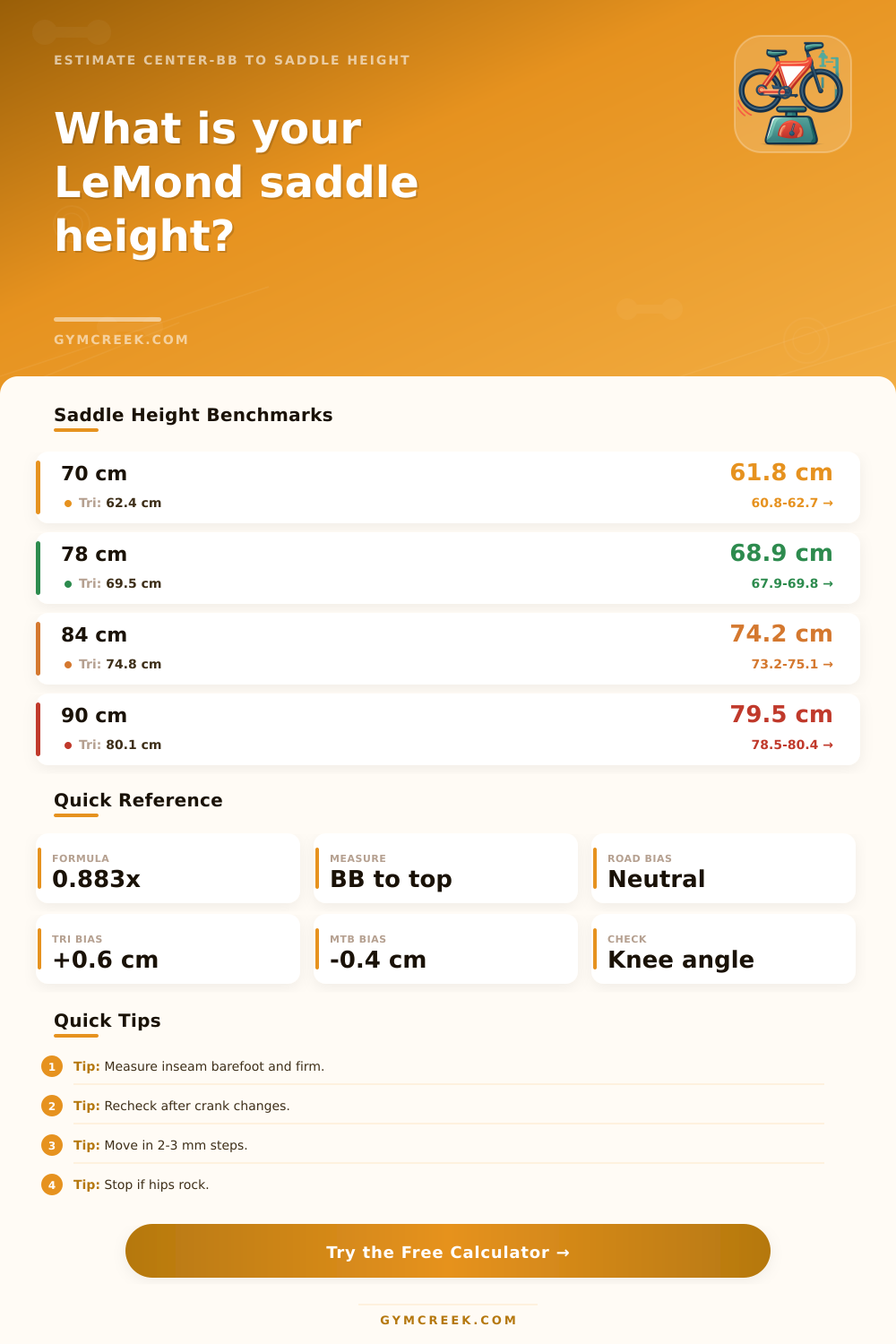
Estimate bike saddle height from inseam using the classic LeMond 0.883 method, then adjust for crank length, pedal stack, shoe sole, and riding discipline.
📌Presets
Each preset fills a realistic bike-fit scenario and recalculates the LeMond center-of-bottom-bracket to saddle-top height.
⚙Fit Inputs
LeMond saddle height snapshot
Enter inseam and equipment details to estimate your starting saddle height.
📊Fit Metrics
📑Reference Tables
| Formula | Input | Output | Measurement |
|---|---|---|---|
| LeMond | Inseam x 0.883 | Saddle height | BB center to saddle top |
| Trial low | Target - 0.8 cm | Lower bound | Use for first rides |
| Trial high | Target + 0.8 cm | Upper bound | Avoid hip rocking |
| Change step | 2-3 mm | Adjustment pace | Retest comfort |
| Discipline | Bias | Reason | Caution |
|---|---|---|---|
| Road | 0 cm | Classic baseline | Check knee angle |
| Tri | +0.6 cm | Steeper hip angle | Avoid toe reach |
| Gravel | -0.2 cm | Mixed terrain | Watch pedal strike |
| MTB | -0.4 cm | Handling room | Dropper may vary |
| Inseam | LeMond | Low Trial | High Trial |
|---|---|---|---|
| 70 cm | 61.8 cm | 61.0 cm | 62.6 cm |
| 76 cm | 67.1 cm | 66.3 cm | 67.9 cm |
| 82 cm | 72.4 cm | 71.6 cm | 73.2 cm |
| 88 cm | 77.7 cm | 76.9 cm | 78.5 cm |
| Signal | Likely Height | First Move | Retest |
|---|---|---|---|
| Hips rock | Too high | Lower 3 mm | Easy spin |
| Knee cramped | Too low | Raise 3 mm | Flat ride |
| Toe reach | Too high | Lower 2 mm | Cadence check |
| Stable pelvis | Near fit | Hold setup | Longer ride |
🧪Common Fit Scenarios
| Scenario | Input Change | Height Effect | Why |
|---|---|---|---|
| Shorter crank | 172.5 to 165 | Raise saddle | Foot travels less low |
| Thicker shoe | +4 mm sole | Lower reading | Foot sits taller |
| Rearward cleat | More midfoot | Slightly higher | Less toe reach |
| Soft saddle | More sink | Lower tape value | Loaded height differs |
| Check | Target | Tool | Use |
|---|---|---|---|
| Inseam | Repeatable | Book or level | Formula base |
| Height tape | Seat tube line | Metric tape | Main setting |
| Knee angle | 25-35 deg | Video still | Sanity check |
| Pelvis | Quiet hips | Trainer view | Too-high check |
💡Fit Notes
Finding an correct height for the bicycle saddle is important for cyclist. The height of the saddle impacts the way that the cyclist’s body move on the bicycle. If the height of the bicycle saddle is incorrect, the cyclist may experience pain in there lower back or in the front of they knee.
Many cyclists attempt to find the correct height for their saddle by guessing at a proper height. Guessing, however, is not an effective means of determine the correct height for the saddle, since guessing often leads to incorrect adjustment to the height of the saddle. Adjusting the height of the saddle by only a few millimeter may lead to the cyclist feeling as if their hips are rocking on the bicycle.
How to Find the Right Bike Saddle Height
Thus, using a mathematical means of determining the height of the saddle is likely to be more effective than guessing. One method of finding the height of the saddle is by utilizing the LeMond method. The LeMond method involve using a specific multiplier of the length of the cyclist’s inseam to determine the height at which the saddle should be adjusted.
This method starts with the math to determine the height of the saddle, and is, therefore, more reliable than randomly guess at the height of the saddle. Additionally, the method does not account for each individual’s unique anatomy. Thus, while the method can help the cyclist to find a starting point for the height of the saddle, the cyclist’s calculator can perform the calculation.
Another measurement that is necessary to determine the height of the saddle is the inseam of the cyclist. However, many cyclists measure there inseam incorrect. The inseam of a cyclist is not the same as the size of pants that they may wear.
To measure the inseam of the cyclist, the cyclist is to stand on their tiptoes against a wall and press a hard object into their pubic bone. By pressing into the pubic bone, the cyclist takes the inseam measurement in the same manner as their body will be in relation to the saddle when cycling. If too little pressure is placed into the pubic bone, the inseam will be too loose for the saddle height calculation.
In these instances, the cyclist will feel as if they are crouching on the bicycle while riding. The inseam is one means of calculating the height for the saddle, but it does not account for the equipment that the cyclist may use. For instance, the height of the pedals may change the length at which the feet will be from the crank arm of the bicycle.
Different type of pedals will have different pedal stacks. Additionally, the type of shoes that the cyclist uses may change the length of the legs of the cyclist. For instance, a soft-sole shoe will have a different measurement than a stiff carbon racing shoe.
Thus, a cyclist must consider the type of shoes that a cyclist uses when determining the height at which the saddle should be adjusted. The length of the cranks that are used on the bicycle can also impact the height at which the cyclist should set their saddle. Standard calculation for the height of the saddle utilize a specific length for the crank arm of the bicycle.
However, if the cyclist uses shorter cranks, the foot will travel a shorter distance down towards the ground during the cycling motion. Thus, the cyclist should adjust the height of the saddle to account for the length of the crank so that the angle of the cyclist’s knee remain the same. Finally, the discipline of cycling that is to be performed can dictate the height of the saddle that is to be established.
For instance, a cyclist who intends to perform a triathlon setup may require a different saddle height than a cyclist who intend to ride a mountain bike. For instance, a mountain bike may require that the height of the saddle be lower than that of a road bike so that the saddle does not continually hit the cyclist’s ribs while descending mountains. Thus, the type of cycling that is to be performed can dictate the height of the saddle for each individual cyclist.
Finally, the flexibility of the cyclist can impact the height of the saddle. Cyclists with open hips may be able to set their saddle higher than cyclists with tight hamstring. If a cyclist has tight hamstrings, they may feel as if their hips are rocking back and forth while riding at high altitude with a high saddle.
Thus, a cyclist with tight hamstrings will have to adjust the height of their saddle to accommodate their flexibility. While the mathematical formula will provide a target for the height of the saddle, that target should only be used as a hypothesis regarding the height of the saddle. The height can be adjusted in increments of two or three millimeter.
If the cyclist feels pain in their knee or hip while adjusting the height of the saddle, the cyclist should adjust the saddle in the opposite direction of the adjustment that was just made. If the height is adjusted to where the cyclist feels no pain and has a stable pelvis with a slight bend in the knee when reaching the bottom of the pedal stroke, the height of the saddle is correct. No adjustment should be made to the height of the saddle to increase the speed at which the cyclist may cycle.
Excessive adjustment to the height of the saddle may strain the cyclist’s joints. Instead, the correct height of the saddle will allow the cyclist’s muscles to engage without excessively stretching those muscle to their limit.