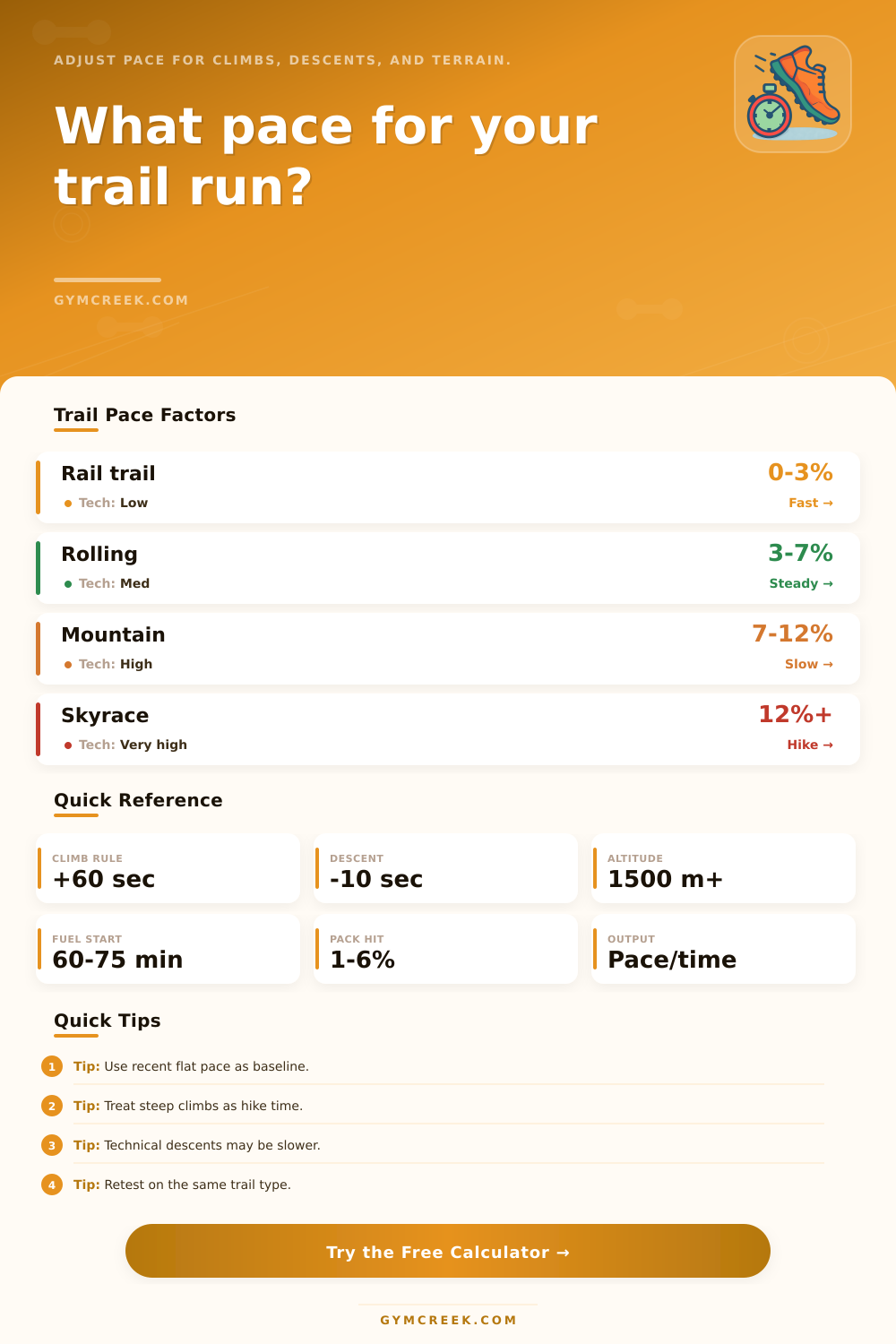
Trail Running Pace Calculator
Estimate trail pace from flat fitness, distance, elevation gain and loss, technical footing, altitude, pack weight, aid-stop time, and race effort.
📌Presets
Presets load realistic trail scenarios and calculate immediately so you can compare flatter routes, rolling terrain, technical courses, mountain races, and ultra pacing.
⚙Calculator
Trail pace estimate
Enter route details to adjust flat pace for trail conditions.
📊Trail Metrics Grid
📑Reference Tables
| Terrain | Multiplier | Typical Feel | Use Case |
|---|---|---|---|
| Smooth dirt | 1.00-1.03 | Roadlike | Rail trail, fire road |
| Flowy singletrack | 1.04-1.08 | Steady | Runnable trail |
| Rooty or rocky | 1.10-1.18 | Broken rhythm | Technical forest |
| Mountain technical | 1.18-1.30 | Slow focus | Rock gardens |
| Scramble terrain | 1.30+ | Hike mix | Hands-on trail |
| Grade Cue | Climb Load | Pace Note | Strategy |
|---|---|---|---|
| 0-3% | Low | Run steady | Hold cadence |
| 3-7% | Moderate | Ease effort | Shorten stride |
| 7-12% | High | Power-hike ok | Save legs |
| 12%+ | Very high | Hike likely | Use poles if trained |
| Duration | Carbs | Fluid | Check |
|---|---|---|---|
| Under 60 min | Optional | Thirst | Warm days |
| 1-2 hours | 20-40 g/hr | 300-600 ml/hr | Practice |
| 2-4 hours | 40-70 g/hr | 400-800 ml/hr | Sodium |
| 4+ hours | 60-90 g/hr | Plan aid | Gut train |
| Formula | Inputs | Output | Limit |
|---|---|---|---|
| Flat pace base | Recent pace | Min per mile/km | Fitness varies |
| Climb penalty | Gain, grade | Added time | Terrain varies |
| MET calories | MET, kg, min | Calories | Estimate |
| Mifflin-St Jeor | Age, sex, size | BMR/TDEE | General |
💡Tips
Trail running pace are different from road running pace because the terrain that trails presents creates resistance for trail runners that does not exist on the flat terrain of roads. Many trail runners use there road running pace to determine their trail running pace, but that is an inaccurate metric for trail races because the terrain of trails is not flat and is not entirely predictable. Road surfaces is the same throughout a race, but trail runners encounter a variety of different trail surface that require adjustments in the movement of the ankles and feet of trail runners.
These adjustments impact the movement of trail runners and create slower movement of trail runners at a given pace. Thus, trail runners must understand that trail running pace is a fluid metric that adapts according to the terrain of the trail that they is running on. The verticality of the trails that trail runners encounter also alters the movement of trail runners and the amount of energy that they expend during trail running.
Why Trail Pace Is Slower Than Road Pace
On hills with a steep grade, trail runners may have to change from running to a power hike to cover the steeper hills. Power hiking utilize a different system of energy than trail runners do when they are running. Trail runners expend more energy on hills than on flat terrain, and trail runners may find that their heart rate increase if they attempt to maintain their road running pace on a steep hill.
Trail runners may find that descending the hill takes more energy then ascending it. On muddy and technical descents, trail runners must expend energy to stabilize their movement on the trail, which slows their rate of descending the hill. Another factor that impacts trail runners is the altitude and the weight that trail runners have to carry on the trails.
At high altitudes, trail runners find that there is less oxygen in the air. With less oxygen available for their muscles, trail runners expend more energy and have a slower pace than trail runners at sea level. Additionally, trail runners expend more energy if they are carrying the weight of their gear.
Trail runners has to carry items like hydration vests, safety kits, and clothing, which all add to the weight of the trail runners. Because trail runners have to climb hills, the additional weight of their gear increase the difficulty of climbing these hills. Thus, trail runners with additional gear will have a time penalty in long trail race.
Trail runners must adjust their nutritional intake to provide enough energy to support their trail running demands. Because trail runners require more energy to traverse technical trails and hills, their glycogen levels will deplete at a faster rate. Trail runners must use caloric estimates to determine the energy that they need to run without depleting their glycogen stores.
If they deplete trail runners glycogen stores, they will experience a drop in their performance levels. Additionally, trail runners must account for the time that they take breaks at aid stations. If trail runners only calculate the time that they spend running, they will not calculate there actual time for the race.
Lastly, trail runners can use the estimates for trail and road running to better understand their performance expectations. If trail runners find that their trail running pace is slower than their road running pace, they should expect this slower pace due to the different terrain of trails. By understanding the elements that affect trail runners rate of movement, such as grade, technicality, altitude, and weight, trail runners can adjust their rate of running to avoid the “trail runner’s wall.” By using these numbers and calculations to understand the expected effort for trail runners, trail runners can better plan there races to not start too quick, which will help to avoid hitting the trail runners wall during the race.