Standing Long Jump Calculator
Score a standing long jump, adjust for landing quality, estimate takeoff speed and power, compare benchmark bands, and calculate the gap to a target distance.
📌Presets
Each preset loads a realistic test profile and recalculates the standing long jump score immediately.
⚙Jump Test Inputs
Standing long jump snapshot
Enter a jump distance to score the test and compare your result.
📊Metrics Grid
📑Reference Tables
| Level | Men | Women | Read |
|---|---|---|---|
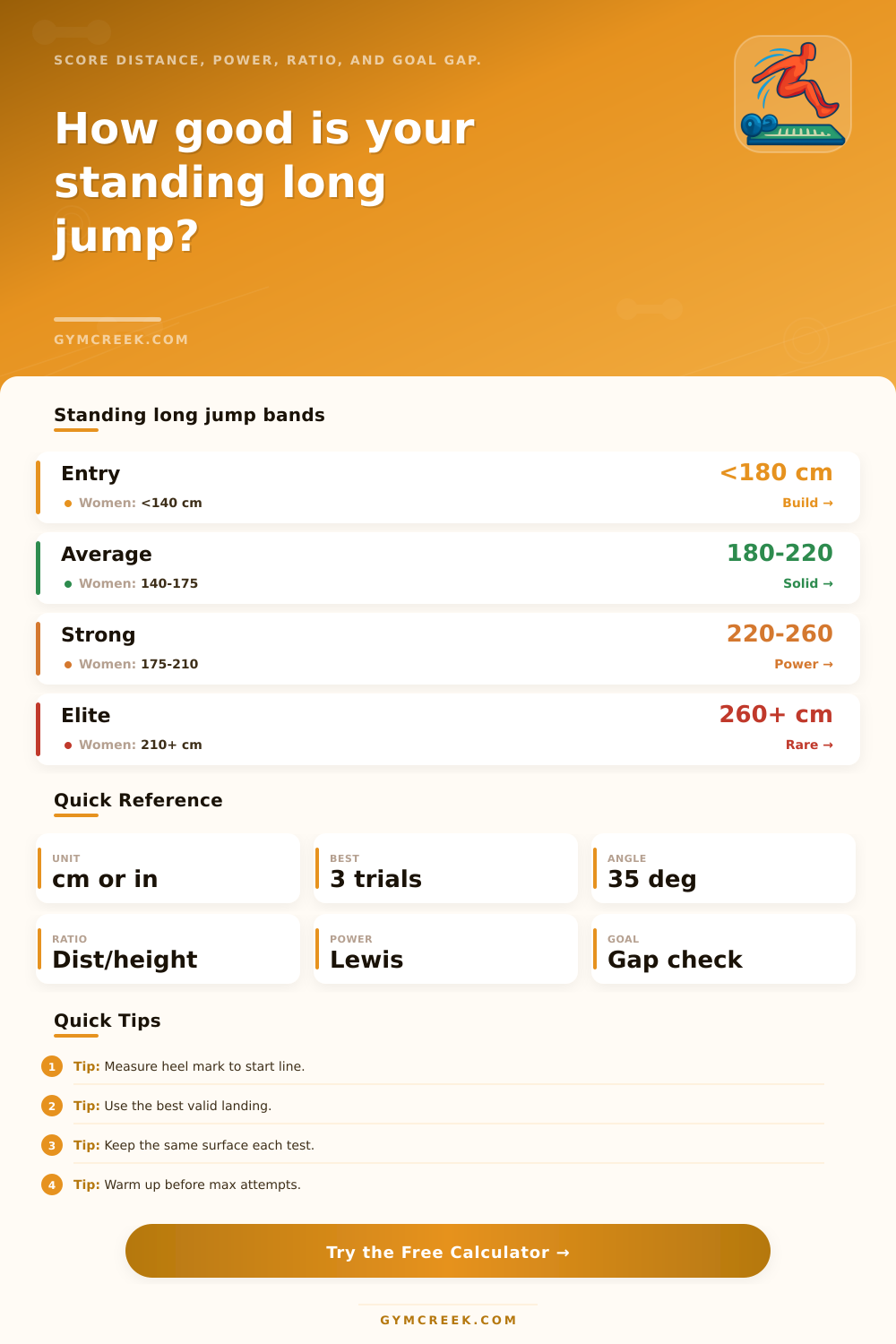
| Entry | <180 cm | <140 cm | Build base |
| Average | 180-220 cm | 140-175 cm | Solid fitness |
| Strong | 220-260 cm | 175-210 cm | Powerful |
| Elite | 260+ cm | 210+ cm | High output |
| Ratio | Meaning | Focus | Read |
|---|---|---|---|
| <1.05x | Low | Strength base | Build |
| 1.05-1.25x | Fit | Consistency | Solid |
| 1.25-1.45x | Athletic | Elastic power | Strong |
| 1.45x+ | Explosive | Max power | Elite |
| Surface | Adjustment | Reason | Use |
|---|---|---|---|
| Court | 0% | Stable | Default |
| Track | +1% | Grip | Fast |
| Turf | -1% | Give | Field |
| Grass | -3% | Uneven | Caution |
| Formula | Inputs | Output | When |
|---|---|---|---|
| Ratio | Distance, height | Body scale | All tests |
| Projectile | Range, angle | Speed | Estimate |
| Lewis | Mass, height | Power | Peak power |
| Gap | Target, result | Need | Goal check |
💡Tips
The standing long jump is a measurement of explosive power of an individuals lower body. More specificaly, the standing long jump measure the amount of power that an individual can generate while in a stationary start. The standing long jump dont require an individual to perform a running start to the jump, and it doesnt require any specialized equipment.
Many individuals uses the standing long jump as a means of measuring the athletic readiness of an individual. However, using only the distance that an individual jumps is insufficient as a measurement of that athletes readiness, since the distance do not account for the size of that individual. For example, a standing long jump distance may be considered sufficient for an individual with smaller physical trait than others, but may not be considered a sufficient distance for an individual with greater physical size.
How the Standing Long Jump Test Works
To counteract this potential issue, the calculator utilize an individual’s height and weight to calculate the ratio of an individuals explosiveness. The calculator determines this ratio as a means of providing a more accurately comparison of the strength of individuals of each of different body types. Band performance ratings allow an individual to compare their standing long jump distance to the general population.
The tool can place an individuals standing long jump distance into one of several performance band, such as entry level, average, strong, or elite. An individual’s placement within the entry level band, for instance, may indicate a lack of strength of that individual or a lack of the power of that individual. Strength is the amount of weight that an individual is able to lift, while power is the speed at which the individual can move that weight or there own body.
Landing loss is one variable that should of been considered when measuring an individuals standing long jump distance. An individuals distance may be lower than their potential flight capacity if they stumble or touch the ground during the jump. For this reason, the tools input for landing loss allow for an individuals standing long jump distance to be adjusted for any potential landing error.
Adjusting for potential landing errors allow for an individuals potential flight capacity to be measured rather than the potential mistake during there landing. An individuals standing long jump may also be affected by the type of surface upon which they jump. Surfaces may provide different level of grip for an individual jumping standing long jumps on those surfaces, such as a hardwood court versus a grass field.
Additionally, surfaces may provide different levels of energy return, such as grass fields reflecting more energy than gym mats. These variables are accounted for in the calculator so that an individual’s standing long jump distance measured on a soft field can be compared to an individuals standing long jump distance measured on a track. The swing of an individuals arms is one of the critical component of a good standing long jump.
The arm swing provide the individual with the momentum necessary to jump greater distances. If an individual limits the movement of their arms, they will have less momentum, which will lead to a decrease in their jumping distance. The standing long jump is a full-body jump because the movement of an individuals arms during the jump help to shift their center of mass to help their jump distance.
In order to increase an individuals standing long jump distance, they should focus on their takeoff angle for their jump. Many individuals jump too high or too low when performing standing long jumps. If an individuals takeoff angle is not evened between jumping too high and jumping too low, they will not be able to reach their maximal jumping distance.
Additionally, by using the estimates of an individuals takeoff speed and takeoff power, the individual can monitor their form while jumping. Monitoring there form will allow the individual to reach their specific jumping target or goal. The standing long jump calculates an individuals baseline for their athletic readiness, which are based off the relationship between an individuals mass and their velocity.