Hamstring Quad Ratio Calculator
Compare left and right hamstring-to-quadriceps balance, side-to-side symmetry, and strength relative to body weight from a knee strength test.
📌Presets
Each preset fills a realistic knee strength profile and runs the calculator with matching unit labels.
⚙Calculator
Hamstring quad ratio snapshot
Enter matched hamstring and quad values for both legs.
📊Fitness Metrics Grid
📑Reference Tables
| Test method | Watch zone | Typical target | Use |
|---|---|---|---|
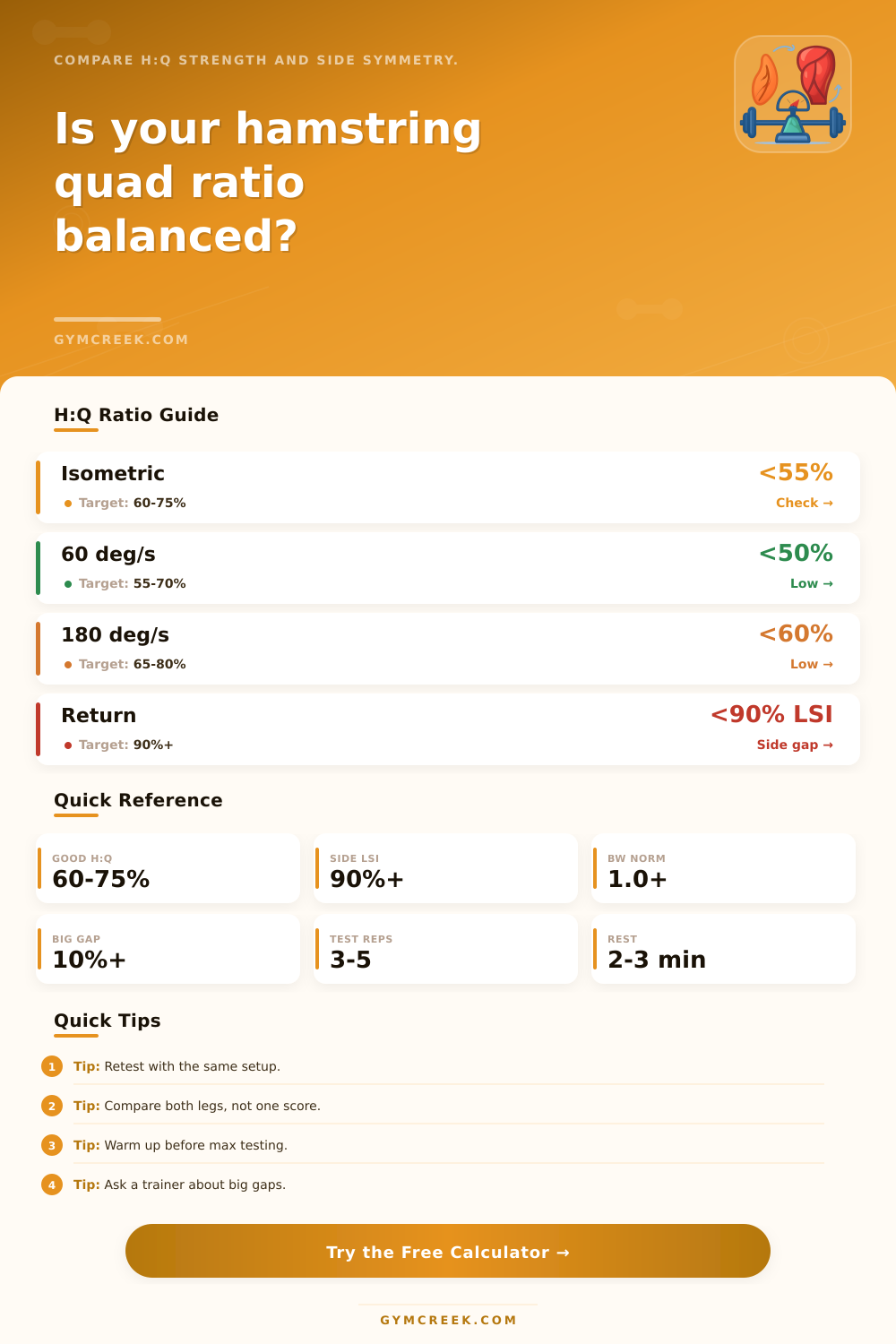
| Isometric | Below 55% | 60-75% | Field screening |
| Isokinetic 60 | Below 50% | 55-70% | Max torque |
| Isokinetic 180 | Below 60% | 65-80% | Fast testing |
| Handheld | Below 55% | 60-75% | Clinic trend |
| Metric | Formula | Good sign | Flag |
|---|---|---|---|
| H:Q ratio | Ham / quad | Near target | Very low |
| Quad LSI | Low / high | 90% or more | Under 90% |
| Ham LSI | Low / high | 90% or more | Under 90% |
| Strength index | Total / BW | 1.0 or more | Trend only |
| Profile | Common pattern | Result cue | Next check |
|---|---|---|---|
| Field athlete | Strong quads | Ratio 60-75% | Retest monthly |
| Runner | Quad bias | Watch H:Q | Add context |
| Lifter | High force | Use BW index | Track phase |
| Return sport | Side gap risk | LSI 90%+ | Coach review |
| Setup factor | Why it matters | Best practice | Record |
|---|---|---|---|
| Knee angle | Changes force | Repeat angle | Degrees |
| Lever arm | Changes torque | Same strap | Position |
| Warm-up | Affects peak | Standard reps | Routine |
| Fatigue | Lowers output | Test rested | Session state |
💡Tips
The quadriceps and the hamstrings is two muscle groups in the leg that work together to stabilize the knee joint. The quadriceps are located on a front of the leg, and the hamstrings are located on the back of the leg. When an individual is sprinting or changing direction, the quadriceps muscles produce the force that propel the individual forward, but the hamstrings act as brake on the leg to prevent the knee from moving too far.
If the quadriceps muscles are significantly more strong than the hamstrings, the tibia will be pulled forward, potentially leading to an injury to the ACL. To avoid such injuries, it is essential for an individual to monitor the strength of there hamstrings in relation to the strength of their quadriceps muscles. The hamstring to quadriceps ratio is a measurement of the strength of the hamstrings in relation to the strength of the quadriceps muscles.
Balance Your Hamstrings and Quadriceps to Protect Your Knee
To get an accurate measurement of the strength of the hamstrings in relation to the quadriceps, an individual must use the same testing method each time. For instance, an individual can perform tests on a leg extension machine or a leg press machine. Furthermore, the angle of the knee must also be the same each time that an individual perform these tests.
The strength of the legs will change depending on the angle of flexion of the knee. For instance, if an individual tested with a 30-degree flexion of the knee one week, but 90 degrees the next, their hamstring-to-quadriceps ratio would of changed even without a change in the strength of there muscles. The Limb Symmetry Index (LSI) compares the strength of an individual’s left leg to their right leg.
Individuals may not have perfect symmetry between there two legs, but differences in strength between the left and right leg can create problems for the body. For instance, if an individual’s left leg is weaker than their right leg, their body will shift the body weights to their right leg during physical activity. This can cause overuse injury in the hips or the ankles.
A high Limb Symmetry Index indicate that an individual’s left and right legs are of equal strength. A high Limb Symmetry Index allows an individual to use their legs equally when performing physical activity. Another measurement for leg strength is known as body weight normalization.
This measurement allow for the comparison of leg strength to the body mass of each individual. An individual’s raw strength indicates the total force that their leg muscles can produce. Furthermore, an individual’s strength relative to their body weight indicate the amount of force produced in comparison to their body mass.
For instance, a 200-pound individual can produce the same amount of raw strength as a 150-pound individual, but the 150-pound individual will have more stronger relative to their body mass. Furthermore, by dividing the total amount of force produced by the body weight of the individual, an individual can calculate the strength index of their leg muscles. If an individual discovers that their hamstring-to-quadriceps ratio is too low, the individual should increase the strength of their hamstrings.
In addition to performing hamstring curls, the individual should incorporate eccentric movements into their leg strength program. Eccentric movements are movements that focus on the lowering phase of an exercise. For instance, when performing a bicep curl, the eccentric movement is the lowering of the weight.
Eccentric movements teach the hamstrings to handle tension while lengthening. Since most leg injuries occur when the hamstrings are lengthening, strengthening the hamstrings during this phase of exercise can help prevent those type of injuries. The ultimate goal in monitoring the strength of the hamstrings in relation to the quadriceps and the Limb Symmetry Index is to create a balance in the legs that meets the specific needs of the individual.
For instance, a marathon runner will have different strength requirement in their legs than a powerlifter. While an individual should utilize the tools provided to establish their leg strength, an individual should use their bodys physical symptoms as another guide to leg muscle strength. By monitoring the strength of an individual’s hamstring in relation to their quadriceps and measuring the Limb Symmetry Index for each leg, that individual will be able to ensure that the two groups of muscles work together in a way that protect their knee joint.