Bouldering Calorie Calculator
Estimate bouldering calories from body size, session length, active climbing time, wall angle, grade difficulty, attempts, sends, rest time, and heart-rate context.
📌Presets
Presets load realistic bouldering sessions and auto-calculate so you can compare volume, projecting, board climbing, and outdoor days.
⚙Calculator
Bouldering calorie estimate
Enter session details to estimate energy burn.
📊Fitness Metrics Grid
📑Reference Tables
| Session style | Base MET | Common use | Burn cue |
|---|---|---|---|
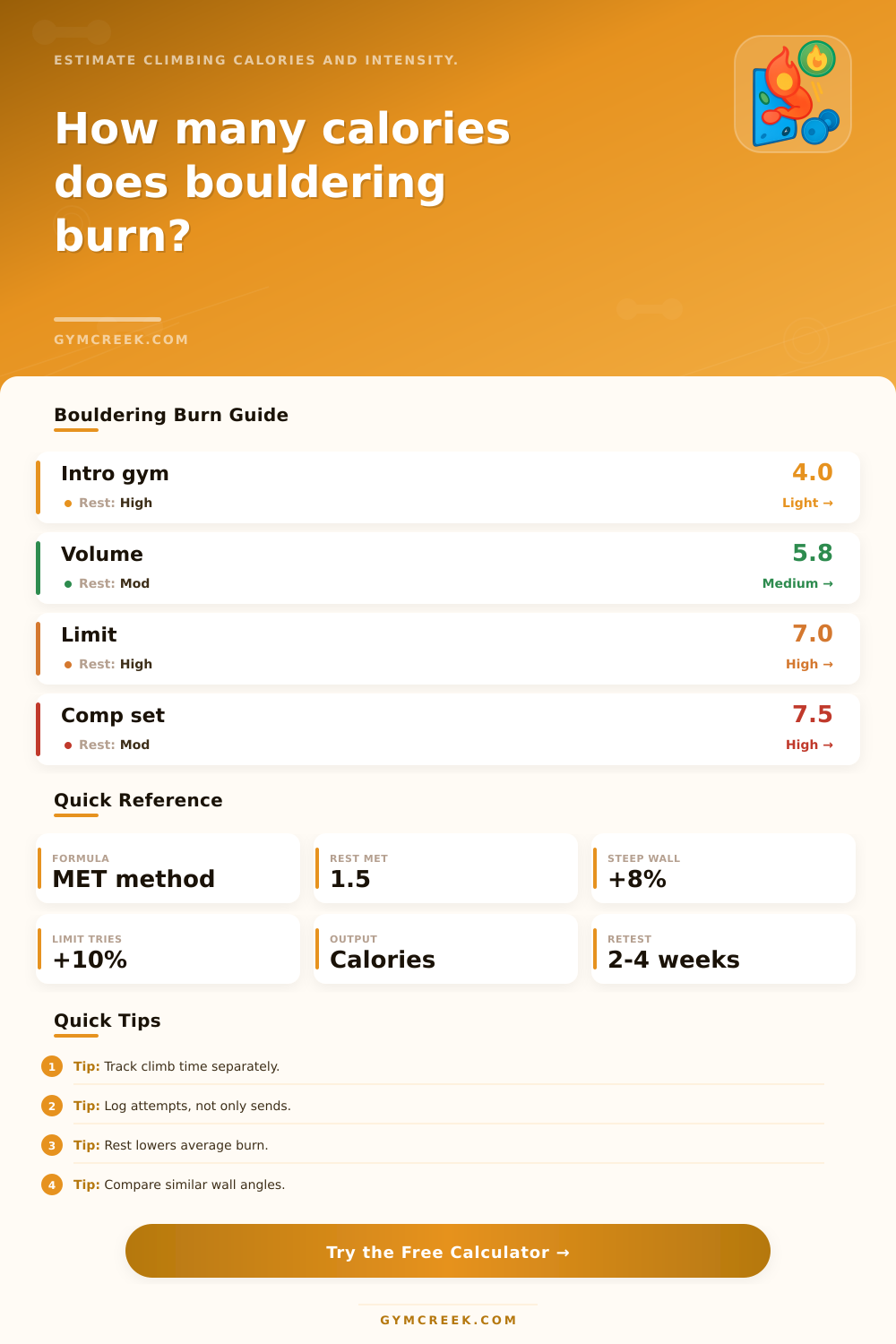
| Intro gym | 4.0 | Learning basics | Light |
| Technique volume | 5.0 | Movement practice | Moderate |
| Moderate volume | 5.8 | Most gym sessions | Medium |
| Limit project | 7.0 | Hard attempts | High |
| Comp circuit | 7.5 | Dynamic sets | High |
| Modifier | Low | Middle | High |
|---|---|---|---|
| Wall angle | Slab | Mixed | Roof |
| RPE | 4-5 | 6-7 | 8-10 |
| Rest time | 0-1 min | 2-4 min | 5+ min |
| Grade band | VB-V2 | V3-V5 | V6+ |
| Density | Active share | Session feel | Note |
|---|---|---|---|
| Low | <25% | Projecting | Long rests |
| Moderate | 25-40% | Typical gym | Balanced |
| High | 40-55% | Volume | Busy session |
| Very high | 55%+ | Circuit | Watch fatigue |
| Formula | Variables | Best use | Limit |
|---|---|---|---|
| MET calories | MET, kg, min | Session burn | Estimate |
| Mifflin BMR | Age, sex, size | Daily context | General |
| HR reserve | HR, age | Strain check | Optional |
| Send rate | Sends, tries | Session type | Skill varies |
💡Tips
Because bouldering are not a constant activity, it is difficult to estimate the number of calories that are burned during a bouldering session. Bouldering sessions consist of periods of intense physical movement and period of physical rest. Individuals will spend a considerable amount of time resting on their crash pads while taking breaks between climbing sessions.
If the total time spent at the gym were used to calculate the number of calories burned during bouldering, the measurement will likely overstate the number of calories that the body actualy burned during that time period. Thus, it is necessary to separate the length of the bouldering session from the minutes that were spent actively climbing in order to accurately calculate the calories that were burned during that time period. An individual’s body weight is one of the main factors that must be considered in the calculation of the number of calories that are burned during bouldering.
Calories Burned While Bouldering
Since bouldering require an individual to move their body weight, individuals with a higher body weight will have to exert more energy to move their body weight upward on the climbing wall than individuals with a lower body weight. The laws of physics create this relationship and it is the very reason that an individual’s body weight is one of the factors used in the MET method for calculating the calories that are burned during bouldering. The MET method calculates an individual’s energy expenditure by utilizing their weight to establish a baseline measurement of the number of calories that are burned.
The angle of the climbing wall will impact the number of calories that are burned during bouldering. The angle of the climbing wall will impact the amount of effort that an individual must expend while performing bouldering activities. When climbing a steep wall, an individual will require more muscular effort to keep their body from falling off the climbing wall than when they are climbing a vertical area of the climbing wall.
This additional muscular effort will result in an increase in the individual’s heart rate and the number of calories that the body burns. Thus, climbing a steep climbing wall will result in the burning of more calories then climbing a vertical climbing wall. The difficulty of the bouldering problems that are attempted will also impact the number of calories that are burned during bouldering.
The difficulty of the bouldering problems will impact the way that an individual’s muscles functions during bouldering. Bouldering problems that are designed for beginners will have larger holds and fewer movement required to complete the problem than elite bouldering problems. Thus, beginners will require less muscular effort than individuals who attempt bouldering problems that are of an advanced or elite difficulty level.
These explosive muscle movements will burn more calories than those required of beginners performing bouldering activities of less difficulty. The data regarding the calories that are burned during bouldering sessions can be used to determine the accuracy of the calorie calculations that are made for bouldering sessions. The Rated Perceived Exertion (RPE) of an individual’s bouldering sessions will help to determine if the calculations made for the calories that are burned are accurate.
Two individuals may burn the same amount of calories during bouldering sessions of the same length, but one individual may feel as if the bouldering was of less difficulty than the other individual. This subjective measurement of the effort that is required from the body during bouldering is used to account for the mental and physical effort required from the body to perform bouldering. Since a timer only measures the amount of time spent performing bouldering sessions, the body cannot be timed to measure the amount of effort that an individual put into bouldering activities.
Thus, RPE is used as a measurement of accuracy in addition to the measurement of time spent bouldering. The calories that are burned during bouldering sessions can provide an individual with a breakdown of the active calories that are burned during bouldering versus the total calories for the bouldering session. If an individual burns a high number of active calories yet spends most of their time resting on their crash pads during a bouldering session, then that individual will have a high density of bouldering activity during that session.
If an individual burns fewer calories during bouldering activities than others of similar strength and bouldering skill, then the individual is likely having a projecting bouldering session that includes long breaks between bouldering attempts. These calculations provide an individual with an understanding of the type of bouldering sessions that they performed during a given period of time and an understanding of the purpose of those bouldering session. Because bouldering sessions burn calories, an individual can use that information regarding the calories that are burned to manage their total daily energy expenditure.
If an individual spends most of their daily activities performing bouldering, they will burn enough calories to require a large meal to replenish the energy that was expended during bouldering. If bouldering is a small portion of an individual’s total daily activity, however, they will only require a snack to replenish the body’s expended energy. Thus, energy expenditure data allows individuals to turn hunger into data regarding how much food the body need to replenish energy for the activities that were performed.
Though not absolute truths, the information regarding the number of calories that are burned during bouldering is useful data for individuals who perform bouldering activities. An individual’s metabolism, their fitness level, the temperature within the gym will all change the number of calories that are burned during bouldering. However, an individual can use this data to compare their performance in different types of bouldering sessions.
These calories can be compared for sessions performed on different types of climbing walls and of different difficulty level. Thus, the knowledge of the calories that the body burns during bouldering allows individuals to better fuel their bodies and to better recover from the physical training that they perform during bouldering sessions.