Calorie Calculator Swimming Laps
Estimate calories burned from lap swimming using body weight, pool length, completed lengths, swim time, stroke, effort, and rest time.
📌Presets
Presets load realistic lap-swim sessions and immediately calculate calories, distance, pace, and active swim intensity.
⚙Calculator
Swimming lap calorie estimate
Enter a lap swim session to estimate calories burned.
📊Fitness Metrics Grid
📑Reference Tables
| Stroke | Easy | Moderate | Vigorous |
|---|---|---|---|
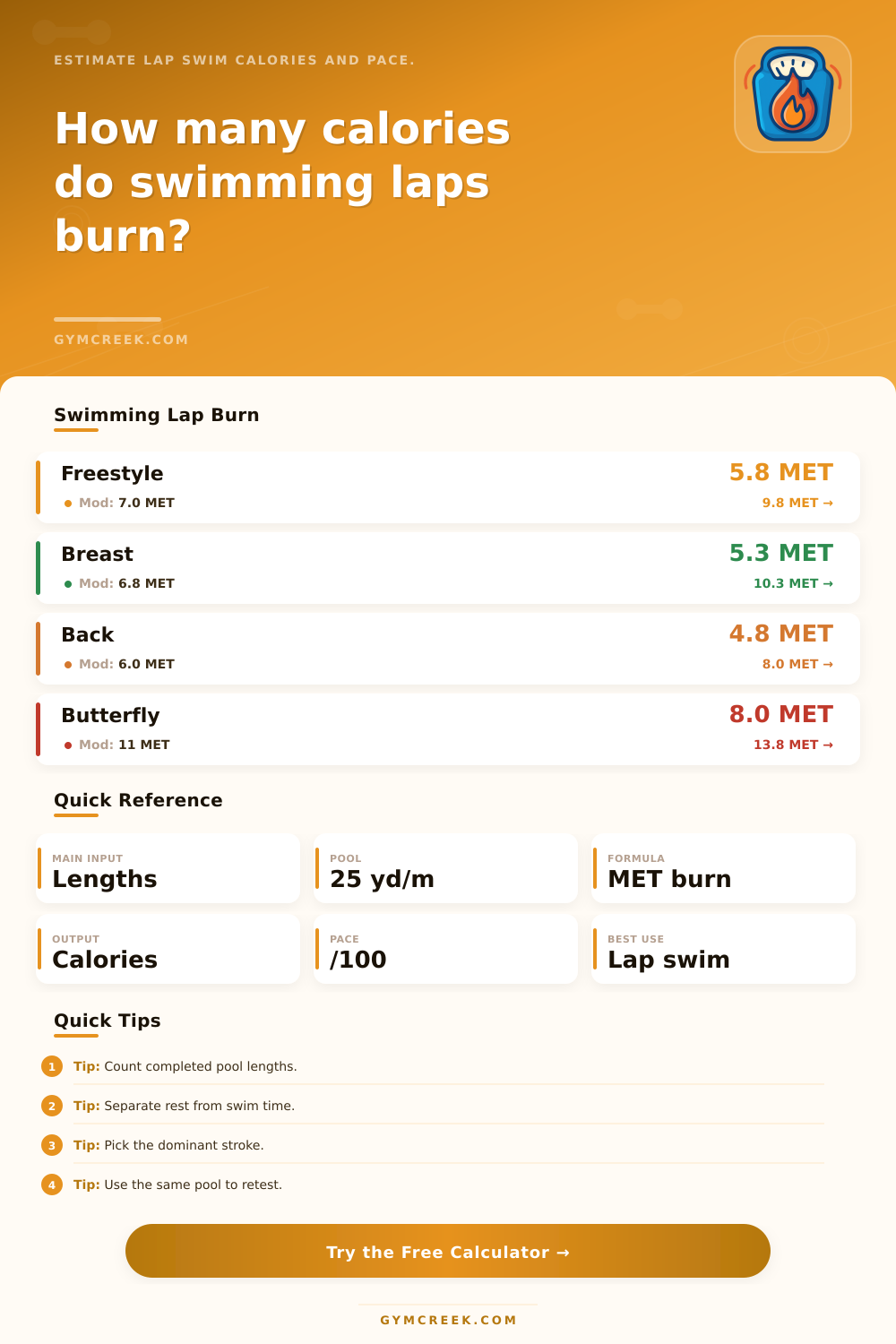
| Freestyle | 5.8 MET | 7.0 MET | 9.8 MET |
| Breaststroke | 5.3 MET | 6.8 MET | 10.3 MET |
| Backstroke | 4.8 MET | 6.0 MET | 8.0 MET |
| Butterfly | 8.0 MET | 11.0 MET | 13.8 MET |
| Mixed session | 5.8 MET | 7.6 MET | 10.2 MET |
| Pool type | One length | 40 lengths | Distance note |
|---|---|---|---|
| Short-course yards | 25 yd | 1000 yd | Common US pool |
| Short-course meters | 25 m | 1000 m | Common training pool |
| Long-course meters | 50 m | 2000 m | Olympic format |
| Hotel pool | 15 yd | 600 yd | Measure first |
| Session style | Rest share | Pace cue | Calorie cue |
|---|---|---|---|
| Continuous easy | 0-8% | Smooth | Steady burn |
| Fitness laps | 10-20% | Repeatable | Moderate burn |
| Intervals | 20-35% | Fast repeats | High bursts |
| Sprint set | 35-50% | Race pace | High MET |
| Formula | Variables | Best use | Limit |
|---|---|---|---|
| MET calories | MET, kg, min | Lap swim burn | Estimate |
| Mifflin BMR | Age, sex, size | Daily context | Not swim-specific |
| Pace /100 | Time, distance | Compare sets | Rest affects it |
| Cal /100 | Burn, distance | Session density | Stroke varies |
💡Tips
Swimming can lead to feeling significant amount of both hunger and exhaustion after the swimming session. These feeling of exhaustion are due to the deceptive nature of swimming as a sport. Swimming appears to be deceptive because the water support your body weight and the water keeps your body temperature cool.
Because the body does not feel the water weight while swimming, it does not feel the same amount of sweat as it would feel when performing swim workouts on a treadmill. Furthermore, because the body does not experience the same amount of joint impact as when performing swim workouts on the treadmill, it feel as if the body is not experiencing the same amount of exhaustion during those workouts. However, swimming does require some level of resistance in the body, which make it difficult to measure the amount of energy that is burned while swimming.
Why Swimming Makes You Tired and Hungry
The amount of energy that is burned while performing lap swimming sessions is not linear. The energy that is burned while swimming with different stroke will be different than others. For instance, a person may perform breaststroke strokes during recovery intervals, or perform butterfly stroke at the end of a set of swim intervals.
Each of these swimming strokes will burn a different amount of energy. Energy is often measured by MET values. MET values measure the amount of energy that the body is using in comparison to the amount of energy that the body uses when it is sitting still.
The higher the MET value for a swimming stroke, the more energy that the body is using to overcome the resistance of the water. The body weight of the swimmer is one of the primary factor that impacts the MET value for the swimmer. Additionally, the specific stroke that is used will impact the MET value for that swimmer.
For instance, freestyle is a relatively efficient stroke for swimming, while the butterfly stroke is a stroke that requires more core engagement and strength from the swimmer’s shoulders. As a result, the MET value for the butterfly stroke will be higher then for freestyle swimming. Efficiency while swimming can also impact the amount of energy that the swimmer burns during the session.
Although a beginner swimmer and a competitive swimmer may cover the same distance, the beginner swimmer typically burns more energetic than the competitive swimmer. The beginner swimmer may be less efficient in his or her technique for swimming. For instance, a beginner may splash more water with they arms, or drag their hips through the water when they swim.
The less efficient a swimmer is, the more energy that individual burns during a session of swimming. The pace at which a swimmer swims during a session can also impact the amount of energy that is burned during that session. For instance, if a swimmer performs an interval session, they will rest between each interval of swimming.
During these periods of rest, the body burns less energy than while swimming. Therefore, if the length of the swim session is use to calculate the amount of energy that was burned, the energy burned will be overestimated if the swimmer does not separate the session time from the actual time spent swimming. Distance can also create some confusion for swimmers.
In some pool, a lap is counted as one length of the pool. In other pools, a lap is one round trip for that pool. If swimmers are unaware of the difference between these two distances, they may double the distance that they swim and skew the results of their swim session.
In order to accurately track the distance that an individual swims, swimmers of all levels should use the same system to count their laps. As an individual becomes more skilled in how to swim, they will be able to increase their efficiency in the water. As an individual’s efficiency increases, that individual will be able to swim at faster rates while expending less effort in comparison to there initial skill level in swimming.
The goal that an individual desires to accomplish with their swimming can impact the type of swimming that they perform. For instance, if the goal of the swimmer is to manage their body weight, they may wish to swim at steady rates throughout a one-hour session. However, if their goal is to compete in triathlons, the swimmer may wish to perform high intensity intervals to increase their metabolism.
Each of these types of swimming sessions burn the same amount of energy per minute, although the high intensity intervals may make it easy for the individual to maintain the activity each day. Swimming provides a full-body workout while avoiding the impact on the joints of the body. Whether swimming instructor are performing backstroke or butterfly exercises, the resistance of the water helps the swimmer to increase their muscular strength as well as their cardiovascular fitness.
Thus, while the numbers associated with swimming sessions can help to track the individual’s performance in the water, elements like hunger and exhaustion are also indicators of the amount of work that they performed while swimming.