Push Up Percentile Calculator
Compare a push-up test against age and sex benchmarks, adjust for test style, and find the next practical target.
📌Presets
Presets load realistic test profiles and immediately calculate percentile, rank, and next target reps.
⚙Calculator
Push-up percentile snapshot
Enter a completed test to compare against age and sex benchmarks.
📊Fitness Metrics
📑Reference Tables
| Male age | Average | Good | Excellent |
|---|---|---|---|
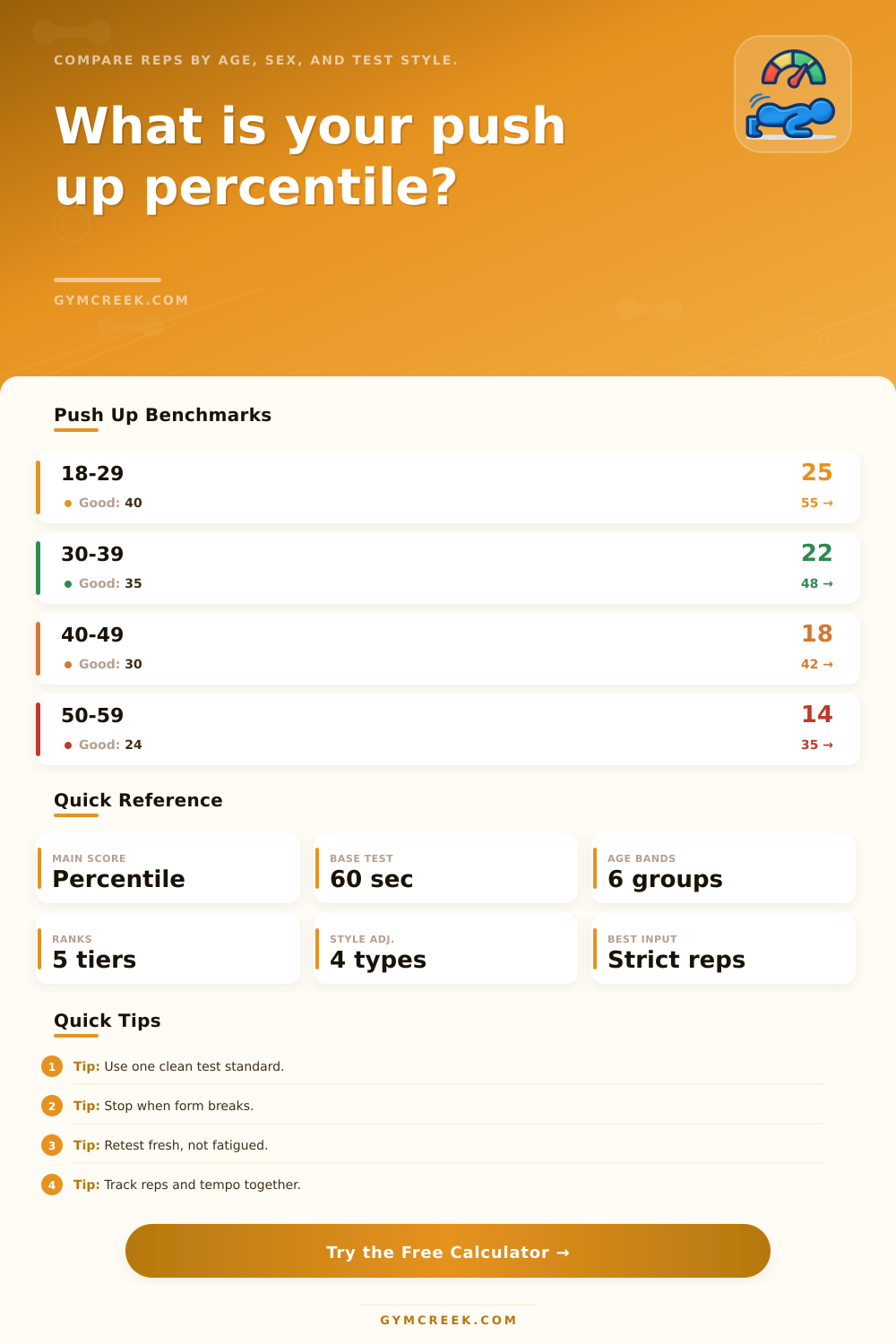
| 18-29 | 25 | 40 | 55+ |
| 30-39 | 22 | 35 | 48+ |
| 40-49 | 18 | 30 | 42+ |
| 50-59 | 14 | 24 | 35+ |
| 60+ | 10 | 18 | 28+ |
| Female age | Average | Good | Excellent |
|---|---|---|---|
| 18-29 | 15 | 28 | 40+ |
| 30-39 | 12 | 24 | 34+ |
| 40-49 | 10 | 20 | 30+ |
| 50-59 | 7 | 15 | 24+ |
| 60+ | 5 | 10 | 18+ |
| Rank band | Percentile | Meaning | Use |
|---|---|---|---|
| Developing | <25th | Build base | Technique |
| Average | 25-59th | Typical range | Retest |
| Good | 60-79th | Above norm | Maintain |
| Excellent | 80-94th | High score | Peak |
| Elite | 95th+ | Top band | Verify |
| Test style | Adjustment | Reason | Best use |
|---|---|---|---|
| Standard | 1.00x | Base norm | Fitness test |
| Hand-release | 1.08x | Slower reps | Strict range |
| Cadence | 1.12x | Fixed tempo | Repeatable |
| Modified | 0.68x | Lower load | Return phase |
💡Tips
Beyond the raw rep count, there are other factor that relate to the physical capability of an individual. A raw rep count is a count of the number of repetitions that an individual perform with a specific movement. However, this raw count dont give an accurate measurement of an individuals physical capabilities.
An individual may be able to perform a high number of repetitions with a movement, but that does not denote that the individual is physicaly strong in comparison to other individuals. The raw rep count does not take into account the body weight of an individual performing the movement. For example, if an individual weighs 140 pounds, they are moving less mass than an individual that weigh 250 pounds.
Why Rep Counts Alone Do Not Show True Strength
Thus, an individual who weighs less will be able to perform more repetitions to exhaustion. The strength index will provide a more accurate measurement of an individual’s physical strength. This physical strength index calculate the number of repetitions that are performed in relation to the body weight of the individual.
This ratio of power to weight is a more precise measurement of physical strength than the raw rep counts. Another factor to consider is the quality of the repetitions that an individual perform. When an individual perform a movement, the quality of each of those repetitions will have an impact on the accuracy of the measurement of their physical strength.
Many individuals may perform repetitions of a specific movement with poor forms. Poor form will lead to a higher count of the number of repetitions that the individual performs; however, that count does not accurately reflect the physical strength of that individual. For example, the number of repetitions of the hand-release movement is higher than those that perform the movement without releasing the individual’s hands from their grasp.
This is because the hand release movement is more difficult, as it eliminate the use of momentum to perform the movements. To adjust for this difference in difficulty, the calculator must adjust the score of the movement upward. Thus, an individual should focus on the quality of the movement rather than the speed at which they performs it.
Another factor that will impact the measurement of an individual’s physical strength is the time frame in which the movements are performed. An individual can perform a series of movements until they become fatigue or can perform a sprint of the movements in sixty seconds. Each time frame will test different aspect of an individual’s physical strength.
Performing a series of movements until failure will test the strength of the muscle, while sixty seconds of performance will test the individual’s anaerobic and explosive strength. An individual can use a time frame of sixty second to test their physical strength, as this allows for the best comparison of physical strength between individuals of different strengths. If an individual test their physical strength using a sixty-second time frame, others performing the same test can easily compare there performance.
The physical condition of the body of the individual can also impact the number of repetitions that they are able to perform. If an individual is fatigued or sore from performing other physical exercise, they will be able to perform fewer repetition of the tested movements. Thus, a lower count of the number of performed repetitions indicates that the individual is not currently recovering from exhaustion.
Their physical strength may still be the same, but their bodies are not providing the strength required to perform the exercises. An individual should of consider their physical condition when performing these test. Additionally, the age and sex of the individual should also be considered when measuring their physical strength.
An individual’s physical capabilities will differ according to their age; a fifty-five-year-old will not have the same physical strength as a twenty-five-year-old. Thus, the individual should compare their physical strength to other individual of their age group. Knowing the percentile rank of an individual’s physical strength allows them to set goal for themselves.
Knowing their percentile is helpful, but knowing how many repetitions they need to perform to increase their percentile is more useful. If an individual know that they need to perform 20 more repetitions then they did today to reach the 80th percentile in strength, they can aim to develop their strength to reach that goal. However, they should never sacrifice the quality of their movement to increase their performance of the exercise.
For example, if an individual increases the number of repetitions of the exercise by reducing the range of motion with their body, they will have increased the number of repetitions that they performed. However, they have not increased their physical strength because they are not performing the exercise correctly. The repetition of any exercise require an individual to aim for a steady increase in their rank in relation to other individuals testing the same physical strength.
This shift in rank indicate that an individual is successfully increasing their physical strength.