Marine OCS PFT Calculator
Estimate your Marine Officer Candidates School PFT score across pull-ups or push-ups, plank, and the 3-mile run, then see the gap to your target.
📌OCS Presets
Presets load realistic officer-candidate profiles and calculate immediately so you can compare event gaps quickly.
⚙PFT Inputs
Marine OCS PFT snapshot
Enter your events and calculate the score.
📊Fitness Metrics Grid
📑Reference Tables
| PFT total | OCS reading | Typical focus | Calculator note |
|---|---|---|---|
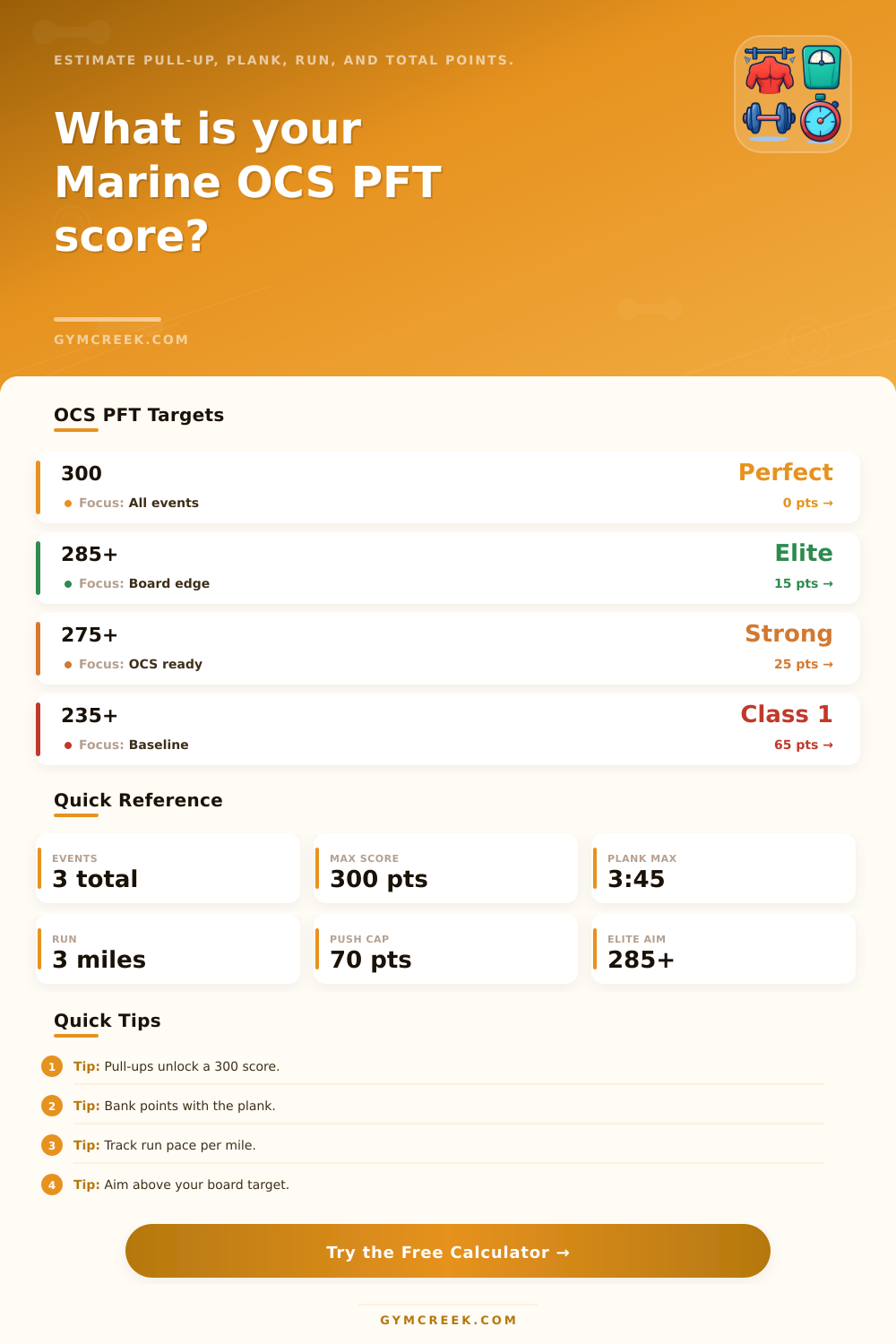
| 300 | Perfect | All three events maxed | No event gap |
| 285+ | Elite | Board-ready cushion | High applicant signal |
| 275-284 | Strong | Competitive OCS range | Polish weakest event |
| 235-274 | First class | Meets broad class band | Build toward 275+ |
| Event | Max reference | Minimum reference | OCS planning note |
|---|---|---|---|
| Pull-ups | Age and sex based | Age and sex based | Only upper event that can reach 100 |
| Push-ups | 70-point cap | Age and sex based | Useful fallback, not perfect-score path |
| Plank | 3:45 | 1:10 for 40 pts | Same table across sex and age |
| 3-mile run | 18:00 male, 21:00 female for younger groups | Age and sex based | Usually the largest point swing |
| Age group | Male run max | Female run max | Run planning cue |
|---|---|---|---|
| 17-40 | 18:00 | 21:00 | Use 6:00 or 7:00 pace targets |
| 41-45 | 18:30 | 21:30 | Protect pacing early |
| 46-50 | 19:00 | 22:00 | Bank plank and pull-up points |
| 51+ | 19:30 | 22:30 | Use age-adjusted run table |
| Formula area | Method | Used for | Limit |
|---|---|---|---|
| Upper event | Age and sex interpolation | Pull-up or push-up points | Push-ups cap at 70 |
| Plank | 1:10 to 3:45 scale | Core score estimate | Rounded to whole points |
| Run | Max to minimum time scale | 3-mile score estimate | Age and sex adjusted |
| Target gap | Target minus total | OCS readiness planning | Not an official board decision |
💡OCS Calculation Tips
The Physical Fitness Test, or the PFT, is a measurement of an applicants physical fitness and used to determine whether or not that applicant is prepared to join the Marine Corps. Many applicants experiences stress during the PFT due to the fact that many applicants are unaware of whether or not their training will result in a competitive score for the test. To avoid this stress and to determine whether or not an applicant is prepared for the Marine Corps, it is necessary for the applicant to understand that the PFT is a test of point optimization.
Point optimization involves a review of the metrics that contribute to an individuals score on the test, and the use of a calculator to determine how to lose the fewest number of points possible. Many applicants make the mistake of only training for the events that they enjoy the most. However, this is a mistake because each of the events on the test contribute to the overall score.
How to Improve Your PFT Score
The upper body event involves the performance of either pull-ups or push-ups. Pull-ups are the event that allows for the best possible score for applicants, while push-ups allow for fewer points. Thus, to maximize one’s score on the test, an applicant should focus upon performing pull-ups.
Push-ups are an event that applicants can perform as a fallback event, but they will not contribute to the best possible scores for applicants that perform them. The plank event is scored the same for all individuals, regardless of there age or sex. Thus, all applicants can easily earn points within this event.
The plank earns points in increments of time performed, so performing more planks then others will contribute to a better score. Because many applicants neglect their plank skills, it is a mistake for these applicants to neglect such an event. Increasing the number of seconds that an applicant can hold a plank will increase its score.
The three-mile run is a portion of the test that can change an applicants total score the most. An applicants score on the three-mile run is dependent upon their pacing and lung capacity. Many candidates have the mistake of running too fast at the start of the three-mile run.
An excessive start to the race can exhaust an applicant prior to the end of the three-mile race. Using a pace output can help an applicant to understand the pace that they should maintain throughout the three-mile run. For those interested in attending Officer Candidate School (OCS), there are additional steps that can be taken to determine whether or not an applicant will be prepared for the school.
Those applying for OCS can use a target score and a calculation of the gap between their current score and the target score to determine how to close that gap. For instance, if an applicant calculates that they are sixty points away from their target score for OCS, and they have four weeks to prepare, specific training recommendations need to address the sixty-point gap. Using such data to prepare for OCS will allow an applicant to understand their level of readiness for OCS, and to avoid underestimating the requirements for the Physical Fitness Test (PFT).
It is also important to include a margin of safety within an applicants fitness levels. An applicant should train to score a PFT score that is between ten and fifteen points higher than their target score. This margin of safety ensures that if an individual should of had a bad day in relation to the PFT, or if they experience a cramp during the test, that they will still score within one of the higher score categories.
For instance, if an individual targets a score of 275, but has a bad day and scores a 270, they may fall into a score category with a lower score. However, if they aim for 290, even if they score 275, they will still remain in a higher score category. Finally, an individual should transition from guessing their physical fitness levels to measuring their physical fitness.
By measuring their physical fitness, an individual can determine where they lack in comparison to others with similar goals. By discovering their physical fitness gaps, they can focus upon the event that is the easiest for them to improve, and develop a plan to prepare for that skill. Whether an individual is working on their pull-ups or their three-mile run, the data will contribute to a roadmap that an individual can follow to prepare for the PFT.
By focusing upon measuring and planning an individuals fitness, the PFT can be transformed from a gamble to a predictable event.