A Body Composition Assessment is use to measure the body fat of each sailor. A Body Composition Assessment, however, is often a source of stresses for sailors due to the measurements and mathematical formulas that is used to determine the percentage of body fat of each sailor. Despite feeling good about the condition of ones body, there is the potential to fail a Body Composition Assessment if the measurements taken are not in accordance with specific requirements of the Navy.
The anxiety that many sailor experience during a Body Composition Assessment is due to the difference between two methods of measuring body fat percentage. The first stage of a Body Composition Assessment is the measurement of an individual’s waist-to-height ratio. The Navy does not use the raw measurement of an individual’s waist and height to calculate this ratio, but instead utilize specific rounding rules for those measurements.
How the Navy Measures Body Fat and How to Prepare
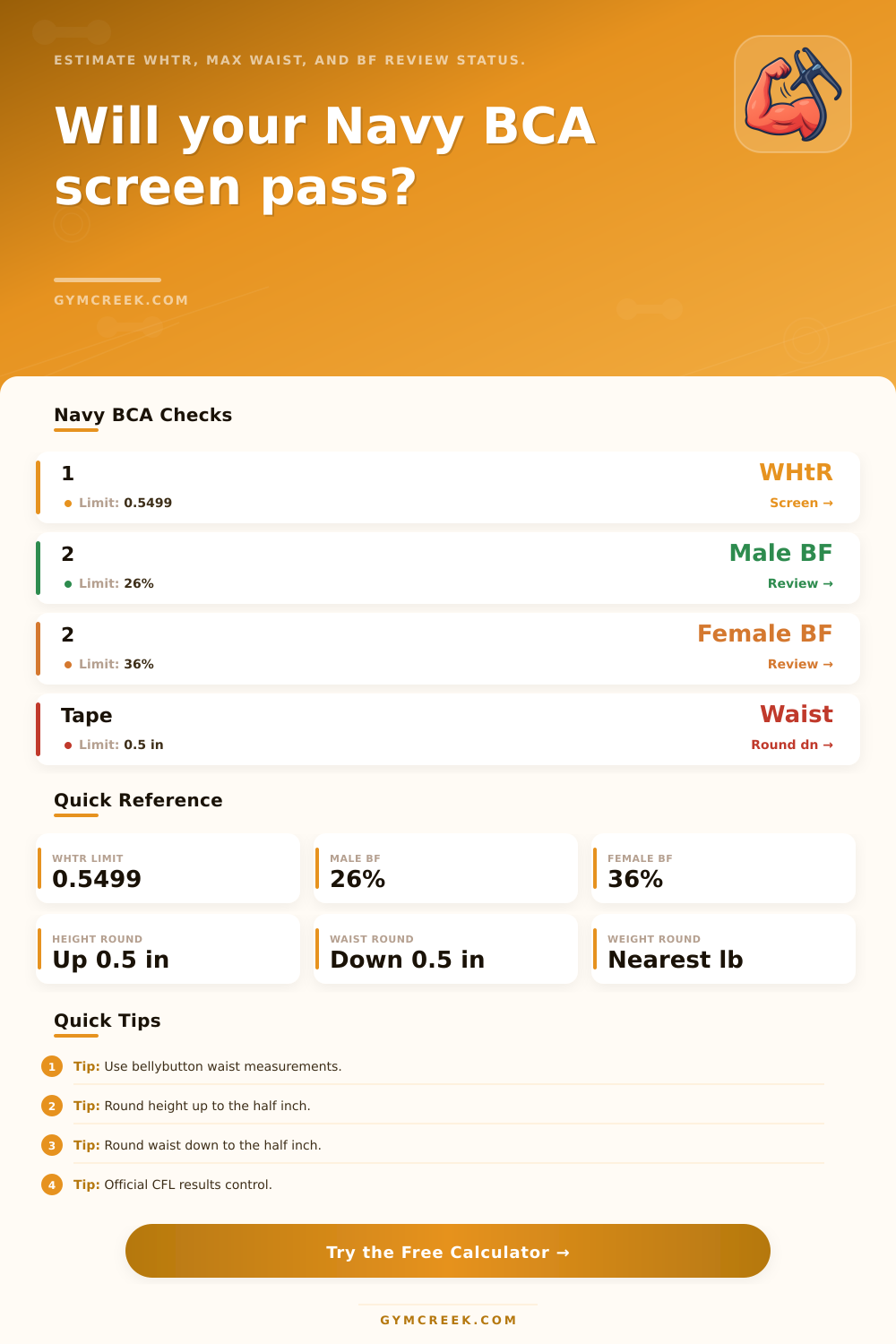
For instance, the Navy should round an individual’s height up to the nearest half inch, while the individual’s waist measurement should be rounded down to the nearest half inch. These rounding rules help to make calculating an individual’s waist-to-height ratio, but any difference in the measurements can still cause an individual to fail this initial screening. An individual can use a calculator prior to there official Body Composition Assessment to calculate their waist-to-height ratio.
By calculating the ratio, an individual can determine their waist cushion. An individual’s waist cushion is the amount of inches that they have before reaching the limit of 0.5499 for their waist-to-height ratio. By knowing the waist cushion of an individual, it is possible to determine whether they have enough room in their body to pass the Body Composition Assessment, and to prevent guess at the body measurements that will be taken during the assessment.
Individuals that do not pass the waist-to-height ratio will be taken to the Step 2 estimate of body fat. The Navy calculates this Step 2 estimate by utilizing an individual’s height, weight, and waist measurement to determine the percentage of that individual’s body fat. Men are allowed to have a maximum body fat percentage of 26%, while women is allowed to have a maximum body fat percentage of 36%.
Despite the belief that the waist measurement is the only measurement that is used to calculate body fat percentage for the Step 2 calculation, both the waist and the weight of an individual will impact that calculation. For instance, individuals that have alot of muscle may have a more higher weight than others, which can impact that Step 2 calculation. In order to accurately calculate an individual’s body fat percentage for the Body Composition Assessment, the waist measurement must be accurate.
The Navy requires that any waist measurement be taken at the level of the umbilicus, or the belly button. If the body composition measurement is taken too highly or too low of the umbilicus, the waist measurement will not be accurate. Additionally, the Navy requires that any waist measurement be taken after an individual perform a normal exhale.
If an individual takes the measurement while sucking in their stomach or while bloating, their body fat percentage will be calculated inaccurately. Individuals should track their Body Composition Assessment measurements over time. By logging the body fat measurements of individuals over a period of time, it is possible to determine whether or not an individual’s waist-to-height ratio is increase.
By determining that an individual’s ratio is increasing, it is possible for those individuals to alter their diet or training to improve their body composition prior to the official Body Composition Assessment. The reference tables included with the Body Composition Assessments can help to determine the maximum waist measurement for individuals of various height. An individual that is tall will have a different maximum waist measurement than an individual that is short.
Thus, there is no maximum allowance for body fat percentage of all individual. By understanding the reference tables for Body Composition Assessments, individuals can have a better understanding of the requirements of the Navy for sailors body composition. While using a calculator to determine a Body Composition Assessment is not a replacement for the official Body Composition Assessment that a Command Fitness Leader or Assistant Command Fitness Leader will perform, the Body Composition Assessment will be the only measurement of an individual that will be log within the PRIMS database.
Thus, using a calculator to estimate body fat percentage will help individuals prepare for there official Body Composition Assessment. By knowing their body measurements, and by understanding the rounding rules, individuals can better approach the official Body Composition Assessment. Furthermore, by managing the Body Composition Assessment metric, individuals can also manage the stress that they experience during those assessments.