Sit and Reach Calculator
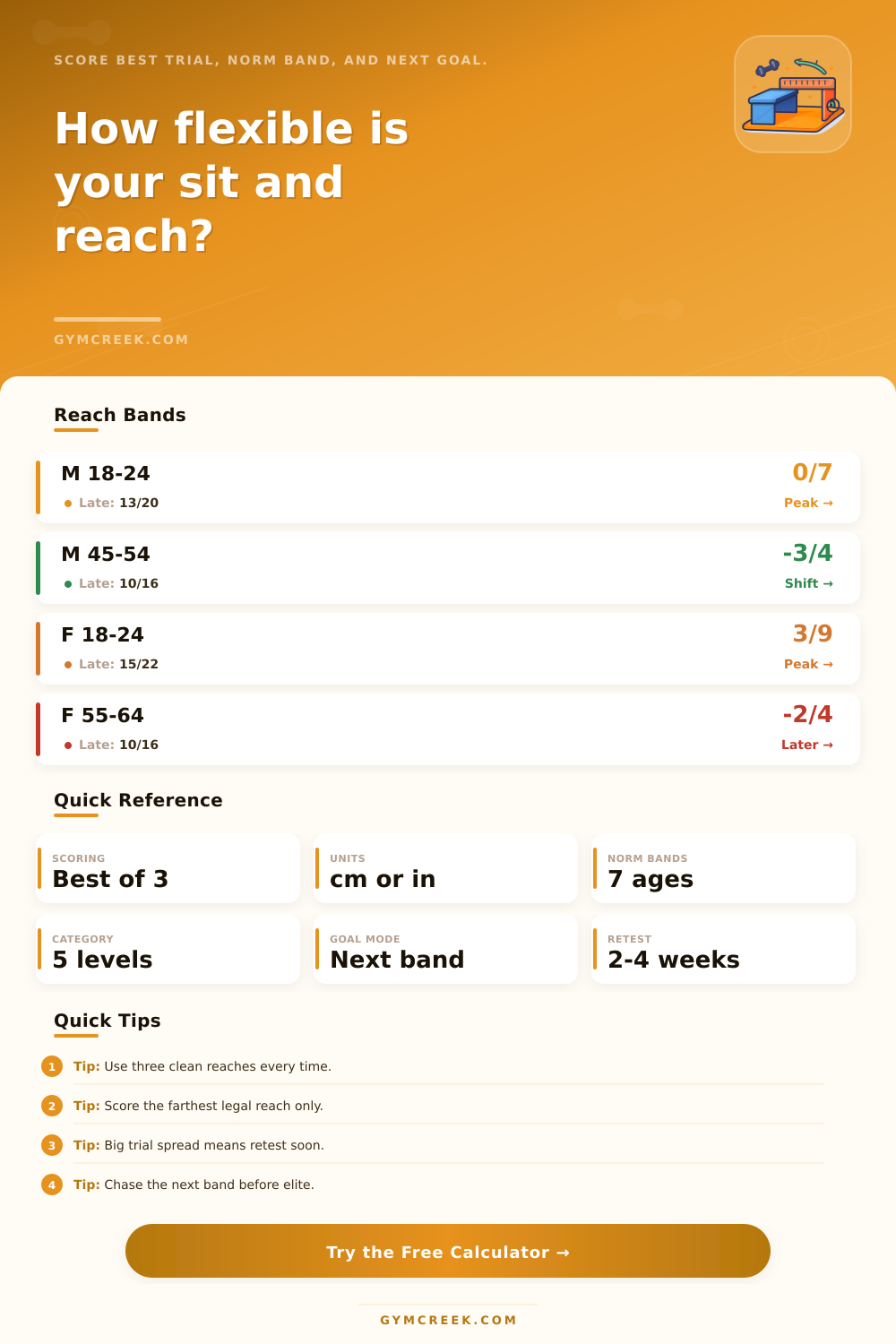
Score your best sit-and-reach trial by age and sex norms, see your flexibility category, and map a realistic progression target for the next retest.
📌Preset Profiles
Each profile loads three realistic trials, an age band, and a planning horizon so you can compare best-of-three scoring with a useful next-step target.
⚙Reach Inputs
Sit-and-reach snapshot
Enter three trials to score the best attempt, category, norm score, and progression target.
📊Mobility Markers
📑Reference Tables
| Male age | Develop | Solid | Strong | Exceptional |
|---|---|---|---|---|
| 10-17 | 1 cm | 8 cm | 14 cm | 20 cm |
| 18-24 | 0 cm | 7 cm | 13 cm | 20 cm |
| 25-34 | -1 cm | 6 cm | 12 cm | 18 cm |
| 35-44 | -2 cm | 5 cm | 11 cm | 17 cm |
| 45-54 | -3 cm | 4 cm | 10 cm | 16 cm |
| 55-64 | -5 cm | 2 cm | 8 cm | 14 cm |
| 65+ | -7 cm | 1 cm | 6 cm | 12 cm |
| Female age | Develop | Solid | Strong | Exceptional |
|---|---|---|---|---|
| 10-17 | 4 cm | 10 cm | 16 cm | 23 cm |
| 18-24 | 3 cm | 9 cm | 15 cm | 22 cm |
| 25-34 | 2 cm | 8 cm | 14 cm | 21 cm |
| 35-44 | 1 cm | 7 cm | 13 cm | 19 cm |
| 45-54 | 0 cm | 6 cm | 12 cm | 18 cm |
| 55-64 | -2 cm | 4 cm | 10 cm | 16 cm |
| 65+ | -4 cm | 2 cm | 8 cm | 14 cm |
| Category | Score zone | Read | Goal cue | Retest |
|---|---|---|---|---|
| Limited | 0-19 | Toe line is far | Build range first | 2 weeks |
| Developing | 20-39 | Base range is back | Close the next gap | 2-3 weeks |
| Solid | 40-59 | Daily range is useful | Add clean depth | 3 weeks |
| Strong | 60-79 | Good trunk fold | Hold and refine | 3-4 weeks |
| Exceptional | 80-100 | Top-end reach | Maintain quality | 4 weeks |
| Frequency | 4 weeks | 8 weeks | 12 weeks | Use |
|---|---|---|---|---|
| 1-2 per wk | 1-2 cm | 2-4 cm | 3-5 cm | Restart base |
| 3-4 per wk | 2-3 cm | 4-6 cm | 5-8 cm | Steady build |
| 5+ per wk | 2-4 cm | 5-7 cm | 6-9 cm | High focus |
| Spread over 3 | Hold pace | Retest first | Then progress | Fix setup |
| Spread under 1 | Push next tier | Stretch goal | Maintain form | Best data |
💡Tips
The sit-and-reach test are used to measure flexibility in an individual. The sit-and-reach test specificaly measure the flexibility of the lower back and hamstrings. To perform the test, an individual is to sit on a floor with there toes against a box.
The individual should leaning forward toward their toes to measure the distance the individual can reach. The sit-and-reach test has been used since the 1950s to determine the range of motion of an individual’s lower back and hamstrings. Because the test measures an individual’s ability to fold their trunk, it is thought to be beneficial in measuring the individual’s ability to perform daily task or physical activities.
How to Do the Sit-and-Reach Test
The results of the sit-and-reach test can vary according to the age and sex of the individual taking the test. An individual’s age can alter the test score for what is considered a normally score. For instance, men typically lose flexibility after there twenties, whereas women typically retain their flexibility for longer period of time.
An individual who score 13 centimeter on the test might have a strong score as a twenty-year-old male, but their score would be exceptional for a fifty-year-old male who typically has less flexibility. Thus, the sit-and-reach test allows individuals to compare their flexibility score to others of the same age and sex. In order to obtain accurate results on the sit-and-reach test, the test should be performed three times.
The individual might not be able to achieve the same score during each pass of the test. For instance, the individual might not have warmed up proper prior to the test, or their knee might not have been flat on the floor. Thus, by performing the test three times, the score can be reported for the individual’s farthest reach while minimizing daily variance in flexibility.
Flexibility is important to an individual’s health in relation to the health of their lower back. If an individual has tight hamstrings, they may pull on their lower back when they perform certain movement. Additionally, studies have indicated that individuals who can score well on sit-and-reach tests score fewer injury in activities like running or field sports.
Furthermore, while the sit-and-reach test does not help to build muscle, it can reveal any muscle imbalance in the body. For instance, if an individual’s hips are tight, their flexibility score will reflect this. There are some mistake that will make the score for the sit-and-reach test inaccurate.
Bouncing while performing the test will sacrifice the individual’s control, which invalidate the test. The individual should hold their score for two second while reaching for the toes. Additionally, the individual’s knees should be flat on the floor; any elevation of the knees will provide an artificially high score for the test.
Finally, the individual should perform the test with their bare foot; wearing shoes will make the score inaccurate. There are several ways to improve an individual’s score on the sit-and-reach test. For instance, if an individual scores in the developing category, they can work to improve their flexibility to move into the solid category.
Thus, performing the test one or two time per week will maintain flexibility, while three to four performances per week will show the most greatest improvements. Performing the test five or more times per week will help an individual to close the gap in their flexibility the most fast. An individual should retest their flexibility every few week.
Each test should be performed on the same floor, at the same time of day. Additionally, if the difference between the individual’s scores for the three tries decrease over time, it indicates that their flexibility is becoming more consistent. Thus, an individual can use the feedback provided by the sit-and-reach test to improve their flexibility and training habit.