BMR NEAT EAT TEF Calculator
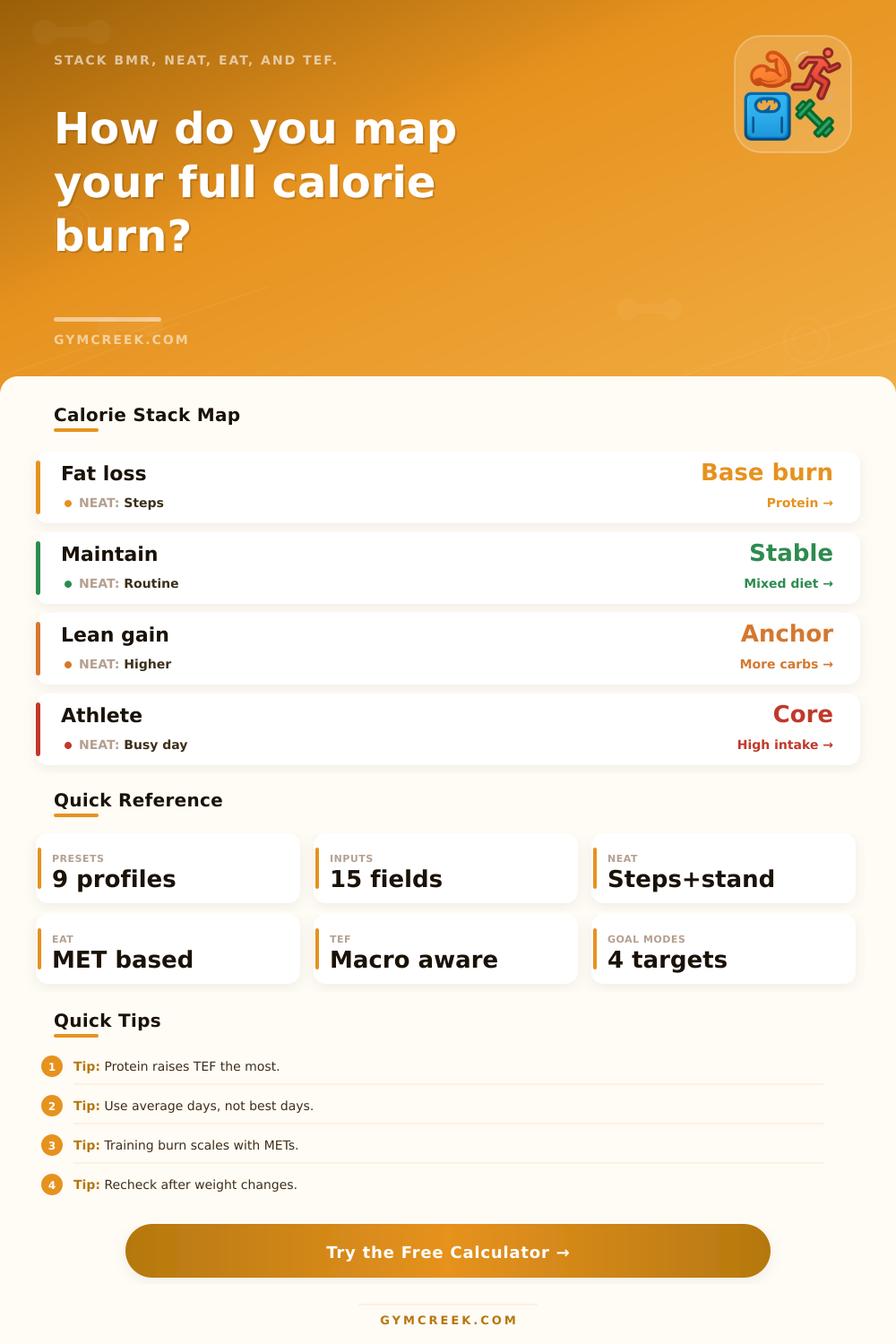
Estimate your full daily energy stack by separating resting burn, everyday movement, planned exercise, and macro-driven thermic effect before you set maintenance or goal calories.
📌Preset Energy Profiles
Each profile loads a realistic body size, movement pattern, training load, macro template, and calorie goal so you can compare how the full stack shifts before changing any single input.
⚙Energy Stack Inputs
Energy stack snapshot
Load a profile or enter your own data to compare maintenance intake, goal intake, and the contribution of each energy system.
📊Macro and Burn Metrics
📑Reference Tables
| Layer | Daily kcal | Share | Driver |
|---|---|---|---|
| BMR | --- | --- | Resting need |
| NEAT | --- | --- | Steps and standing |
| EAT | --- | --- | Workout average |
| TEF | --- | --- | Macro mix |
| Phase | Calories | Protein | Carbs |
|---|---|---|---|
| Maintenance | --- | --- | --- |
| Goal | --- | --- | --- |
| Fat grams | --- | --- | --- |
| TEF rate | --- | --- | --- |
| Mode | MET | Session read | Typical use |
|---|---|---|---|
| Strength | 5.0 | Lower | Steady lifting sets |
| Mixed class | 6.0 | Moderate | Bootcamp or hybrid class |
| Circuit | 7.0 | Higher | Minimal rest training |
| Sport | 7.5 | Higher | Games with repeated bursts |
| Endurance | 8.3 | High | Steady run or ride block |
| Intervals | 9.0 | Very high | Hard conditioning repeats |
| Goal | Bias | Weekly delta | Best fit |
|---|---|---|---|
| Small cut | -8% | Gentle drop | Tight recomp or long cut |
| Main cut | -15% | Clear deficit | Focused fat-loss phase |
| Maintain | 0% | Flat week | Performance or stability |
| Lean gain | +8% | Small surplus | Slow mass push |
| Formula | Used for | Needs | Why here |
|---|---|---|---|
| Katch-McArdle | BMR | Body fat % | Lean-mass aware resting burn |
| Mifflin-St Jeor | BMR fallback | Age, sex, size | Reliable when body fat is rough |
| Step-distance model | NEAT | Steps, height | Turns movement into daily miles |
| MET session model | EAT | Minutes, intensity | Weekly exercise average |
| Macro TEF mix | TEF | P, C, F | Shows protein-driven thermic lift |
| Macro style | Protein TEF | Carb TEF | Fat TEF |
|---|---|---|---|
| Higher protein | 25% | 8% | 2% |
| Balanced intake | 25% | 8% | 2% |
| Lower carb day | 25% | 8% | 2% |
| Higher carb day | 25% | 8% | 2% |
💡Practical Notes
Maintenance estimates shift most when your movement pattern changes, so daily steps, standing time, and workout frequency should reflect a week you can actually repeat.
Use TEF as a meaningful adjustment layer, not a magic discount. The calculator shows it separately so you can see how much of maintenance comes from eating itself.
Total daily energy expenditure are the total amount of energy that an individual burn in one day. The total daily energy expenditure include four component of energy expenditure: Basal Metabolic Rate (BMR), Non-Exercise Activity Thermogenesis (NEAT), Exercise Activity Thermogenesis (EAT), and the Thermic Effect of Food (TEF). If these four component of energy expenditure are not account for in the estimation of an individual’s energy expenditure, the targets that is set for that individual will be incorrect in relation to the actual energy expenditure of that individual.
Basal Metabolic Rate (BMR) is the amount of energy that an individual burns while at rest. Furthermore, Basal Metabolic Rate (BMR) is the energy that are necessary to maintain the basic functions of the body, such as breathing and organ function. An individual that have more muscle mass has a higher Basal Metabolic Rate (BMR) than an individual that has more body fat.
The Four Parts of Your Daily Energy Use
This is due to the fact that muscle mass require more energy to maintain than body fat does. There are various formulas that can be used to calculate Basal Metabolic Rate (BMR) for an individual, but most use variable like age, sex, height, and weight, and dont account for body composition. Non-Exercise Activity Thermogenesis (NEAT) is the amount of energy that an individual burn as a result of movement during the day outside of exercise.
For instance, an individual may burn energy as a result of walking, standing, or perform tasks in the job that they have. An individual that has a job that require standing and walking will have a more higher Non-Exercise Activity Thermogenesis (NEAT) value than an individual that has a more sedentary job. Therefore, an individual must track their daily movements to determine their Non-Exercise Activity Thermogenesis (NEAT) value.
Exercise Activity Thermogenesis (EAT) is the amount of energy that an individual burns as a result of perform exercise. Exercise Activity Thermogenesis (EAT) can include activities like weightlifting, running, or cycling. These values can be calculated through the measurement of the intensity of those exercise activities.
For instance, Metabolic Equivalent of Task (MET) values can be used to calculate the intensity of exercise, and the inclusion of these values will ensure that an individual does not overestimate the amount of calories that is burned through Exercise Activity Thermogenesis (EAT). If an individual overestimates the amount of calories that burn through Exercise Activity Thermogenesis (EAT), they may consume too many calorie, which will prevent them from reaching their weight goals. The Thermic Effect of Food (TEF) is the amount of energy that the body uses to digest food and nutrient.
The Thermic Effect of Food (TEF) of different nutrients is different; protein has a higher Thermic Effect of Food (TEF) than carbohydrates or fats. For instance, protein require 25% of the calories from that protein to be processed by the body, while fats only contain 2% of the calories from that fat product that the body is being digest by. Therefore, the inclusion of protein into the diet is one way to increase an individual’s total daily energy expenditure.
These four component of energy expenditure can be combined to create a complete picture of the total daily energy expenditure for an individual. Energy expenditure at rest (Basal Metabolic Rate [BMR]) is the baseline measurement of energy expenditure for an individual. Non-Exercise Activity Thermogenesis (NEAT) is the energy expenditure of an individual through their daily movement.
Exercise Activity Thermogenesis (EAT) is the energy expenditure of an individual through their performance of exercise. Finally, the Thermic Effect of Food (TEF) is the energy expenditure of an individual while they is digesting food. In order to lose weight for an individual, the number of calories that an individual consume must be lower then their total daily energy expenditure.
In order for an individual to gain weight, the number of calories that an individual consume must be higher than their total daily energy expenditure. It is important to remember that the total daily energy expenditure for an individual is not a static value. An individual’s total daily energy expenditure will change according to their weight and activity level.
Therefore, the individual should evaluate their total daily energy expenditure periodically to ensure that their Basal Metabolic Rate (BMR) is decrease if their weight is decreasing, and that their Non-Exercise Activity Thermogenesis (NEAT) is changing if their lifestyle is changing. Through the measurement of each of these four component of energy expenditure, an individual can adjust their food intake based off their physical activity and weight goal.