🚶 Steps to Miles Calculator
Convert your step count to miles, kilometers, and feet using your stride length or height
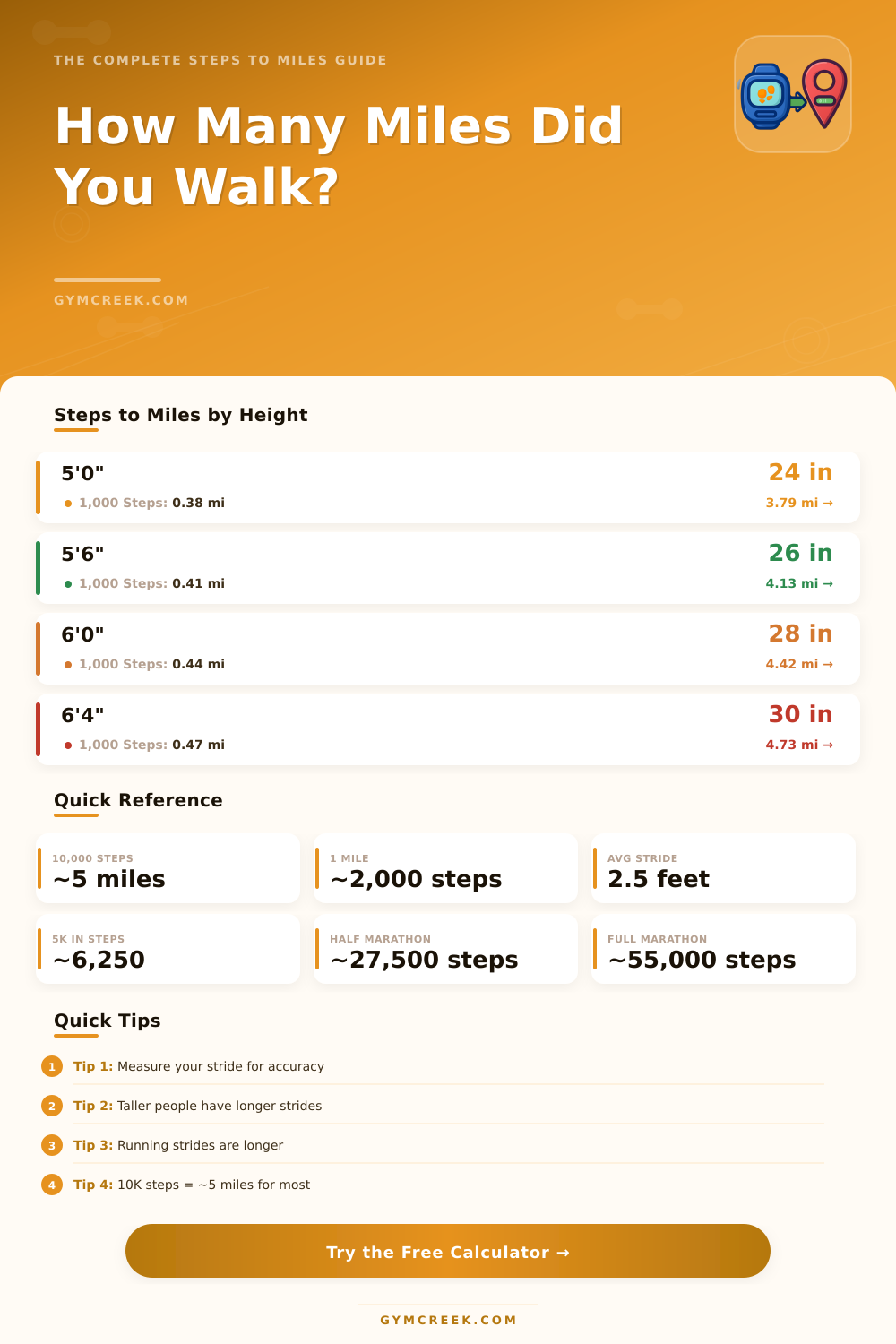
| Height | Male Stride (in) | Female Stride (in) | Steps per Mile (avg) |
|---|---|---|---|
| 5'0" (152 cm) | 24.0 | 23.0 | 2,371 |
| 5'2" (157 cm) | 24.8 | 23.8 | 2,295 |
| 5'4" (163 cm) | 25.6 | 24.6 | 2,224 |
| 5'6" (168 cm) | 26.4 | 25.4 | 2,159 |
| 5'8" (173 cm) | 27.2 | 26.2 | 2,098 |
| 5'10" (178 cm) | 28.0 | 27.0 | 2,041 |
| 6'0" (183 cm) | 28.9 | 27.8 | 1,980 |
| 6'2" (188 cm) | 29.7 | 28.6 | 1,929 |
| 6'4" (193 cm) | 30.5 | 29.4 | 1,879 |
| Step Count | Miles (5'6" avg) | Kilometers | Feet Walked |
|---|---|---|---|
| 1,000 steps | 0.41 mi | 0.66 km | 2,167 ft |
| 2,000 steps | 0.83 mi | 1.33 km | 4,333 ft |
| 3,000 steps | 1.24 mi | 1.99 km | 6,500 ft |
| 5,000 steps | 2.07 mi | 3.33 km | 10,833 ft |
| 7,500 steps | 3.10 mi | 4.99 km | 16,250 ft |
| 10,000 steps | 4.13 mi | 6.65 km | 21,833 ft |
| 12,000 steps | 4.96 mi | 7.98 km | 26,200 ft |
| 15,000 steps | 6.20 mi | 9.98 km | 32,750 ft |
| 20,000 steps | 8.27 mi | 13.3 km | 43,667 ft |
| 25,000 steps | 10.33 mi | 16.6 km | 54,583 ft |
| Activity | Avg Stride (in) | Steps per Mile | Steps per km |
|---|---|---|---|
| Leisurely Walk | 24–26 | 2,250–2,400 | 1,398–1,491 |
| Brisk Walk | 26–28 | 2,100–2,250 | 1,304–1,398 |
| Jogging | 32–36 | 1,700–1,900 | 1,056–1,181 |
| Running | 36–42 | 1,450–1,700 | 901–1,056 |
| Hiking (trail) | 22–26 | 2,300–2,600 | 1,429–1,616 |
| Treadmill Walk | 24–27 | 2,150–2,400 | 1,335–1,491 |
| Elliptical | 18–22 | 2,600–3,200 | 1,616–1,988 |
| Race / Goal | Distance | Avg Steps (walk) | Avg Steps (run) |
|---|---|---|---|
| 1 Mile Walk | 1 mi / 1.61 km | ~2,000–2,400 | ~1,600–1,800 |
| 5K Race | 3.1 mi / 5 km | ~6,200–7,500 | ~4,900–5,600 |
| 10K Race | 6.2 mi / 10 km | ~12,400–15,000 | ~9,800–11,200 |
| Half Marathon | 13.1 mi / 21.1 km | ~26,200–31,500 | ~20,800–23,600 |
| Full Marathon | 26.2 mi / 42.2 km | ~52,400–63,000 | ~41,600–47,200 |
| Daily Goal | ~5 mi / 8 km | ~10,000 | ~7,500–9,000 |
In order to calculate the distance from a step count, it is first important to understand your stride length and how your stride length can determines the distance that you travel. While it is true that you can calculate the distance that you traveled from your step count, you will need to know your stride length in order to make that calculation. Many people attempts to calculate their distance from their step count, but the stride length of each individual are different than the stride length of other individuals.
Your stride length is the distance that you travel with one step, and there are several different factor that influence your stride length. One of the factors that can influence your stride length is your height. In general, individuals that are taller will have a longer stride length than individuals that is shorter in height.
How to Calculate Distance From Your Steps
A person that is very tall will have more longer stride length than an individual that is short, and an individual that is short will have a shorter stride length than an individual that is tall. In addition to height, the gender of an individual may also play a role in there stride length. Women typically have shorter strides than men of the same height.
Thus, 10,000 steps will travel more distance for an individual of one gender than it will for an individual of an other gender. The activity that you perform will also impact your stride length. If you are walking quick or if you are running, your stride length will be longer than if you are walking slowly or if you are hiking on an uneven trail.
Thus, your stride length will change according to the activity that you are perform. The stride length that you can measure manually will be more accurate than any generic estimate of stride length. Additionally, you can measure your stride length by walking 10 paces in a straight line, measuring the distance of those 10 paces, and dividing the total distance by 10 to obtain your stride length.
Your manually measured stride length will be more accurate than a generic estimate of stride length. This information of your stride length can be especially helpful if you are training to cover a certain distance, as it will allow you to more easily calculate the distance that you need to cover to complete your race. The distance that a certain number of steps will cover will vary from one individual to another individual, and the number of miles that those steps will cover will also vary.
For instance, 10,000 steps may travel you approximately five mile if you are an individual that is 5’6” in height, but 10,000 steps will cover a different distance for an individual with a different physical characteristic. Individuals often aim to take 10,000 steps in a day in order to improve their health. While 10,000 steps is a common target for individuals to aim for in terms of physical activity, the distance traveled by those 10,000 steps will vary according to your stride length.
There are some common errors that may be made when attempting to perform the conversion of steps to distance traveled. For instance, an individual may fail to account for the terrain that they traveled on, the type of activity perform, or even their age. As individuals age, their stride length may change, potentially shortening with time due to changes in their joint.
To avoid these potential error, individuals should periodically determine their stride length, and note any change to their stride length according to the type of activity that they perform. Finally, there are various reason for which it may be useful for individuals to understand the relationship between the number of steps that are taken and the distance that is traveled by an individual. For instance, individuals who are likely to be taking long distances on hiking trails may use this information to determine the number of calories that is burned during such a hike.
Similarly, individuals who commute to work may use such a relationship to determine the distance that they walk during the day, or to track their travel. Therefore, if an individual can accurately track their stride length, they will have an accurate understanding of the distance that they traveled, which will help the individual to track their physical progress.