Front Squat to Back Squat Calculator
Estimate what a front squat set may mean for back squat loading by combining Epley rep math, level-based carryover coefficients, and context trims for how the set was performed.
📌Transfer Presets
These nine presets cover newer lifters, taller builds, paused front squats, strength peaks, cutting phases, and front-squat specialists so the coefficient profile never has to be guessed blindly.
⚙Front Squat Inputs
Estimated back squat profile
Enter a front squat set to estimate a back squat 1RM, a same-rep target, and a training max that fits the selected goal.
📊Transfer Metrics
📑Reference Tables
| Reps | %1RM | Back load | Read |
|---|---|---|---|
| 1 | 100% | --- | Max check |
| 3 | 93% | --- | Top triple |
| 5 | 87% | --- | Work set |
| 8 | 80% | --- | Volume |
| Profile | Front Share | Back Mult | Read |
|---|---|---|---|
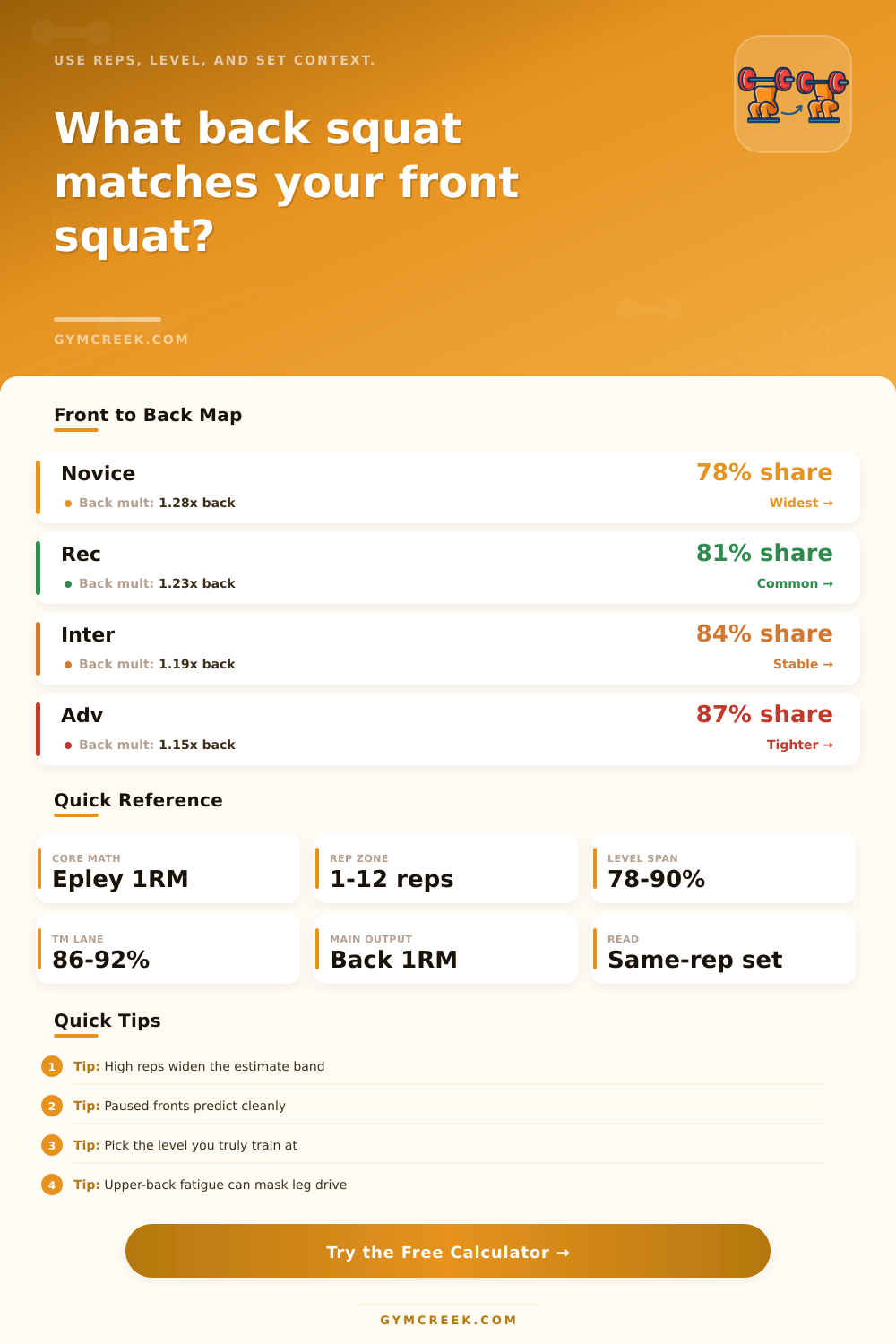
| New to squatting | 78% | 1.28x | Usually the widest gap. |
| Recreational strength | 81% | 1.23x | Common gym baseline. |
| Intermediate barbell | 84% | 1.19x | Stable bracing and rhythm. |
| Advanced bracing | 87% | 1.15x | Closer front to back transfer. |
| Front squat specialist | 90% | 1.11x | Weightlifting-biased profile. |
| Context | 1RM Trim | Share Shift | Use |
|---|---|---|---|
| Near-max 1-2 | 1.005x | +1.0% | Tightest read. |
| Clean 3-5 | 1.000x | 0.0% | Best baseline. |
| Volume 6-8 | 0.992x | -0.8% | Fatigue widens spread. |
| Grindy 9+ | 0.985x | -1.5% | Use more caution. |
| Paused strict | 1.008x | +0.6% | Cleaner positions. |
| Lane | Men | Women | Read |
|---|---|---|---|
| Base | Under 1.00x | Under 0.80x | Early strength build. |
| Solid | 1.00-1.34x | 0.80-1.14x | Good recreational squat. |
| Strong | 1.35-1.74x | 1.15-1.44x | Advanced gym range. |
| High | 1.75x+ | 1.45x+ | Plan loads carefully. |
| Snapshot | Front Set | Likely Back | Context |
|---|---|---|---|
| General lifter | 225 x 5 | 275-290 | Clean 3-5 |
| Field athlete | 245 x 3 | 295-310 | Near-max 1-2 |
| Tall build | 205 x 8 | 255-275 | Volume 6-8 |
| Weightlifter | 110 kg x 6 | 122-128 kg | Paused strict |
| Step | Formula | Purpose | Read |
|---|---|---|---|
| Front 1RM | Load x (1 + reps/30) | Epley estimate | Rep math base. |
| Context trim | Front 1RM x factor | Set quality lens | Strict vs grindy. |
| Back 1RM | Front 1RM / share | Transfer estimate | Level coefficient core. |
| Same-rep set | Back 1RM / (1 + reps/30) | Equal rep target | Programming use. |
| Training max | Back 1RM x 86-92% | Goal-based TM | Planning buffer. |
💡Transfer Tips
A front squat and a back squat is two different exercise. The strength use in a front squat does not necessarily have to be the same as the strength used in a back squat. Many lifter want to know the relationship between the two squat exercises, specifically, what relationship exist between the weight that an individual can lift in a back squat based off the weight that they can lift in a front squat.
While it is possible to use a front squat to provide an estimate as to the strength that an individual can produce during a back squat exercise, the squat exercises employ different type of mechanics. For instance, in a front squat, an individual must maintain an upright torso and high elbows. In addition, the front squat place more emphasis upon the strength of the quadriceps and core muscle of the lifter.
How Front Squat Shows Back Squat Strength
In contrast, an individual can allow the bar to rest on their traps when performing a back squat exercise, and their torso can tilt forward towards their legs to allow the glutes and hamstrings to contributes to the squat movement. Because more of the posterior (non-quadriceps) muscles of the body is utilized during a back squat exercise, an individual can typically lift more weight during back squat exercises than during front squat exercises. The difference between the two squat exercises can also relate to the training level of the individual that are performing those squats.
New lifter often find larger gaps between their front squat and back squat strength because new lifters typically have weak upper backs and/or cores. A weak upper back will typically fail during a front squat exercise before the legs begin to tire. Experienced lifter and Olympic weight lifter typically have smaller gaps between their front and back squat strength because their upper backs are stronger and their cores are stronger.
For instance, a newcomer to weight lifting may only be able to front squat 80% of the weight that they are able back squat, but an experienced lifter may be able to front squat 90% of the weight that they are able back squat. Thus, an individuals training level can impact the ability to use a front squat to estimate back squat strength. An individual’s number of repetitions during squat exercises can also impact the relationship between front and back squat strength.
For instance, if an individual perform many repetitions during a front squat exercise, the individuals posture may fail before their legs fail, indicating that an estimate of back squat strength would not be as accurately. However, if an individual performs few squat exercises using the front squat (such as triples or fives), the front squat exercise may be a very accurate estimation of back squat strength. Paused front squats also indicate back squat strength because paused exercises require more control from the individual.
Thus, the number of repetitions that a lifter performs can impact the accuracy of the estimates regarding squat strength. An individual’s body composition also has an impact upon the relationship between front and back squat exercises. For instance, individuals that have long femurs or that are tall may find it more difficultly to perform a front squat exercise.
The long femurs make it more difficult for an individual to maintain an upright torso. Individuals with long femurs will typically exhibit a larger gap between front and back squat exercises than individuals with short femurs. Additionally, the activities that an individual perform each day, and the age of that individual, can also have an impact upon their strength and recovery from performing squat exercises.
For instance, if an individual is cutting body fat, they may have higher level of fatigue. An individuals body composition and activity level should also be taken into consideration when calculating squat strength. These estimated values of strength can be used to help an individual plan their training program.
For instance, if an individual calculates their estimated back squat one-repetition maximum (1RM), that calculated value can be used to determine the weight for sets of three or sets of five squats. For instance, if that individual calculates their back squat maximum, they can calculate that they should of perform a set of three squats at 93% of that calculated back squat maximum strength. By using the estimated back squat maximum, an individual can plan their training program based on their front squat performance.
Thus, these estimates can be used to avoid guesswork in the lifting program, and to ensure that the weights that the lifter lifts are appropriate to the goal of those lifting programs.