Adonis Index Calculator
Measure shoulder-to-waist ratio, check waist-to-height context, correct for tape posture, and see how far your current taper sits from practical or classic physique targets.
📌Taper Presets
These nine presets span office recomp, physique dieting, strength offseason, swimming, hybrid racing, stage-lean female prep, masters training, weight cuts, and metric-first tracking.
⚙Adonis Inputs
Adonis ratio and taper snapshot
Enter shoulder and waist numbers to see your current ratio, correction-adjusted band, and goal target.
📊Taper Metrics Grid
📑Reference Tables
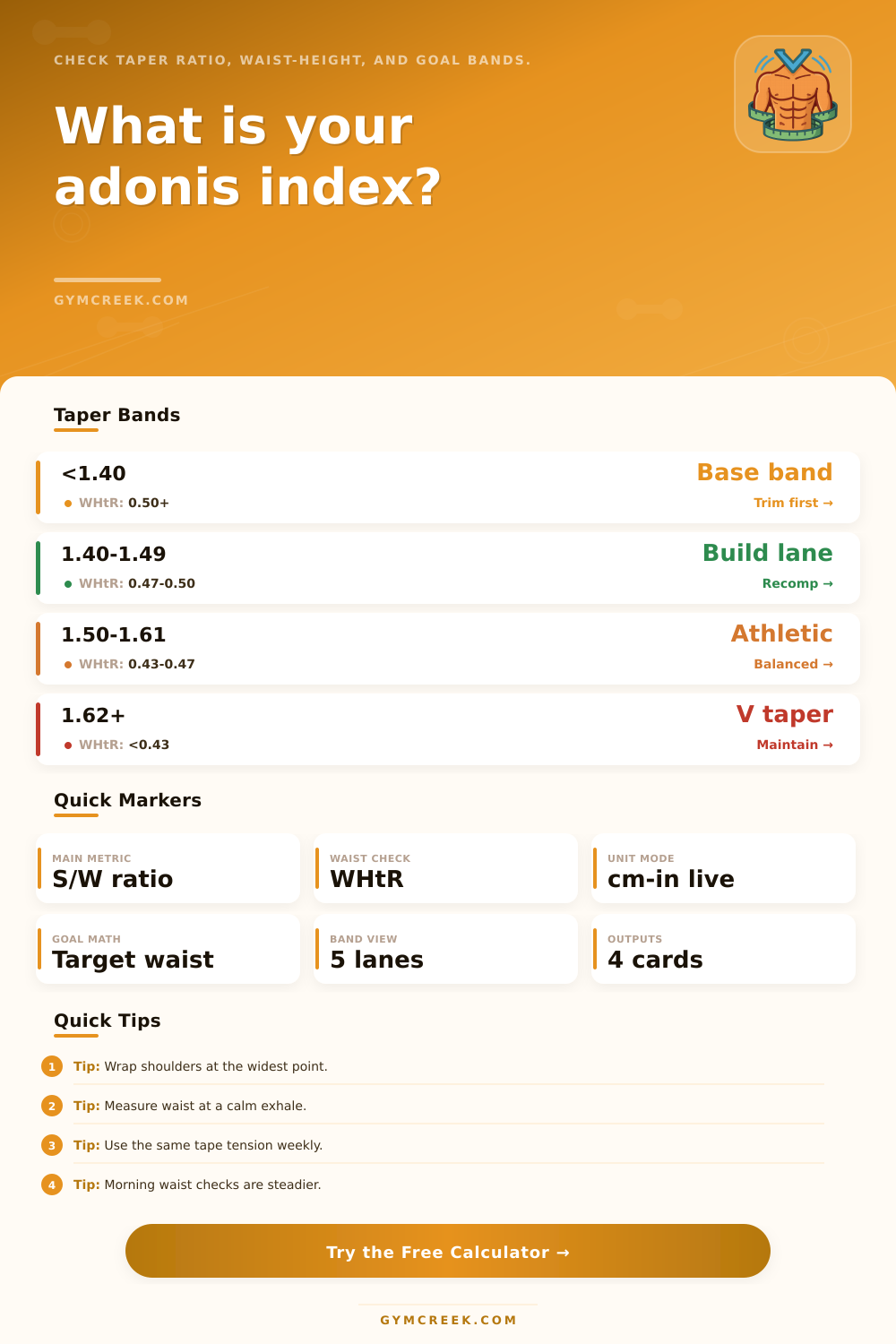
| Band | Men | Women | Read |
|---|---|---|---|
| Base | Under 1.40 | Under 1.28 | Minimal V taper |
| Build | 1.40 to 1.49 | 1.28 to 1.37 | Developing shoulder contrast |
| Athletic | 1.50 to 1.59 | 1.38 to 1.47 | Balanced athletic look |
| Classic | 1.60 to 1.67 | 1.48 to 1.55 | Pronounced taper lane |
| Dramatic | 1.68+ | 1.56+ | Very strong shoulder contrast |
| WHtR | Context | Common read | Priority |
|---|---|---|---|
| Under 0.43 | Very trim | Lean waist anchor | Protect muscle |
| 0.43 to 0.47 | Athletic | Strong physique window | Balanced recomp |
| 0.48 to 0.50 | Average | Taper can improve quickly | Waist cleanup |
| Over 0.50 | Higher waist | Ratio usually waist-limited | Trim first |
| Scenario | Ratio | WHtR | Typical note |
|---|---|---|---|
| Office recomp | 1.40 to 1.50 | 0.47 to 0.52 | Waist loss moves the needle fastest |
| Field sport build | 1.48 to 1.60 | 0.44 to 0.49 | Shoulders and torso both carry mass |
| Physique cut | 1.58 to 1.70 | 0.40 to 0.46 | Small waist swings change stage look |
| Endurance frame | 1.36 to 1.48 | 0.42 to 0.47 | Shoulder size is the slower lever |
| Metric | Formula | Uses | Why it matters |
|---|---|---|---|
| Adonis index | Shoulder / Waist | Primary ratio | Main V-taper comparison |
| Waist-height | Waist / Height | Secondary ratio | Adds health and leanness context |
| Shoulder-height | Shoulder / Height | Frame context | Separates tall and short builds |
| Target waist | Shoulder / Goal ratio | Goal output | Shows waist needed at the chosen look |
| Target shoulder | Waist x Goal ratio | Goal output | Shows shoulder size needed at the chosen look |
💡Practical Tips
The shoulder to waist ratio is a measurement of the ratio of a persons shoulder width to there waist width. This ratio are often used to identify if an individual has a V shaped physique. V-shaped physiques has broad shoulders and a narrow waist.
Furthermore, an individual can use the ratio as a means of understanding their body composition. To calculate the ratio of an individuals shoulders to their waist, the individual will need to take both of these body measurements. The individual should use a tape measure to measure the widest part of their shoulders, from the deltoid to the latissimus dorsi muscles.
How to Measure and Improve Your Shoulder to Waist Ratio
The individual should measure the waist at the level of the navel while they is exhaling. This ratio is calculated by dividing the individuals shoulder width by their waist width. For example, men often aim for a ratio of 1.6 or higher, while women aims for a ratio between 1.4 and 1.5.
The individuals body posture can often greatly impact the accuracy of these measurements. For example, if an individual flexes or sucks in their stomach, their ratio will be inaccurate. Similarly, if an individual slouches while measuring their waist or shoulder, their ratio will again be inaccurate.
Therefore, individuals should maintain the same posture and use the same measuring technique each week. Consistently measuring the body will allow individuals to track any change in their body composition over time. Height is another factor that relates to body composition.
The waist-to-height ratio can be used to measure an individuals health. If an individual have a waist-to-height ratio of 0.5 or higher, they may need to reduce their body fat. In addition, taller individuals may look different at the same ratio than individuals with shorter statures.
Thus, height is another factor that must be considered in the use of the shoulder-to-waist ratio calculation. Based off the ratio of an individuals body fat percentage to their shoulder-to-waist ratio, individuals can determine the focus of their strength and endurance training program. For individuals with a high body fat percentage, reducing their waist is the best way to increase their shoulder-to-waist ratio.
This is due to the fact that reducing their waist will lead to a higher ratio as a result of the division of these two values. Additionally, building the muscles of the shoulders will lead to an increase in the ratio, but it will take longer to achieve the same results then reducing the waist. Thus, individuals looking to increase their ratio can focus on either reducing their waist measurements or increasing the size of their shoulder muscles.
The individual should not focus upon achieving a certain ratio without considering there body composition. For instance, there body may exhibit a high ratio of shoulders to waist, but have a high waist-to-height ratio. Individuals with a waist-to-height ratio of 0.50 or higher should focus upon reducing the fat around their waist.
Individual with a waist-to-height ratio of under 0.43 is considered to be very trim in relation to the majority of individuals. These ratios should be tracked each month, rather than daily. Based upon these ratios, individuals can create the focus of their training program.
For instance, individuals can input their measurements into a tracking system. Furthermore, individuals can determine their body band and select the lever that will best improve their body composition. For instance, if the waist-to-height ratio is high, the waist is the most best area to focus upon.
Conversely, if the waist-to-height ratio is low, building the shoulders is the best lever to focus upon. Thus, by focusing upon the correct part of the body, the individual can increase their shoulder-to-waist ratio and their overall physical appearance. They should of tracked these measurements more regulary.
It would of been better to use moddern tools to recieve more accurate results.