Shimano Crank Length Calculator
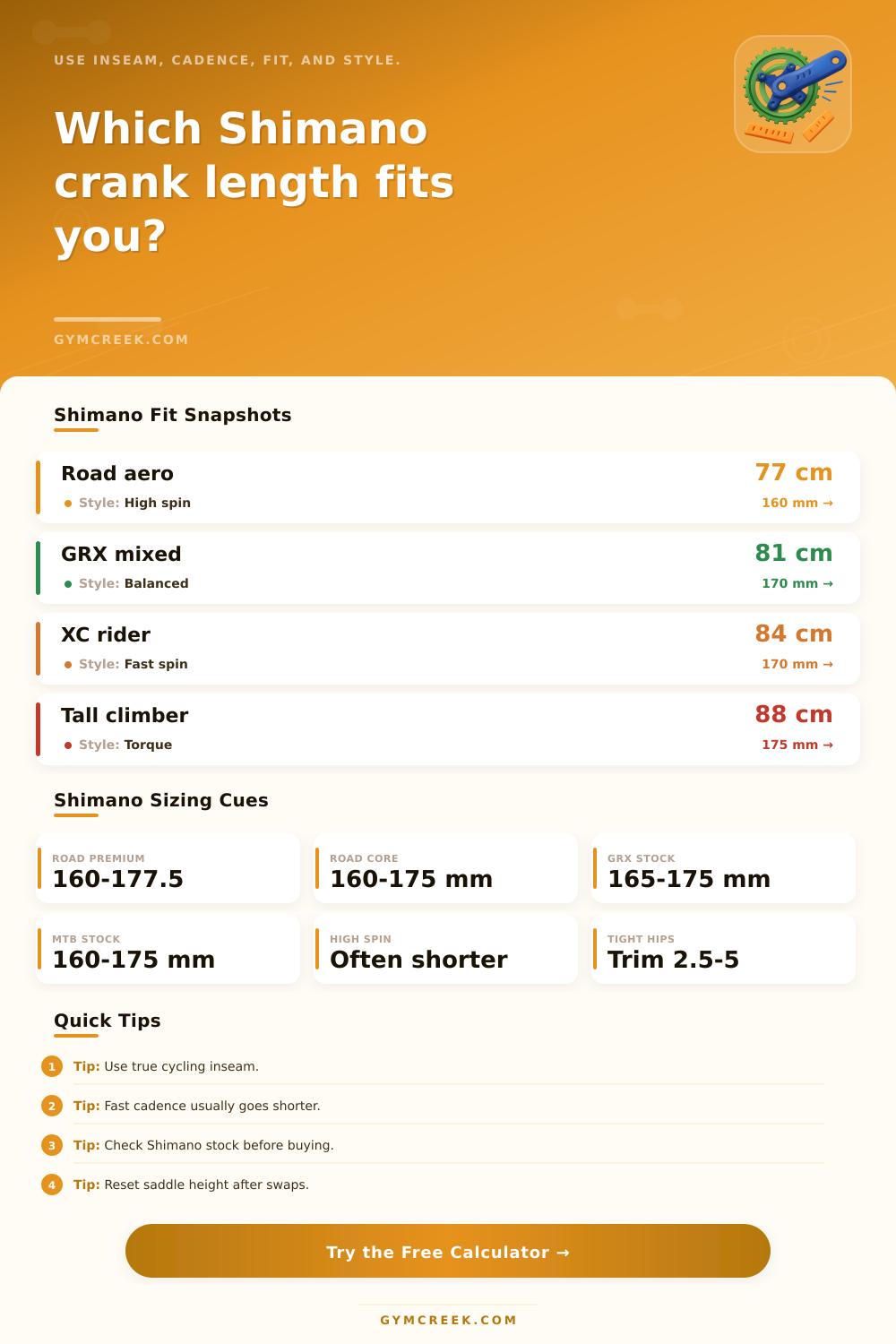
Start with inseam, then var Shimano family, riding discipline, cadence preference, power style, and fit limits push the number toward a crank length you can actually buy and ride comfortably.
Shimano Presets
These presets mirror real Shimano use cases across road, gravel, XC, trail, e-bike, track, and commuting so the result stays grounded in available stock lengths instead of a generic fit chart.
Shimano Fit Inputs
Shimano crank recommendation
Enter rider details to estimate a practical Shimano crank length.
Shimano Metrics Grid
Reference Tables
| Family | Lengths | Bias | Use |
|---|---|---|---|
| Dura-Ace road premium | 160-177.5 | Broadest road range | Aero, race, fit-driven road |
| Ultegra / 105 road core | 160-175 | Main road stock | Endurance, race, fondo |
| GRX gravel | 165-175 | No 160 or 167.5 in most builds | Mixed terrain and gravel |
| XT / SLX / MTB | 160-175 | Clearance-minded | XC, trail, technical MTB |
| E-MTB crank arm set | 160-175 | Shorter is common | Torque with ground clearance |
| Inseam | Baseline | Often tests | Read |
|---|---|---|---|
| 74-78 cm | 159-168 mm | 160-165 mm | Shorter road and gravel riders |
| 79-83 cm | 170-178 mm | 165-172.5 mm | Most adult stock fits sit here |
| 84-88 cm | 181-189 mm | 170-175 mm | Tall riders still get stock-capped |
| 89-93 cm | 191-200 mm | 172.5-177.5 mm | Very tall riders need stock reality |
| Context | Shorter cue | Longer cue | Why |
|---|---|---|---|
| Discipline | Tri, gravel, trail | Track, long climbs | Hip room and clearance change demand |
| Cadence | 90+ rpm | Below 80 rpm | Fast turnover favors less leg travel |
| Power style | Spinner | Sprinter or stomper | Torque riders accept more lever |
| Posture | Low cockpit | Upright fit | Top-of-stroke space shifts the call |
| Constraint | Typical trim | Main reason | First check |
|---|---|---|---|
| Tight hips | -5 mm | Opens hip angle | Top of stroke comfort |
| Front knee discomfort | -2.5 mm | Reduces knee compression | Seated threshold feel |
| Pedal clearance need | -5 mm | Fewer strikes and cleaner timing | Corner or trail timing |
| Back or hamstring tension | -2.5 mm | Calms extension load | Saddle height reset |
Fit Tips
Crank length are the measurement from the center of the bottom bracket to the center of the pedal spindle. Crank length impacts the way a person move there legs on the bike. Additionally, crank length also impacts the angle of a persons hips and knees.
If the crank length is too long for a person, it may result in discomfort for that individual at their hips or knees due to the angles created by the long crank length. However, if the crank length is too short, it could result in a loss of leverage from the legs, but may allow a person to increase there cadence. Most individuals simply use the crank length that is pre-installed on there bicycle.
How to Choose the Right Crank Length
However, the length that is pre-installed may not be the best length for each individual. One of the factor to consider for individuals is their inseam length. An inseam length is the measurement of an individual from there floor to there crotch bone.
This measurement is one of the primary measurements of what is the best length for a persons crank length. For individuals with shorter inches, such as those under 78 cm in length, using a crank length of 160 or 165 mm will allow for better hip clearance when cycling. For those with a longer inseam length, such as those over 84 cm, a crank length of 175 mm may be more appropriate.
To calculate the baseline length for a persons crank length, an individual can multiply their inseam length by 2.15. However, an individual must also consider there cycling discipline. Individuals in different cycling disciplines may require different lengths for their crank.
For example, gravel and triathlon riders may require shorter crank length to allow for more ground clearance with there bike and an open angle of their hips. In contrast, those who race on the track may require crank lengths that provide more leverage for the riders legs when sprinting. Additionally, an individuals preferred cadence may also play a role in there crank length.
An individual who prefers a high cadence may find more comfort and easy with a shorter crank length. If a cyclist prefers a low cadence and high torque output, they may benefit from a longer crank length due to the increased leverage that longer cranks provide. Shimano produces various crank lengths.
However, they does not produce every possible crank length in the market. Shimano produces crank lengths in increments of 2.5 mm or 5 mm. Based off the specific needs of an individual, a person can choose the best crank length for themselves.
For instance, Shimano offers road bike cranks that go as long as 177.5 mm. However, there mountain bikes and e-bikes dont go beyond 175 mm. A persons saddle height must be adjusted whenever they change there crank length.
This is because changing the crank length alters the distance between there pedal and there saddle when they are at the lowest point in there leg extension. Installing a shorter crank requires the rider to raise the saddle. However, installing a longer crank length requires the rider to lower the saddle.
Therefore, whenever a person changes the length of there crank, they must re-measure there saddle height to ensure that there hips and knees dont suffer from pain. Before a person purchase a crank of a preferred length, they must test it out. They can either borrow or purchase used bicycle components of different crank lengths to test how they affect there cycling.
When cycling with a newly tested crank length, pay attention to whether their hips or knees begin to feel uncomfortable. If a person feels that there hips are pinching at the top of there pedal stroke, they may need to purchase a shorter crank length. Alternatively, if there crank strikes against the ground when they turn the bicycle, they may also need to purchase a crank of a shorter length.
By testing out different crank length, a person can find the most perfect length and comfort for there body.