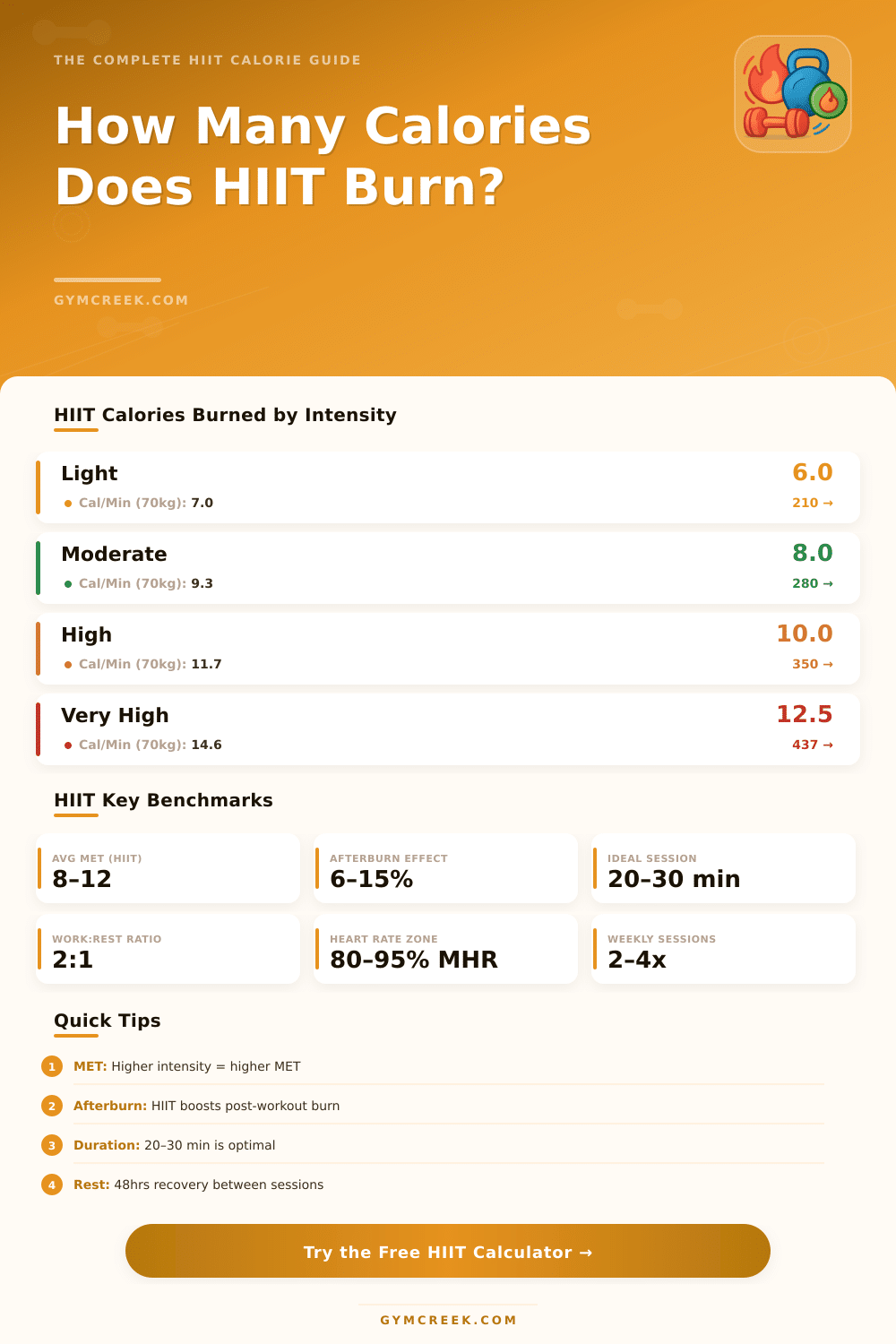
🔥 HIIT Workout Calorie Calculator
Estimate calories burned during High-Intensity Interval Training based on your body, intensity & duration
| HIIT Type | MET Value | Cal/Min (70kg) | Cal/Min (90kg) | Intensity |
|---|---|---|---|---|
| General HIIT (moderate) | 8.0 | 9.3 | 12.0 | Moderate |
| Tabata Protocol | 10.0 | 11.7 | 15.0 | High |
| Sprint Intervals | 11.0 | 12.8 | 16.5 | Very High |
| Cycling HIIT | 9.5 | 11.1 | 14.3 | High |
| Bodyweight HIIT | 7.5 | 8.8 | 11.3 | Moderate |
| Rowing HIIT | 10.5 | 12.3 | 15.8 | Very High |
| Jump Rope HIIT | 11.0 | 12.8 | 16.5 | Very High |
| Boxing / Kickboxing | 9.0 | 10.5 | 13.5 | High |
| Easy Active Recovery | 6.0 | 7.0 | 9.0 | Light |
| Max Effort HIIT | 12.5 | 14.6 | 18.8 | Extreme |
| Duration | 130 lbs (59kg) | 155 lbs (70kg) | 185 lbs (84kg) | 220 lbs (100kg) |
|---|---|---|---|---|
| 15 minutes | 120–160 | 145–195 | 175–235 | 210–280 |
| 20 minutes | 160–220 | 195–260 | 235–310 | 280–370 |
| 30 minutes | 240–330 | 290–390 | 350–470 | 420–560 |
| 45 minutes | 360–490 | 430–585 | 520–700 | 620–835 |
| 60 minutes | 480–650 | 575–780 | 690–935 | 825–1120 |
| Intensity | EPOC Duration | Extra Cal Burned | Total Boost | Best For |
|---|---|---|---|---|
| Light HIIT | 30–60 min | ~30–50 kcal | ~6% extra | Beginners |
| Moderate HIIT | 1–3 hours | ~50–100 kcal | ~8–10% extra | Intermediate |
| High Intensity | 3–12 hours | ~100–180 kcal | ~12% extra | Advanced |
| Extreme / Max | Up to 24 hours | ~150–250 kcal | ~15% extra | Athletes |
✅ Intensity rating: If you can hold a conversation easily, that is light. If you can only speak a few words, that is high intensity.
✅ Heart rate monitors: Wearing a chest strap HR monitor during HIIT gives calorie data 10–20% more accurate than wrist-based trackers.
✅ EPOC note: The afterburn effect is included in this calculator. It represents additional calories burned in the hours post-workout.
High-intensity interval training, or HIIT, is one of the most popular form of exercise for good reason. It burns a significant amount of calories in less time compared to other forms of exercise.
Understanding the calories burned during a HIIT workout can be challenging. The factors that determine the number of calories burned includes body weight, age, fitness level, the length of the workout, and the intensity put into the workout. A HIIT workout calorie calculator can make it easier to understand how many calories a person will burn during different types of workout.
Maximizing Results with a HIIT Workout Calorie Calculator
How HIIT Burns CaloriesHIIT workouts burn calories through high expenditure during the exercise and the afterburn effect on the metabolism. During intervals, the body utilize aerobic and anaerobic systems. These systems use alot of the bodys energy and cause the heart to work hard to pump the blood to the muscles.
The calories burned during the exercise continue to contribute to the bodys calorie expenditure even after the exercise. During this afterburn effect, the body burns extra oxygen to return to it’s resting state. This process can burn 6 to 15% more calories during a HIIT session compared to other forms of exercise. Many people dont account for this and the calories burned during recovery.
HIIT workouts burn the same number of calories as steady exercises but take up less time. For individuals who may not have a lot of time to commit to fitness, HIIT workouts work better for them. HIIT workouts require individuals of all weights and ages to reach high heart rate during work intervals. These work intervals last between 80 and 95% of an individuals maximum heart rate. This ensures that the body burns a lot of calories.
Individual characteristics affect the number of calories burned during these sessions. Individuals who weigh more will burn more calories during a HIIT workout. This is because individuals have to move a lot of body mass during the exercises. Individuals who are younger typically have higher metabolisms to burn more calories than individuals who are of the older age group. Individuals who have more muscle mass will burn more calories during a HIIT session as muscle tissue burn more calories than fat. Beginners will burn fewer calories during their first HIIT workout as their body isnt yet used to the effort required to perform these exercises as well as an athlete who perform HIIT on a regular basis.
The type of HIIT exercises will burn a different amount of calories. For example, sprint intervals on a track or treadmill will burn more calories than bodyweight exercises. Cycling sessions will work well and place less stress on the joints. Jumping on the spot on a jump rope will burn more calories than cycling. Tabata workouts will burn a significant amount of calories in 4 minutes of exercise but can be repeated for longer sessions.
The afterburn effect on HIIT workouts makes these workouts ideal for individuals looking to lose fat. Moderate exercises will burn the calories while performing the exercise. However, HIIT workouts will continue to burn calories for up to 24 hours. This makes it ideal for individuals to perform the workouts and then continue to work or even sleep.
HIIT workouts that focus on high intensity will work the heart in specific zones. Zones 4 and 5 that burn the most calories require an individual to work at an anaerobic threshold and maximum effort. Warm-up and recovery exercises for HIIT workouts will be in lower zones to allow the body to warm up and recover for the workout. Find the right balance to allow individuals to perform these workouts regularly without getting hurt.
Individuals must include proper nutrition and recovery after a HIIT workout session. Consuming enough protein will help individuals lose weight as it will preserve their muscle mass. Proper sleep and stress management will allow the body to recover after a HIIT session.
Individuals who enjoy performing HIIT workouts can use a HIIT workout calorie calculator to compare the calories burned from various types of workouts. For instance, a bodyweight workout could burn as many calories as a run of 45 minutes. This will aid in scheduling workouts and ensuring that an individual does not undertrain or overtrain.
The numbers shown on a calorie calculator are estimates. Individuals have different metabolisms due to genetics and other health factors. These estimates can help an individual to track the calories burned during workouts over time. They can also help an individual to adjust the intensity of their workouts if they burn fewer calories than they expect.
HIIT workouts are ideal for individuals who are very busy. These workouts will give them the best result in the least amount of time. The variety of exercises also ensures that individuals dont get bored of their workouts.
As one of the tools that can be used to maximize the benefits of exercise, a HIIT workout calorie calculator can help individuals achieve their fitness goals. Combine this tool with the proper body techniques for the exercises to get the best results from a HIIT routine. Whether an individual wants to burn fat, improve their athletic performance, or just feel better overall, knowing the calories that a person burns while performing HIIT exercises will aid in the preparation of an effective training plan specifically for them. You should of used a calculator more often to see teh difference.