💪 Lean Body Mass Index (LBMI) Calculator
Calculate LBMI, LBM, and compare to standard BMI — the smarter metric for athletes
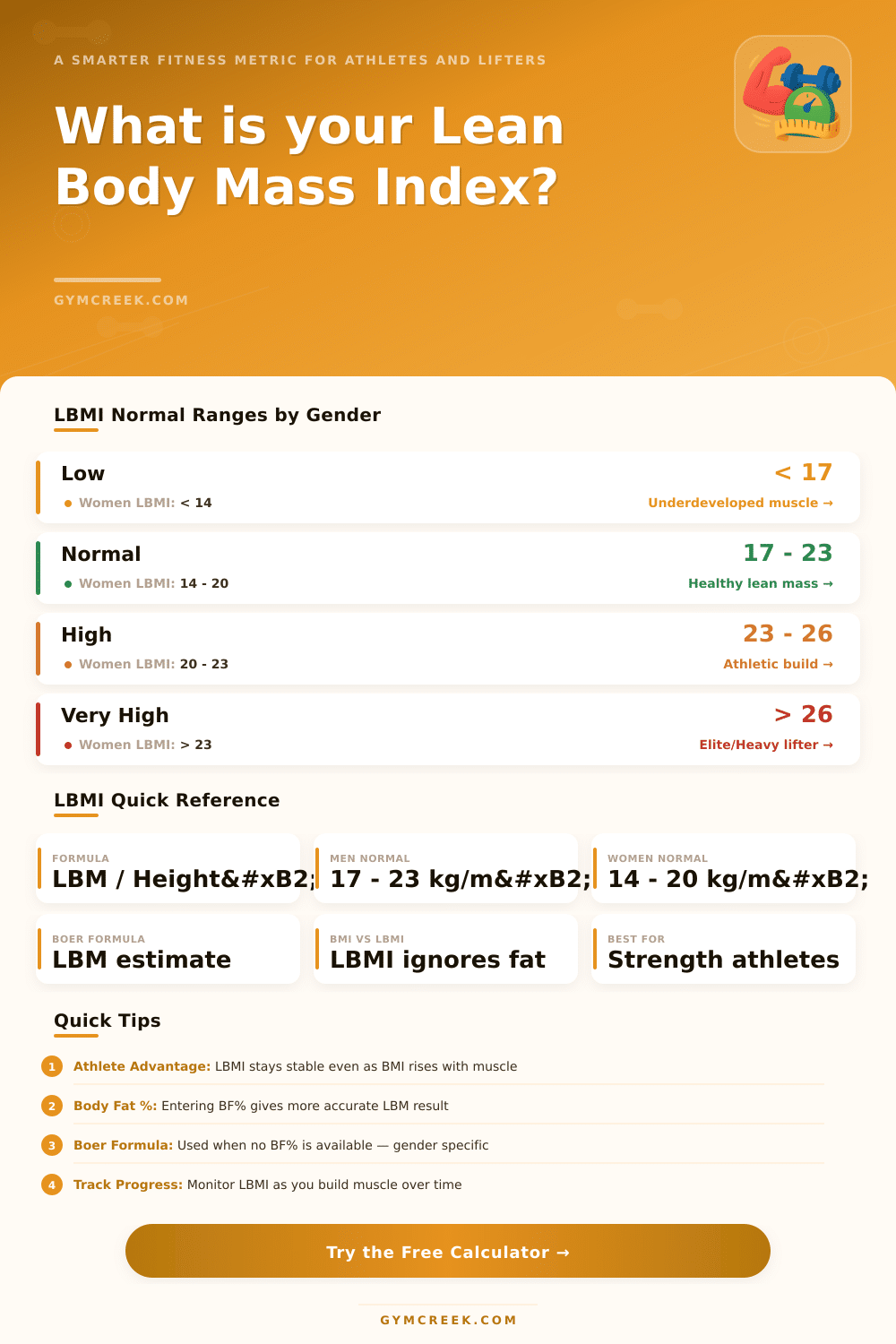
| Category | Men LBMI (kg/m²) | Women LBMI (kg/m²) | Interpretation |
|---|---|---|---|
| Low | < 17 | < 14 | Underdeveloped lean mass |
| Normal Low | 17 – 19 | 14 – 16 | Average lean mass |
| Normal | 19 – 23 | 16 – 20 | Healthy lean mass |
| Athletic | 23 – 26 | 20 – 23 | Well-developed musculature |
| Very Athletic | > 26 | > 23 | Elite strength athlete level |
| Metric | Formula | Includes Fat? | Best For |
|---|---|---|---|
| BMI | Weight / Height² | Yes | General population screening |
| LBMI | LBM / Height² | No | Athletes and strength trainers |
| BMI Limitation | Same formula | Yes | Flags muscular people as overweight |
| LBMI Advantage | Uses LBM only | No | Tracks muscle gains accurately |
| Who needs LBMI | — | — | Powerlifters, bodybuilders, CrossFit |
Lean body mass is made up of everything in your body that does not belong to fat. It includes your muscles, bones, organs, blood, skin and water. Remove all the fat from your whole body weight, and what stays is your lean body mass.
Two people can have exactly the same weight, but look entirely different. Everything deals about the makeup of the body. The difference between lean body mass and body fat is the real cause here.
What Is Lean Body Mass and Why It Matters
A person with more lean mass and less fat looks more toned even if the scale shows the same number.
The standard range for lean body mass sits somewhere between 70% and 90% of your whole weight. Women commonly sit at the bottom end of that range. Looking only at what the scale says can really fool you, when you try to measure the real progress in your health.
Lean body mass opens a clearer view about what really happens in your body.
There is a real difference between lean body mass and fat free mass, although folks commonly use them the same way always. Fat free mass simply matches your whole weight minus the weight of fat. Lean body mass slightly differs, because it counts a bit of fat that naturally exists in your cell walls.
That confusion happens commonly, even in scientific articles.
Lean body mass does not match muscular mass. If weight does not come from fat tissue, it belongs to lean body mass, but muscles form only one part of that whole. Every muscle is lean by definition.
The phrase “lean muscle” commonly floats around in the gym world, but it does not have a real scientific base.
Various ways exist for measuring lean body mass. DEXA scans are very popular and cost somewhere between 50 and 60 dollars. On the other hand, both DEXA and Bod Pod devices come with there own error ranges.
Online calculators can also estimate your lean mass, using data like height, weight, waist and hip. You do not need a perfectly precise number to reach your health targets. More important is staying with the same measuring method and watching how your values move through time.
Protein needs directly relate to lean body mass. If you sit a lot, consider around 0.8 grams per kilo of lean body mass as a bare minimum. When you become more active, that reaches at least 1.2 grams per kilo.
Lose weight too quickly, and your body starts to burn muscle protein instead of fat. Slowly losing (maybe 1 to 2 pounds each week), keeps muscles safe and helps to build them during hardtraining.
You can indeed grow lean body mass without your whole weight changing. That means gaining muscle while losing fat at the same time, which leaves you looking more toned even if the scale almost does not move. Muscle takes up less space than fat, pound for pound.