🏋 Bulgarian Split Squat to Squat Calculator
Estimate your back squat 1RM from Bulgarian split squat performance, or find your BSS target weight from your squat max.
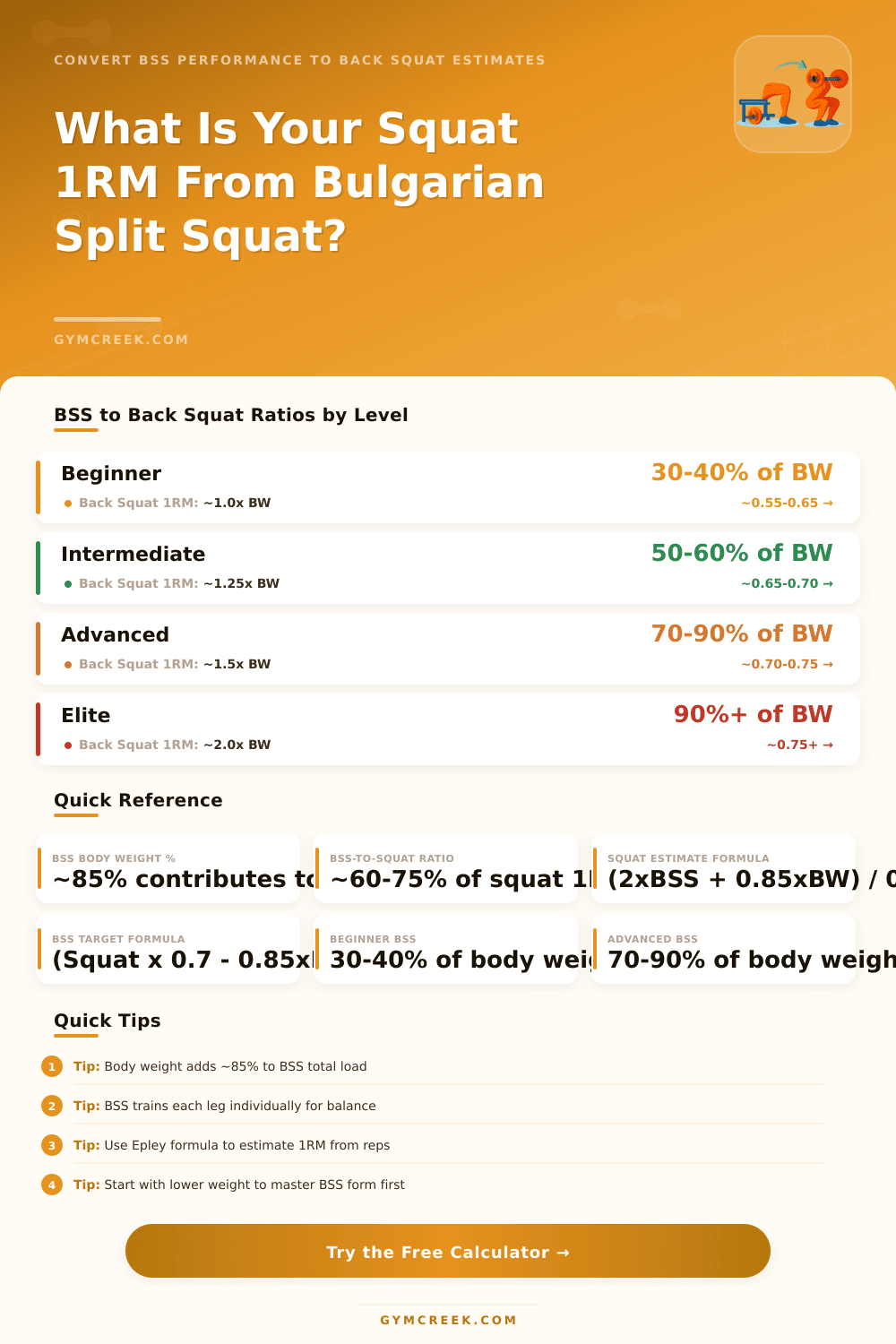
| Level | BSS Per Side (% BW) | Squat 1RM (xBW) | BSS/Squat Ratio | Example (180 lb athlete) |
|---|---|---|---|---|
| Beginner | 30-40% BW | ~0.8-1.0x BW | ~0.55-0.65 | BSS 54-72 lb / Squat 144-180 lb |
| Intermediate | 50-65% BW | ~1.1-1.3x BW | ~0.65-0.70 | BSS 90-117 lb / Squat 198-234 lb |
| Advanced | 70-85% BW | ~1.4-1.7x BW | ~0.70-0.75 | BSS 126-153 lb / Squat 252-306 lb |
| Elite | 90%+ BW | ~1.8-2.0x+ BW | ~0.75+ | BSS 162+ lb / Squat 324+ lb |
| Training Goal | BSS Weight (% Squat 1RM) | Rep Range | Notes |
|---|---|---|---|
| Strength | 50-60% | 3-5 reps | Heavy load, controlled tempo |
| Hypertrophy | 40-50% | 8-12 reps | Moderate load, full ROM |
| Endurance / Volume | 25-35% | 15-20 reps | Light load, high volume |
| Skill / Technique | 0-20% | 10-15 reps | Bodyweight or minimal load |
| Peaking / Testing | 60-70% | 1-3 reps | Near-max effort |
Bulgarian split squat is a kind of one-leg Squat, in that the back leg rests on a bench, strong chair, box or balance ball, during the front leg stays flat on the ground before. In short words, it mixes parts of a regular Squat and lunge. That exercise stresses more the quads than other moves for the lower body.
One also calls it rear foot raised Bulgarian split squat.
How to Do the Bulgarian Split Squat
This exercise is a combo move, not isolating. It trains the quads, glutes and tests the balance of the core. During the lowering phase, the hips bend, what gives great stretch to the glutes.
Later, the glutes work to extend the hips, during the leg helps to keep the weight up. It strengthens especially the gluteus maximus, that powerful hip extensor; that what helps to walk forward any direction at all.
Between 70 and 85 percent of the whole force goes through the front leg, according to the height of the platform for the back foot and the weight of the load. Low bench is enough for good work. No need to lay the foot on a high box for power.
The back foot does not need to be very high to receive the benefits. Raising the back foot to a stable surface at a distance of one foot off the floor is a useful change.
As a one-sided exercise, it wakes the stabilizing muscles of the core and the knees, what helps the balance and firmness. The side parts of the core receive bigger challenge than in normal two-leg Squat. It can correct muscle gaps in the legs for a nicer look.
When one leg is stronger then the other or one glute works more, adding Bulgarian split squat is a clear strategy.
That exercise is quite difficult. It ties demands of force, balance, flexibility and one-sided coordination in one single action. The balance commonly becomes the real challenge, and holding on to something with one hand helps for stability and for better muscle activity.
Choose the right distance from the bench is key, so that the front leg reaches parallel position when one drops.
Bulgarian split squat is a great exercise for the lower body, to grow the quads, force and size. One can do them in medium to high reps to build the whole leg size. The stronger someone does this exercise, the more quickly he runs and the more high he jumps.
It helps to improve the athletic performance in sports that involve jumping, change of directions, swimming and running. Push through the front foot during each rep, rise upward and keep the chest high are basics for good technique. Dumbbells, barbells in front or back position and kettlebells all work asloading weights.