🔥 BMR Calculator — Lean Body Mass
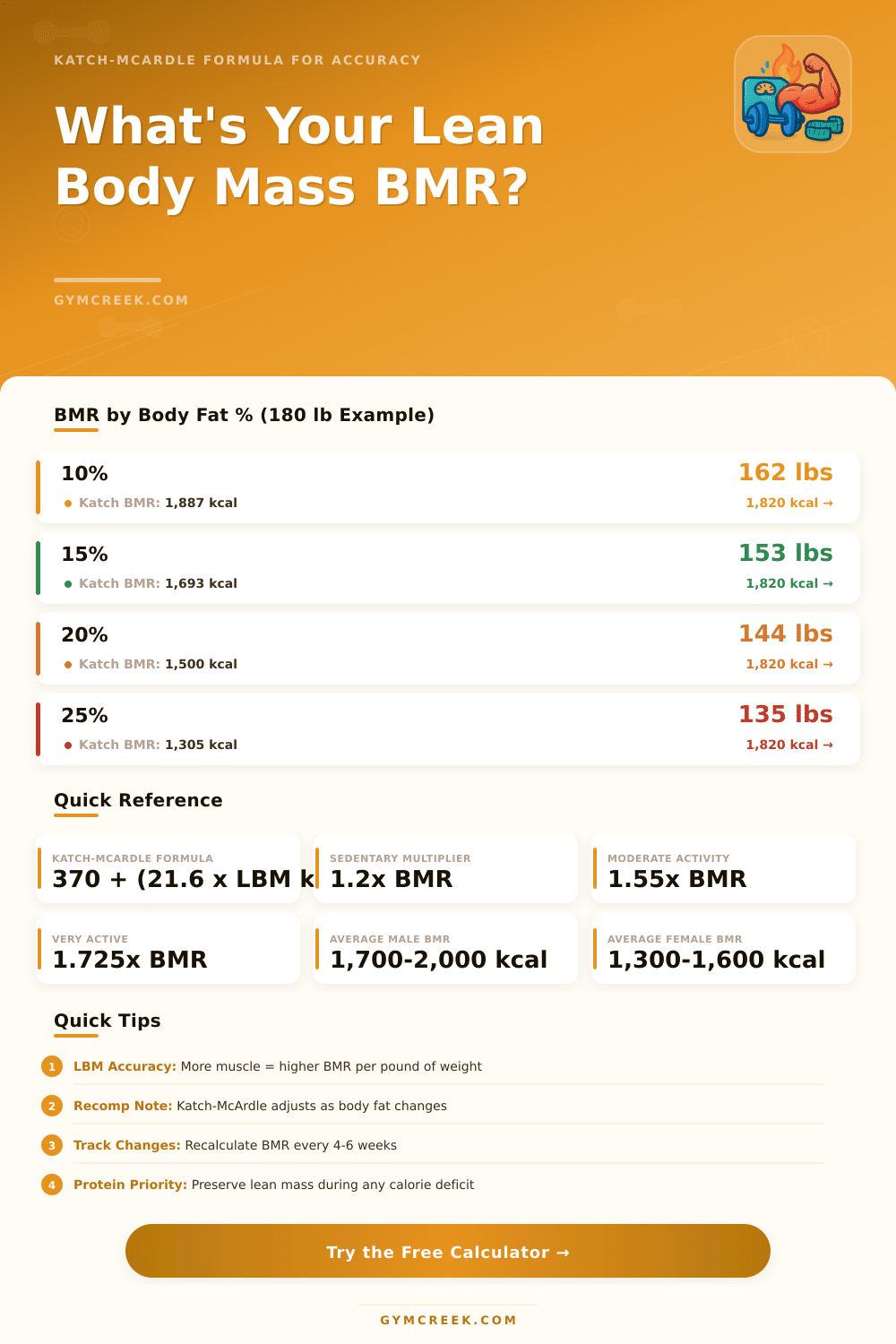
Katch-McArdle formula for the most accurate BMR using your lean body mass and body fat percentage
| Activity Level | Multiplier | Description | Example |
|---|---|---|---|
| Sedentary | 1.2× | Little or no exercise | Desk job, no gym |
| Lightly Active | 1.375× | Light exercise 1–3 days | Weekend walks, light gym |
| Moderately Active | 1.55× | Moderate exercise 3–5 days | Regular gym-goer |
| Very Active | 1.725× | Hard exercise 6–7 days | Daily training athlete |
| Extra Active | 1.9× | Very hard exercise + physical job | Competitive athlete, 2x/day |
| Body Fat % | Lean Mass (lbs) | Katch BMR | Mifflin BMR |
|---|---|---|---|
| 8% | 165.6 lbs | 1,988 kcal | 1,820 kcal |
| 12% | 158.4 lbs | 1,917 kcal | 1,820 kcal |
| 15% | 153.0 lbs | 1,863 kcal | 1,820 kcal |
| 20% | 144.0 lbs | 1,775 kcal | 1,820 kcal |
| 25% | 135.0 lbs | 1,686 kcal | 1,820 kcal |
| 30% | 126.0 lbs | 1,597 kcal | 1,820 kcal |
Your Basal Metabolic Rate. Or BMR for short, simply shows how many calories your body burns while you only sit around and do not do anything. That is the least energy that your body needs to keep everything running, like keeping the lights on.
All those basic processes that help you stay alive, breathing, pumping of blood, creation of new cells, checking of body heat hair growth and hormone production, they use calories all day, whether you walk outside or lie on the sofa.
What Is Your Basal Metabolic Rate (BMR)?
Sometimes you maybe will hear that people call BMR also resting metabolic rate or RMR, and honestly, most folks mix those words freely. Here the more scientific part: for a real BMR measure, they assume that you are in a neutral temperature setting and did not eat nothing for around 12 hours. Like this, if you would manage to sleep whole day without waking, the calories that you would burn in those 24 hours would almost match your BMR.
The main players for calorie burning is your brain, liver, kidneys and lungs. Those organs work constantly just so that you can function. Here something that surprises many folks: BMR makes up between 60 and 70 percent of all calories that you use daily.
It is a huge amount. And the amazing reason is that everything happens on its own, without you needing to think about it even won moment.
BMR and the whole everyday energy use, or TDEE, is not the same. TDEE includes your BMR, together with what you burn during exercises, and also the small moves through the day. To estimate your TDEE, you multiply your BMR by an activity number.
A couch potato could use 1.4. If you move quite a lot, probably it is near to 1.6. Athletes or very active people can reach up to 1.8, or even 2.0.
Various things change your BMR. Genes play a part… Some folks simply have faster metabolism naturally.
Men usually have bigger BMR, because they have more muscles and less body fat. Here the less happy part: after age 20, BMR tends to drop by around 1 to 2 percent each decade, mainly because of muscle loss and falling hormone levels. Sadly, that is not possible to fully escape.
Adding muscles helps to boost BMR, but the change stays small. Every kilo of muscle tissue only speeds up your metabolic rate by about 13 calories a day. Even if you gain 5 kilos, that only would add around 67 calories to your base burning.
Knowing about BMR details matters when you plan calorie targets. If you eat under your TDEE, you will lose weight. But if you cut calories too harshly and fall under your BMR?
Then your body starts breaking down muscle tissue for energy, which is not a good idea. Too harsh calorie cutting also pushes your body to slow its own metabolism. Online BMR calculators exist, but they are not perfect, metabolism varies a lot between people.
The best way is to track your weight during several weeks andadjust your food intake accordingly.