🏃 5K Running Pace Calculator
Calculate your pace, finish time, splits, and running zones for your next 5K race
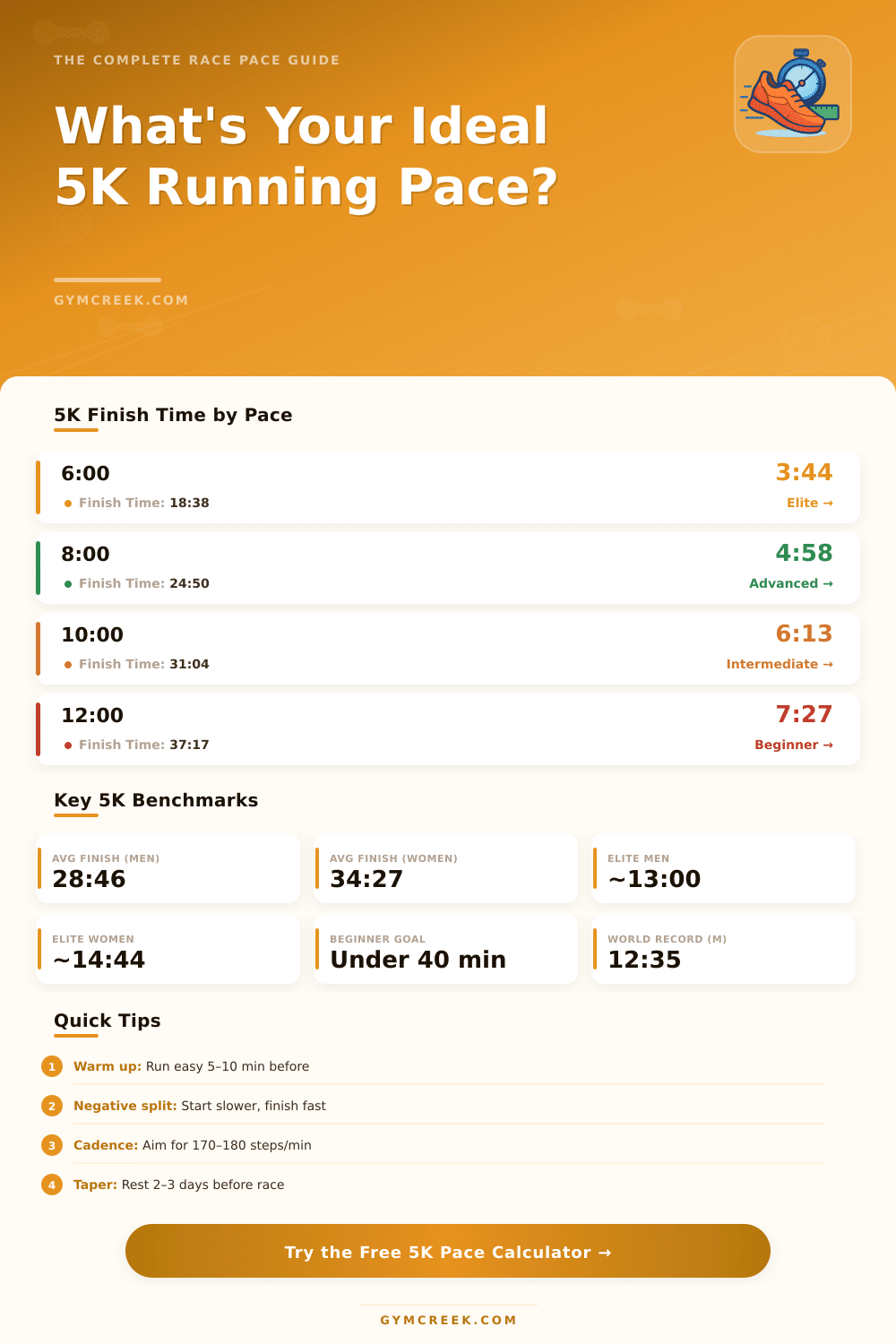
| Finish Time | Pace (min/mi) | Pace (min/km) | Speed (mph) | Runner Level |
|---|---|---|---|---|
| 15:00 | 4:50 | 3:00 | 12.4 | Elite |
| 17:00 | 5:29 | 3:24 | 10.9 | Elite |
| 19:00 | 6:08 | 3:48 | 9.8 | Advanced |
| 21:00 | 6:46 | 4:12 | 8.9 | Advanced |
| 23:00 | 7:25 | 4:36 | 8.1 | Intermediate |
| 25:00 | 8:03 | 5:00 | 7.5 | Intermediate |
| 28:00 | 9:02 | 5:36 | 6.6 | Average |
| 30:00 | 9:41 | 6:00 | 6.2 | Average |
| 35:00 | 11:17 | 7:00 | 5.3 | Casual |
| 40:00 | 12:52 | 8:00 | 4.7 | Beginner |
| 45:00 | 14:30 | 9:00 | 4.1 | Beginner |
| Zone | % Max HR | Purpose | Perceived Effort |
|---|---|---|---|
| Zone 1 — Easy | 50–60% | Warm-up, recovery | Very easy, conversational |
| Zone 2 — Aerobic | 60–70% | Base fitness, fat burn | Easy, can hold conversation |
| Zone 3 — Tempo | 70–80% | Aerobic endurance | Moderate, harder to talk |
| Zone 4 — Threshold | 80–90% | Race pace, lactate threshold | Hard, few words only |
| Zone 5 — Max | 90–100% | Speed, VO2 max | All-out, unsustainable |
| Age Group | Beginner | Average | Advanced | Elite |
|---|---|---|---|---|
| 18–24 | >40:00 | 28–35 min | 22–27 min | <18 min |
| 25–34 | >40:00 | 28–36 min | 22–28 min | <18 min |
| 35–44 | >42:00 | 30–38 min | 24–30 min | <20 min |
| 45–54 | >45:00 | 32–40 min | 26–33 min | <22 min |
| 55–64 | >48:00 | 35–44 min | 29–36 min | <25 min |
| 65+ | >55:00 | 38–50 min | 33–40 min | <28 min |
Intermediate time for distance is the duration that one requires for running a certain length. The main rule is easy: one shares the time by the run distance. Like this, if you require 30 minutes for 5K then the average pace is 6 minutes per kilometer.
Runners usually plan their training according to such pace and estimate whether they do well.
How to Work Out and Use Your Running Pace
pace does not match to simplicity. It deals about wise use of energy. If one starts too quickly in a contest, that can cause fast tiredness.
Start too slowly may hurt reaching your best result. The secret to finish strong is running the second part more quickly than teh first.
A calculator for pace helps to estimate speed, time or distance, when one knows two from those numbers. It also is useful for planning final times and setting pace for courses like 10 km., half marathon or full marathon. Charts show speed of running in kilometers and miles at the same time.
Various distances require different pace. A pace of 8:30 per mile for 5K equals around 8:50 for 10 km. And almost 9:10 for half marathon.
Running at 5K pace is almost without oxygen, while 10 km. Pace implies more steady effort of medium to high strength. Even sew those figures are not strict.
Add 10 or 20 seconds to pace for longer distances is entirely fair. Too fast running risks injury.
running at easy pace creates firm ground for harder training in the future. A runner can shift a bit from the intended easy pace, until 20 seconds per mile more slowly or quickly (on any day), and that is normal. The main point is feel relaxed and comfortable.
Pace for middle runs falls between limits, and a bit faster or slow changes work just as well.
For newcomers the focus should not go to too fast increase of pace or adding too many kilometers. Gains come naturally with time. Progress slowly, extending the main run by little steps each week, builds fitness.
Start by a mix of running and hiking is a good method. It matters more to choose such slow pace that one does not gasp entirely, than reach precise numbers too early.
About training amount it is more logical to think according to time than according to kilometers. A faster runner covers more way in an hour than a slow one. Both put in real work.
Slow pace allows to cover bigger distances, and over time the body adapts and gets stronger. Around 80 percent of training kilometers should happen at easy pace, while the other 20 percent goesto faster exercises.