❤️ Heart Rate Zone & Lactate Threshold Calculator
Calculate your personalized training zones using age, resting heart rate & fitness level
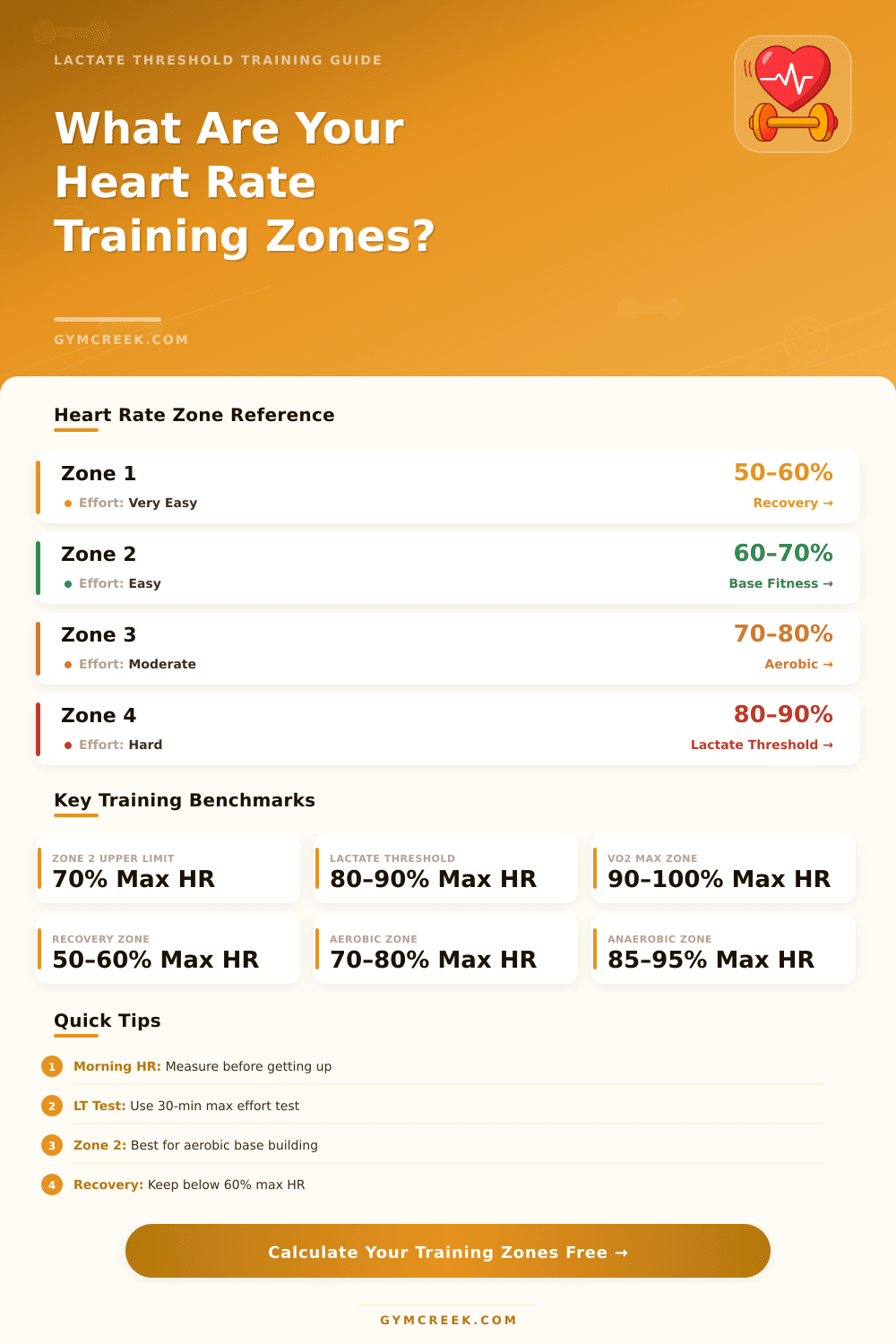
| Zone | Name | % Max HR | % HRR (Karvonen) | Perceived Effort | Primary Benefit | Typical Duration |
|---|---|---|---|---|---|---|
| Zone 1 | Recovery | 50–60% | 30–40% | Very easy — conversation easy | Active recovery, warm-up | 20–60 min |
| Zone 2 | Aerobic Base | 60–70% | 40–55% | Easy — can sing | Fat oxidation, aerobic base | 30 min–3 hrs |
| Zone 3 | Aerobic / Tempo | 70–80% | 55–70% | Moderate — short sentences | Aerobic efficiency, endurance | 20–90 min |
| Zone 4 | Lactate Threshold | 80–90% | 70–85% | Hard — words only | Raise LT, speed endurance | 10–50 min |
| Zone 5 | VO2 Max / Anaerobic | 90–100% | 85–100% | Maximum — unsustainable | VO2 max, speed, power | 30 sec–8 min |
| Fitness Level | LT as % Max HR | Typical RHR (bpm) | VO2 Max Estimate | Training Focus |
|---|---|---|---|---|
| Sedentary | 50–60% | 70–90 | 25–35 ml/kg/min | Zone 1–2 base building |
| Beginner | 60–70% | 65–80 | 35–45 ml/kg/min | Aerobic conditioning |
| Intermediate | 70–78% | 58–70 | 45–55 ml/kg/min | Zone 3–4 threshold work |
| Advanced | 78–85% | 50–65 | 55–65 ml/kg/min | LT intervals + polarized |
| Elite / Pro | 85–92% | 35–55 | 65–90+ ml/kg/min | Race-specific + VO2 max |
| Training Model | Zone 1–2 | Zone 3 | Zone 4–5 | Best For |
|---|---|---|---|---|
| 80/20 Polarized | 80% | 0% | 20% | Endurance athletes, runners |
| Pyramidal | 70% | 20% | 10% | Cyclists, triathletes |
| Threshold Model | 50% | 35% | 15% | Time-crunched athletes |
| High Volume Base | 90% | 8% | 2% | Beginners, base phase |
| HIIT Focused | 40% | 20% | 40% | Sprint, short events |
Talk Test: LT1 (aerobic threshold) is where conversation becomes uncomfortable. LT2 (anaerobic threshold) is where only 1–2 word answers are possible.
30-Minute Field Test: Warm up 10 min, then run/cycle at maximum sustainable effort for 30 minutes. Average HR over last 20 minutes = approximate LT2 heart rate.
RPE Scale: LT1 ≈ RPE 4–5/10; LT2 ≈ RPE 7–8/10.
Understanding how hard to train is one of the most important skill that an athlete can develop. While there are charts that show percentages of an athlete’s maximum heart rate that will guarantee the athlete burns calories, time to exhaustion, and various other metrics, none of those percentage take into account the individual physiology of each athlete. An athlete’s heart rate zone calculator lactate threshold allow an athlete to find accurate percentages based off their fitness level.
Heart rate zones is beneficial for athletes of any sport who wish to ensure that they are training at the apropriate intensity for their goal. Whether an individual is attempting to burn the most calories possible, increase their endurance, or just maintain their strength and stamina, training at an incorrect level will lead to either missed goals or physical fatigue. By training at the apropriate heart rate value according to an athlete’s lactate threshold, those athletes can develop the gains in strength, endurance, and speed that they require to dominate their sport.
Understanding Lactate Threshold Heart Rate Zones
What Is Lactate Threshold and Why Does It Matter?
An athlete’s lactate threshold is the rate at which an individual can produce energy from stored carbohydrate without utilizing oxygen (a process known as anaerobic metabolism). For endurance athletes, the higher an athlete’s lactate threshold as a percentage of their maximum heart rate, the longer that they can perform at maximum effort without fatigue. For individuals who are inactive of any sport, there lactate threshold may only be 55-65% of their maximum rate. For athletes who consistently perform high level of endurance activities, however, their lactate threshold can be 85% or more of their maximum heart rate. As such, an individual’s lactate threshold is a valuable indicator of their endurance as athletes with high thresholds can last longer without tiring from maximum effort.
Heart rate zone calculator ask athletes for a variety of factors that relate to the athlete’s physiology, such as they’re age, resting heart rate, and performance of other endurance metrics. These factor can help to develop formulas for athletes, such as the Tanaka formula, to calculate the athlete’s lactate threshold. More direct calculations of an athlete’s lactate threshold can also be performed by performing simple field tests. For instance, by performing a 30-minute time trial after a warm-up, and calculating the athlete’s average heart rate in the last 20 minutes of the timed trial, an athlete’s lactate threshold can be calculated. Additionally, an athlete can also use the “talk test” to determine lactate threshold; an athlete’s lactate threshold is reached when speaking becomes difficult and few words can be spoke at once.
According to the lactate threshold calculated by the athlete, an athlete can determine which portion of a 5-zone training plan to use. Zones 1 and 2 ensures that athletes gain the strength and endurance required for races of shorter distances by using primarily fat as fuel. Zone 3 focus upon endurance and improving an athlete’s ability to burn fat efficienty. Zone 4 trains athletes to improve their lactate threshold and increase the bodys ability to clear lactic acid. Zone 5 allow athletes to develop pure speed and VO2 max, the rate at which an athlete can utilize oxygen to produce energy.
The majority of coach recommend that athletes focus primarily upon Zones 1 and 2, the 80/20 rule for athletes suggests 80% of training efforts should be in Zones 1 and 2, while only 20% of training effort should be spent in Zones 3, 4, and 5. Studies have published the benefits of this training strategy for athletes of all levels, from the beginning to the most competitive end-of-year athlete in any particular sport.
An athlete’s resting heart rate is another critical metric to track for athletes of all levels. For athletes who are competing in endurance sports, their resting heart rate typically hover in the low 40s to the high 30s. Any increase in an athlete’s resting heart rate of 5 or 10 bpm can indicate any number of issue with the athlete, ranging from overtraining to the development of illness. Therefore, tracking both resting heart rate and heart rate variability (HRV) can help athletes to adjust their training efforts to allow for more or less intense training according to their physical state.
An athlete’s heart rate is also influenced by a variety of other factor outside of their physiology. Heart rates can increase due to dehydration, high temperatures, high altitudes, caffeine intake, and a variety of medication. For instance, athletes who use beta-blockers to even out their heart rates or treat high blood pressure may have significantly lower resting and maximum heart rate. In these cases, an athlete’s lactate threshold calculated through these formulas may not be accurate, and it is beneficial for athletes to know their own heart rate in these different condition.
Prolonged training within the “gray zone” of an athlete’s heart rate capacity leads to fatigue, injury, and stalled performance. By ensuring that athletes know how to train their bodies to remain easy runner on easy days, athletes can ensure that they feel the burn and develop adaptations from high intensities on the days when their bodies can handle such effort. Thus, training within the “gray zone” leads to the worst of both worlds for athletes… They do not experience the benefits of high intensities with low training efforts, but they also do not have the endurance to compete in high levels of competition.
As indicated in the calculator above, using an athlete’s fitness level and their primary sport allow for the production of zones that are more appropriate for their body and sport than the age-based calculations of their heart rate zones. Athletes in different sports has different thresholds for their lactate threshold. For instance, cyclists have different thresholds than runners, and masters athletes have different thresholds than younger competitor of the same sport.
Beyond the bodys physiology, athletes can utilize the calculated zones to guide the athlete in their training effort. While other factor like the athlete’s level of perceived exertion, talk test, and the power indicator for athletes in sports like cycling or skiing can help to validate or alter those zones, heart rate zones are created as a guide for athletes. Additionally, experienced athlete will have an understanding of the various zones that their body can train in after a period of time. Thus, an athlete’s lactate threshold zone calculator allow for athletes to develop such an understanding of their zones, with confidence and without prolonged trial-and-error effort.
Regardless of an athlete’s goal for their training efforts, understanding and training within their individual heart rate zones will transform their results according to their specific goal. By utilizing these parameter and calculating an athlete’s zones, athletes of all levels can begin to train in the appropriate zone according to their fitness level. As an athlete’s lactate threshold increase with time, effort, and focus on their goal, their easy pace can increase as well. Thus, by training within these zones, athletes will not only see improvement in their physical abilities, but also have confidence in the zones at which they are training.