❤ Heart Rate Zone Calculator
Karvonen Formula — Personalized training zones based on your Heart Rate Reserve
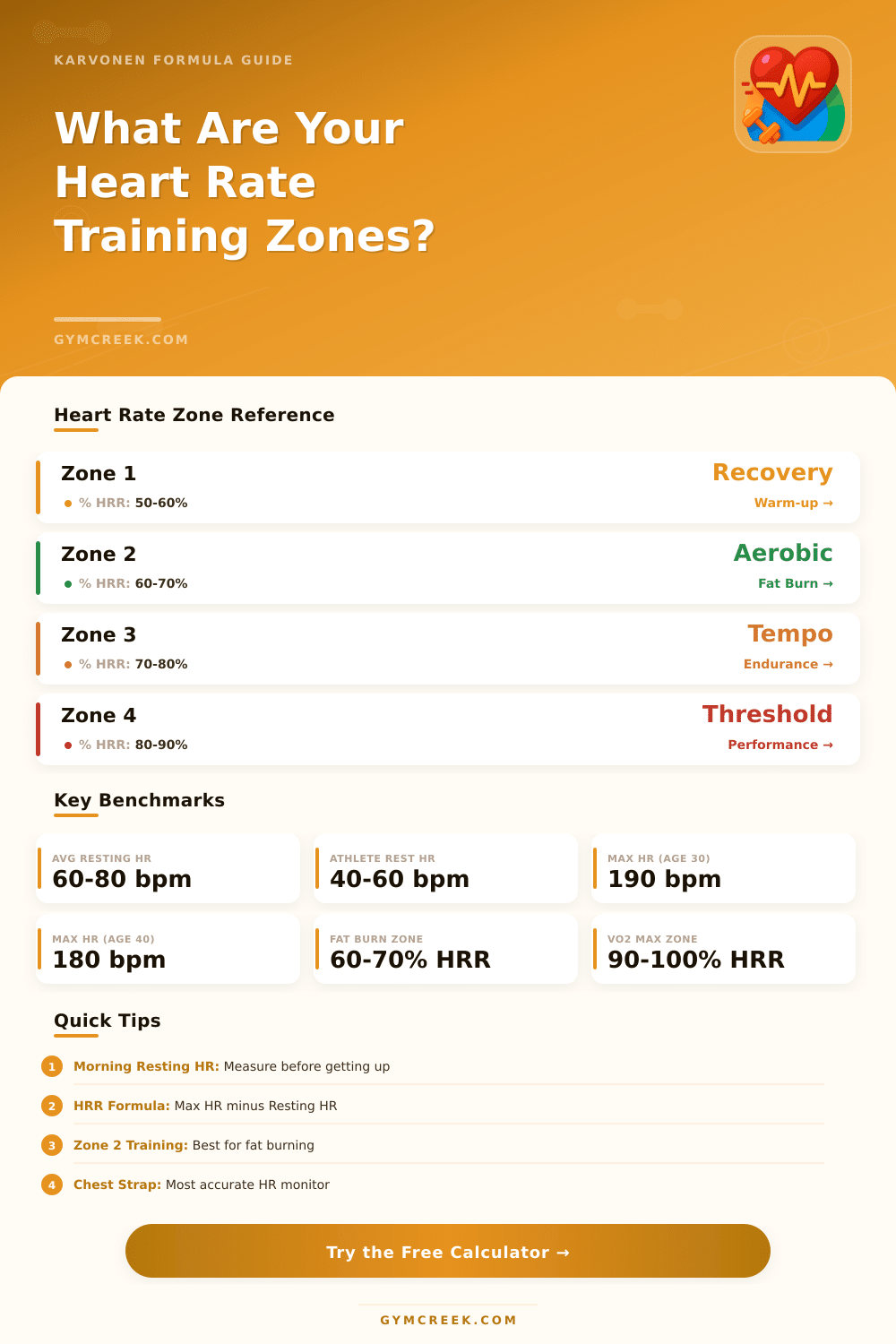
| Zone | Name | % of HRR | Intensity | Primary Benefit | Typical Duration |
|---|---|---|---|---|---|
| Zone 1 | Active Recovery | 50–60% | Very Light | Recovery, warm-up, cool-down | Any duration |
| Zone 2 | Aerobic / Fat Burn | 60–70% | Light–Moderate | Fat oxidation, aerobic base | 30–90+ min |
| Zone 3 | Aerobic Tempo | 70–80% | Moderate | Cardiovascular fitness, stamina | 20–60 min |
| Zone 4 | Lactate Threshold | 80–90% | Hard | Speed, performance, VO2max | 10–30 min |
| Zone 5 | VO2 Max / Red Line | 90–100% | Maximum | Peak power, anaerobic capacity | 30 sec – 5 min |
| Age Range | Poor (bpm) | Average (bpm) | Good (bpm) | Excellent (bpm) | Athlete (bpm) |
|---|---|---|---|---|---|
| 18–25 | > 82 | 70–82 | 62–69 | 56–61 | < 56 |
| 26–35 | > 82 | 71–82 | 63–70 | 57–62 | < 57 |
| 36–45 | > 84 | 72–84 | 64–71 | 58–63 | < 58 |
| 46–55 | > 84 | 73–84 | 65–72 | 59–64 | < 59 |
| 56–65 | > 84 | 72–84 | 64–71 | 58–63 | < 58 |
| 65+ | > 84 | 70–84 | 62–69 | 56–61 | < 56 |
| Goal | Zone 1-2 % | Zone 3 % | Zone 4-5 % | Recommended Weekly Sessions |
|---|---|---|---|---|
| Weight Loss | 60–70% | 20–25% | 10–15% | 4–5 sessions |
| Aerobic Base | 70–80% | 15–20% | 5–10% | 4–6 sessions |
| Endurance (80/20) | 75–80% | 5–10% | 15–20% | 5–7 sessions |
| HIIT / Performance | 50–60% | 10–15% | 25–35% | 3–4 sessions |
| Cardiac Rehab | 80–90% | 10–15% | 0–5% | 3–5 sessions (supervised) |
Heart Rate Zone helps to understand how hard the heart works during physical activity. There are five main zones for Heart Rate Zone and each of them offers different benefits for health. Those zones are made up of ranges of heart rates, that show the level of effort that someone puts in their exercise.
A good training program should include sessions from all those five zones.
What Are Heart Rate Zones?
The usual method for guessing the maximum heart rate is to take your age from 220. For more accuracy in women, some use 226 minus the age. Like this, a person of 50 years has a rough maximum of 170 beats per minute.
That calculation gives general guidance, even so it commonly errs. It includes standard deviation of 12 beats per minute, what shows that this number can change from simple to almost still. The most reliable way to find the real maximum is by means of a running test in a lab.
One can also test to guess the lactate thershold.
Zone 1 involves 50 to 60 percent of the maximum heart rate. It works for warming and recovery, especially for those that recently exercise for the first time. Zone 2 reaches 60 to 70 percent of that maximum.
Here happens fat burning and improvement of endurance. For some folks fast hiking puts them in Zone 2, while others require slow running. The test of talk works well in this part.
When someone can talk easily during the exercise, probably they find themselves in Zone 2 or below.
In higher levels, as in zones 3 to 5, the body reaches limits of the aerobic system and starts the sugar burning weigh. Zone 5 covers 90 to 100 percent of the maximum heart rate. One saves it for short moments of full force, similar to sprints.
That level requires the most recovery, so one should limit the time passed here.
For sports of long endurance, as running, cycling and triathlon, around 80 percent of the training should happen in zones 1 and 2. The other 20 percent belongs to zones 3 to 5. However the Heart Rate Zone can differ between different sports.
Working with low heart rate helps well with fat burning. It stays aerobic, it is possible to do it in big amount and recovery happens easily. High level burns more energy, but depends on sugar stores and requires more time for recovery.
You do not need high heart rate to have good exercise.
Another way to guess the zones is to use the resting heart rate. One takes the resting rate from the maximum, multiplies the result by the wanted percent, and later adds the resting rate. To check the heart during activity, some find the pulse at the wrist, count the beats during 10 seconds and multiply by 6.
Thatnumber one should compare with the intended training zone.