🏃 Bruce Protocol VO2 Max Calculator
Estimate your aerobic fitness level using your treadmill test duration — trusted by cardiologists and sport scientists
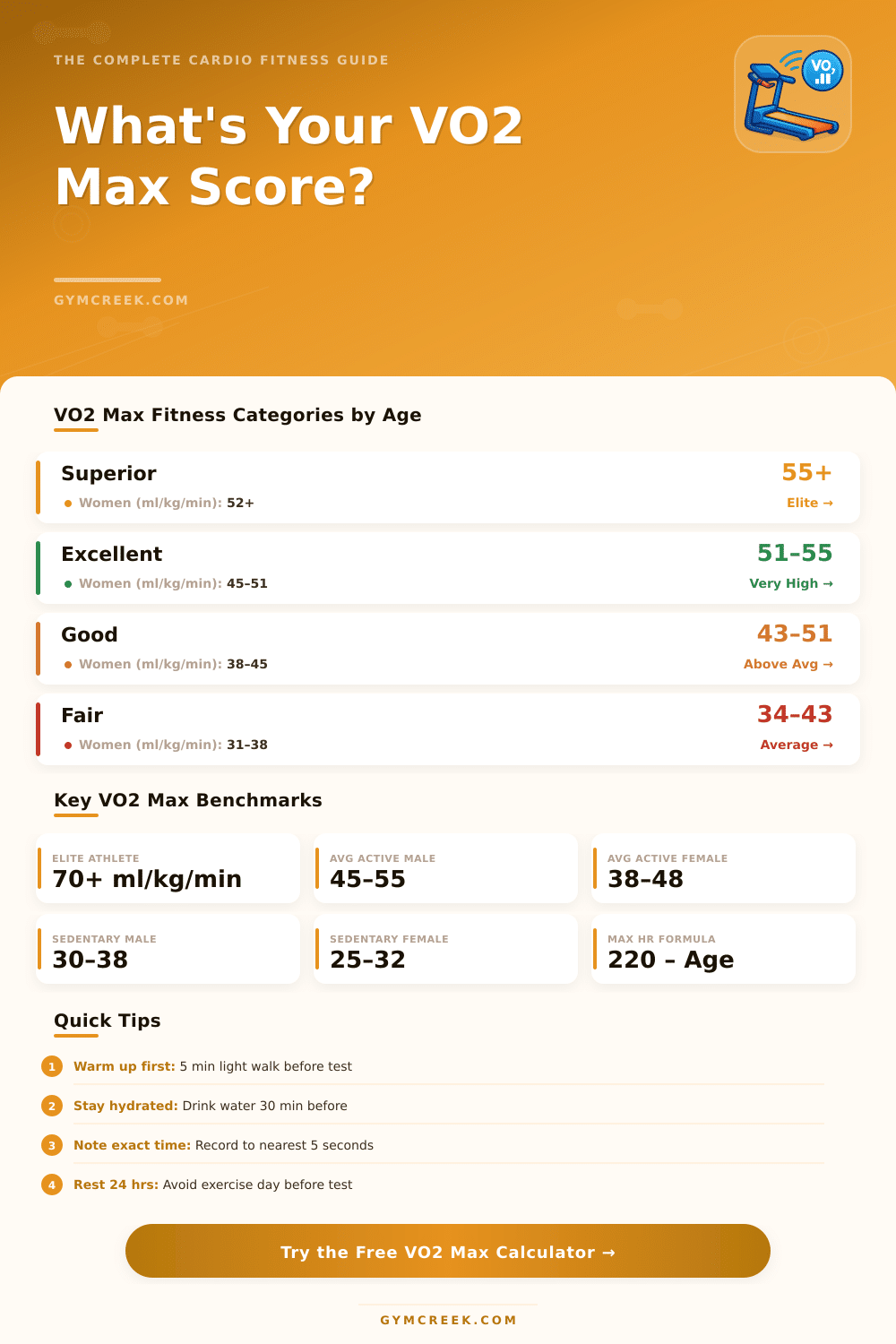
| Age Group | Poor (Men) | Fair (Men) | Good (Men) | Excellent (Men) | Superior (Men) |
|---|---|---|---|---|---|
| 20–29 | <38 | 38–43 | 44–51 | 52–59 | 60+ |
| 30–39 | <34 | 34–39 | 40–47 | 48–54 | 55+ |
| 40–49 | <30 | 30–35 | 36–43 | 44–51 | 52+ |
| 50–59 | <25 | 25–31 | 32–39 | 40–47 | 48+ |
| 60–69 | <21 | 21–26 | 27–35 | 36–44 | 45+ |
| 70+ | <18 | 18–22 | 23–29 | 30–37 | 38+ |
| Age Group | Poor (Women) | Fair (Women) | Good (Women) | Excellent (Women) | Superior (Women) |
|---|---|---|---|---|---|
| 20–29 | <28 | 28–34 | 35–43 | 44–49 | 50+ |
| 30–39 | <27 | 27–32 | 33–40 | 41–46 | 47+ |
| 40–49 | <25 | 25–29 | 30–37 | 38–43 | 44+ |
| 50–59 | <21 | 21–25 | 26–33 | 34–39 | 40+ |
| 60–69 | <18 | 18–22 | 23–30 | 31–36 | 37+ |
| 70+ | <16 | 16–19 | 20–26 | 27–32 | 33+ |
| Zone | Name | % Max HR | Purpose | Feel |
|---|---|---|---|---|
| Zone 1 | Recovery | 50–60% | Warm-up, cool-down | Very easy |
| Zone 2 | Aerobic Base | 60–70% | Fat burning, endurance | Easy, conversational |
| Zone 3 | Aerobic | 70–80% | Cardio fitness | Moderate effort |
| Zone 4 | Threshold | 80–90% | Speed & power | Hard, breathless |
| Zone 5 | Max Effort | 90–100% | Peak performance | Maximum effort |
💧 Stay hydrated: Drink 400–600 ml of water 1–2 hours before the test. Mild dehydration can reduce VO2 max estimates by up to 5%.
⏱ Record exact time: Use a stopwatch and note your time to the nearest 5 seconds. Precision matters — 30 seconds can shift your VO2 max by 1–2 ml/kg/min.
🦶 Avoid gripping handrails: Holding the rails reduces the metabolic demand of the test and inflates your estimated VO2 max score significantly.
VO2 max is simply the biggest amount of oxygen that your body is able to take in and truly use when you exercise. Breaking the word itself: “V” means volume, “O2” means oxygen, and “max” means maximum. It is like the horsepower of a car engine, it measures how much skill the engine of your body has to process oxygen when you push it.
Many folks see it as the most reliable marker for heart and lung health together with oxygen endurance. The more oxygen one manages to use in exercise, the less heavy the work will seem and the longer one can keep going. If your VO2 max grows, your body learns to better take oxygen from the air and deliver it straight to the muscles, where it is needed.
What is VO2 max and why it matters
Here is what truly happens: VO2 max shows how well your heart pumps blood to the muscles and how well those muscles pull oxygen from that blood. While you breathe oxygen, it causes a process in the muscle cells that creates energy. The number itself is figured out by milligrams of oxygen for every kilo of body weight, measured per minute.
During oxygen-based exercise your heart and blood system truly does the main work: it boosts the flow of blood to give oxygen and nutrients to the working muscles.
Endurance athletes; swimmers, cyclists, runners, cross-country skiers… Commonly talk about VO2 max. It already became a usual tool for measuring oxygen endurance before, during, or after training periods. The most exact way to test it happens in a lab.
One wears a mask or mouthpiece, connected to an oxygen meter, while the person exercises at full force on a treadmill, fixed bike, or rower.
If VO2 max is low, even simple tasks leave you breathing heavily, because your lungs need more breaths to receive the needed oxygen. When it improves, something amazing happens (the resting heart rate usually drops). At the same level of effort in exercise, your usual heart rhythm should also drop.
There is also the Cooper test, which gives a faster standard. You run or walk as hard as possible during exactly 12 minutes, and the distance that you cover almost directly ties too your VO2 max.
Genetics and physical structure play big roles. But here is the good news: almost every person can improve it by means of quite hard training that pushes past the oxygen limit. High-intensity interval work commonly shows up among the best methods.
Intervals that last from one to six minutes with equal times for work and rest are a good base for VO2 max. Training at various intensity levels helps at the same time.
A weird trait of VO2 max is that it grows quickly during training, but drops slowly as well. Too many sessions at maximum VO2 can lead to overload and lasting fatigue. The maximum heart rate drops by 0.6 to 0.8 beats each year when we age.
Even so, older adults who trained regularly during nine months to a year experienced improvements of VO2 max on average around 20 percent, without difference between sexes. Even so, VO2 max is not the whole cause. The oxygen threshold speed stays abetter prediction of your real performance.