📅 Calorie Deficit Calculator by Date
Find your daily calorie target and projected goal-weight date based on your stats and deficit level
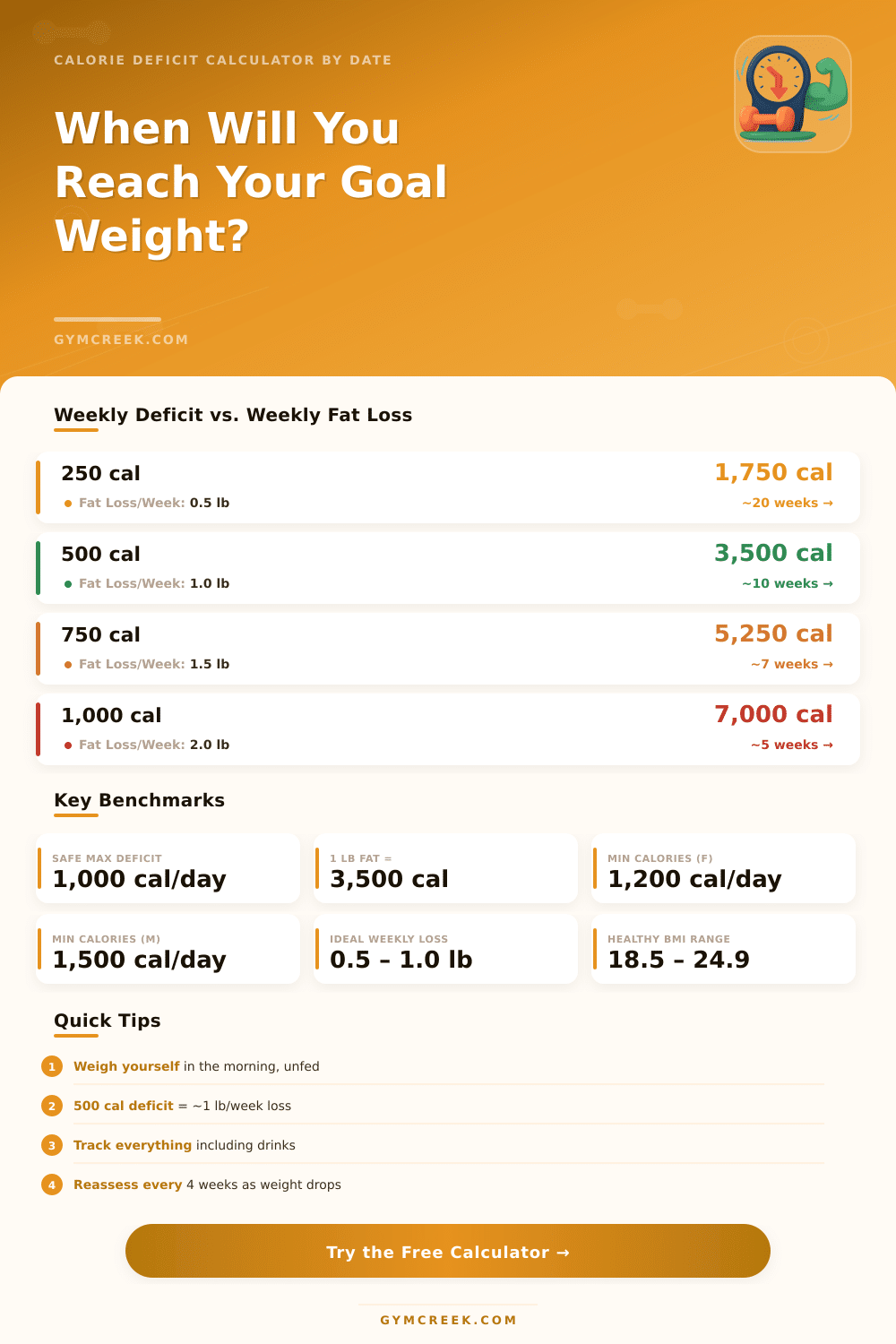
| Daily Deficit | Weekly Deficit | Est. Loss/Week | 10 lb Goal | 20 lb Goal | Safety Rating |
|---|---|---|---|---|---|
| 250 cal | 1,750 cal | ~0.5 lb | ~20 wks | ~40 wks | 🟢 Safest |
| 500 cal | 3,500 cal | ~1.0 lb | ~10 wks | ~20 wks | 🟢 Recommended |
| 750 cal | 5,250 cal | ~1.5 lb | ~7 wks | ~14 wks | 🟡 Moderate |
| 1,000 cal | 7,000 cal | ~2.0 lb | ~5 wks | ~10 wks | 🟠 Max Safe |
| Activity Level | Multiplier | Example Lifestyle | Avg TDEE (175 lb male) |
|---|---|---|---|
| Sedentary | × 1.2 | Desk job, no exercise | ~2,100 cal |
| Lightly Active | × 1.375 | Walk daily, light gym 1–3x/week | ~2,400 cal |
| Moderately Active | × 1.55 | Exercise 3–5 days/week | ~2,700 cal |
| Very Active | × 1.725 | Hard exercise 6–7 days/week | ~3,000 cal |
| Extra Active | × 1.9 | Athlete or physical labor job | ~3,300 cal |
| Group | Min Calories/Day | Why It Matters |
|---|---|---|
| Adult Women (general) | 1,200 cal | Below this risks nutrient deficiency |
| Adult Men (general) | 1,500 cal | Muscle loss risk increases significantly |
| Highly Active Women | 1,500 cal | Supports performance and recovery |
| Highly Active Men | 1,800 cal | Supports performance and recovery |
| Pregnant / Nursing | Consult MD | Deficits not recommended |
| Category | Men | Women | Notes |
|---|---|---|---|
| Essential Fat | 2–5% | 10–13% | Minimum for organ function |
| Athletic | 6–13% | 14–20% | Lean, defined physique |
| Fitness | 14–17% | 21–24% | Healthy, active lifestyle |
| Acceptable | 18–24% | 25–31% | Average healthy range |
| Obese | ≥25% | ≥32% | Increased health risks |
Weight loss is about consuming fewer calories than your body burn each day. However, determining how many calories to consume daily and how long it will take to reach your goal can be extremely overwhelm. That’s where an calorie deficit calculator by date comes in incredibly useful. This calculator ask for your stats and gives you a target daily calorie intake that will help you reach your goal weight in a set period of time.
Understanding how the calculator work gives you a better idea of the mechanics behind losing weight in a healthy and sustainable manner. Being able to calculate how many calories you need daily and how long it will take to reach your goal allows you to create a plan that suit your lifestyle and commitments.
Calorie Deficit Calculator By Date
What Is a Calorie Deficit and Why Does the Timeline Matter?
A calorie deficit refer to consuming fewer calories than your total daily energy expenditure (TDEE). TDEE indicate how many calories your body burns daily. Experts recommend creating a 500-calorie deficit daily, which will result in the loss of roughly one pound of body fat per week. Losing one pound of body fat equal 3,500 calories.
Creating a 250-calorie daily deficit will allow your body to lose weight more slow, which is ideal for individuals who want to maintain there muscle. Creating a 750-to-1,000-calorie daily deficit will help you lose weight faster. However, going too low can slow your metabolism over time.
Using a calorie deficit calculator by date allows individuals to define the date they want to reach their goal. Whether it’s for a wedding, a summer vacation, or even just to reach a healthy BMI, setting a goal date for weight loss is incredibly motivate. Being able to see your projected goal date give you an idea of the number of weeks you need to lose the amount of weight you desire. It also allows you to adjust your body composition to accommodate these changes.
One of the benefits of using a calorie deficit calculator by date is that it accounts for the slowdown in weight loss that occur as you lose weight. As you lose weight, your body require fewer calories to maintain your weight. Any good calorie deficit calculator by date can account for this and give individuals an accurate projection of how long it will take to reach there goal weight. A major advantage of using such a tool is that it can take into account your age, biological sex, and level of physical activity.
Each individual burns different amount of calories daily based off various factors. Your biological sex is one of them. Men typically have higher muscle mass than women. This results in higher basal metabolic rates for men. With higher metabolic rates, men can consume more calories daily than women. The age at which an individual set a goal for weight loss matters as well. After the age of 30, an individual’s metabolism can slow by about 2 to 3% each decade. As a result, older adults may have to adjust their goals. You can program an individual’s biological sex, age, and level of activity into the calculator to provide an accurate daily calorie requirement and timeline for reaching their goal weight.
Another recommendation for individuals looking to lose weight is to create a deficit that is sustainable over the long term. Crash diets can result in rapid weight loss initially. However, these diets typically result in weight gain over time. Creating a caloric deficit that focus on weight training and high amount of protein is more likely to provide long-term benefits to the body composition of an individual trying to lose weight.
The calculator above allows you to experiment with different calorie deficits and see how they may impact your daily calorie intake and goal date. Using the calculator to determine these variables will allow you to find a plan that fit with your lifestyle. The projected goal date will also allow you to determine the consistency of your calorie deficit to ensure it is sustainable over time. Many experts also recommend using the calculator every four to six week. As you lose weight, your projected goal date may change. This can be helpful in adjusting your projected goal to stay informed about your weight loss journey without getting discouraged during challenging times.
Ensuring the diet you follow has high levels of nutrients is crucial to your weight loss goal. A diet of 1,500 calories daily from mostly vegetables and lean proteins is far better than chowing down on 1,500 calories of processed foods. High-calorie diets can cause individuals to feel hungry and deficient in the nutrient that their bodies need daily. Aim for a calorie target that ensures you will have energy to continue your weight loss journey while focusing on eating the best foods for your body.
Other factors that impact the effectiveness of a calorie deficit program are sleep and stress levels and the degree to which an individual incorporate strength training into their fitness routine. Poor sleep and high stress levels can interfere with weight loss efforts. Strength training allows individuals to maintain their muscle mass while losing body fat and weight.
A calorie deficit calculator by date provides individuals with a starting point for their weight loss journey. It provides a number of variables that can guide the body composition and health decisions individuals make daily. The best outcome from incorporating a calorie deficit calculator into your journey to better health is the ability to create healthy habits that last beyond the initial goal date set by the calculator.
Healthy weight loss should yield 0.5 to 2 pounds per week lost for most individuals. However, individuals looking to lose significant amount of weight may lose at a faster rate. However, they should do so under the supervision of a healthcare provider. Losing weight is more than just a number on the scale. It is about creating healthy, sustainable changes that will benefit your body for years to come. By incorporating healthy eating habits and exercise routines into your lifestyle, you will be sure to enjoy the benefits of your weight loss calculator.
By understanding the projected goal date for your weight loss, you can begin to create the healthy habits that will ensure your success. Remember, it is your daily decisions that will determine whether you reach your goal date or not.