⚖️ BMI Calculator India
Body Mass Index with Asian & Indian-specific cut-offs — get your healthy weight range instantly
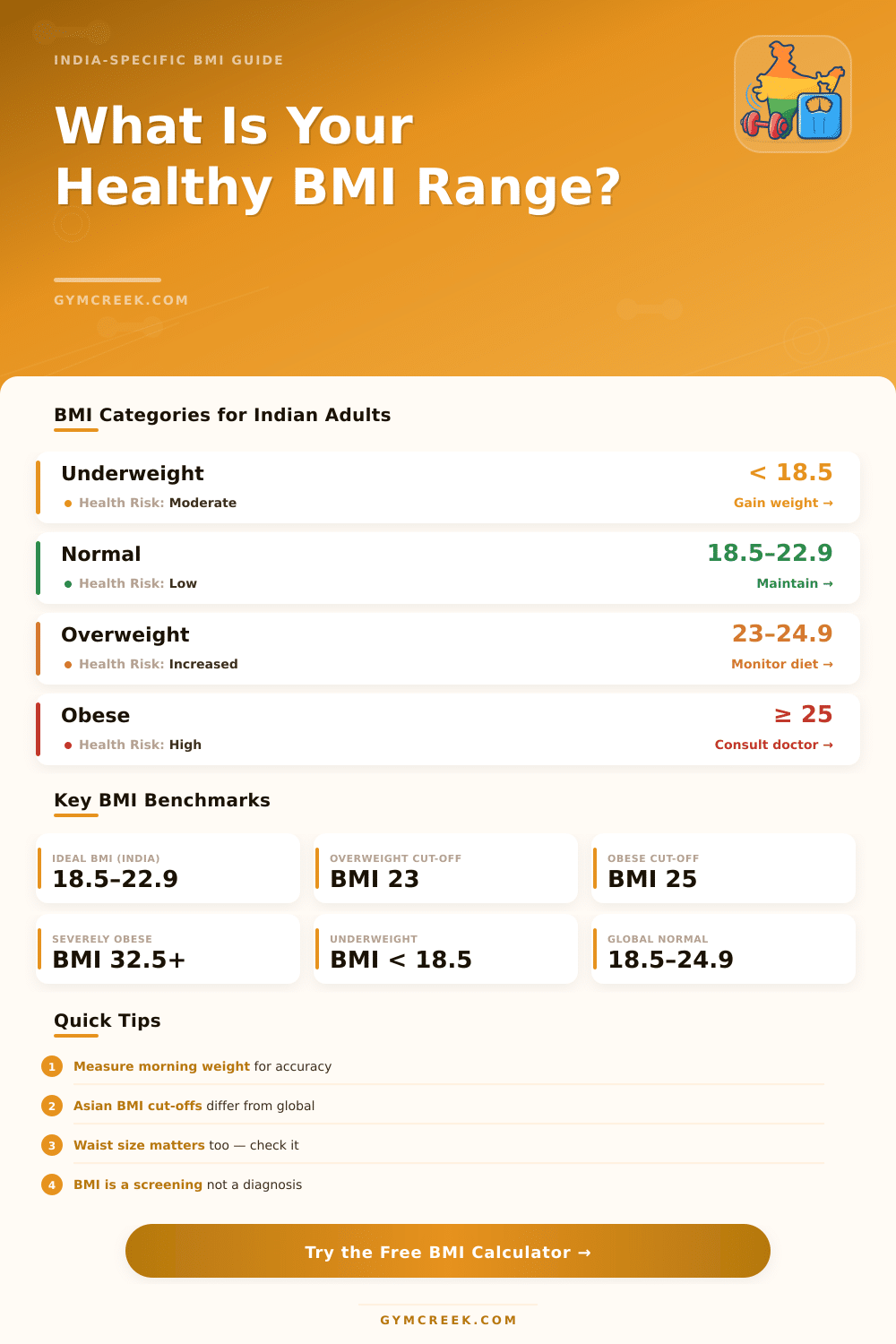
| Category | Asian/Indian BMI | Global/WHO BMI | Health Risk | Recommended Action |
|---|---|---|---|---|
| Severely Underweight | < 16.0 | < 16.0 | Very High | Immediate medical attention |
| Underweight | 16.0 – 18.4 | 16.0 – 18.4 | Moderate | Increase caloric intake, consult doctor |
| Normal Weight | 18.5 – 22.9 | 18.5 – 24.9 | Low | Maintain current lifestyle |
| Overweight | 23.0 – 24.9 | 25.0 – 29.9 | Increased | Diet review, increase activity |
| Obese Class I | 25.0 – 29.9 | 30.0 – 34.9 | High | Structured weight management |
| Obese Class II | 30.0 – 32.4 | 35.0 – 39.9 | Very High | Medical supervision recommended |
| Obese Class III | ≥ 32.5 | ≥ 40.0 | Extremely High | Immediate medical consultation |
| Height | Height (ft-in) | Healthy Weight (Asian, kg) | Healthy Weight (Global, kg) | Ideal Weight (BMI 21, kg) |
|---|---|---|---|---|
| 150 cm | 4'11" | 41.6 – 51.5 | 41.6 – 56.3 | 47.3 |
| 155 cm | 5'1" | 44.4 – 55.0 | 44.4 – 59.9 | 50.5 |
| 160 cm | 5'3" | 47.4 – 58.6 | 47.4 – 63.9 | 53.8 |
| 165 cm | 5'5" | 50.4 – 62.3 | 50.4 – 67.9 | 57.2 |
| 170 cm | 5'7" | 53.5 – 66.2 | 53.5 – 72.1 | 60.7 |
| 175 cm | 5'9" | 56.7 – 70.2 | 56.7 – 76.5 | 64.3 |
| 180 cm | 5'11" | 59.9 – 74.3 | 59.9 – 80.9 | 68.0 |
| 185 cm | 6'1" | 63.3 – 78.4 | 63.3 – 85.6 | 71.9 |
| Risk Level | Men (Waist) | Women (Waist) | Health Implication |
|---|---|---|---|
| Low Risk | < 80 cm (31.5 in) | < 70 cm (27.5 in) | Healthy abdominal fat level |
| Moderate Risk | 80 – 90 cm (31.5–35.5 in) | 70 – 80 cm (27.5–31.5 in) | Some increased metabolic risk |
| High Risk | > 90 cm (35.5 in) | > 80 cm (31.5 in) | Elevated diabetes & heart disease risk |
| Age Group | Normal BMI Range | Note |
|---|---|---|
| Children (2–18 yrs) | Use BMI-for-age percentile (IAP charts) | Not a fixed cut-off |
| Young Adults (18–35) | 18.5 – 22.9 (Asian) | Optimal range for Indians |
| Adults (35–60) | 18.5 – 22.9 (Asian) | Monitor waist circumference too |
| Seniors (60+) | 21.0 – 24.9 | Slightly higher BMI may be protective |
1. Weigh yourself in the morning after using the restroom, before eating or drinking.
2. Use the same scale each time for consistency.
3. Measure height without shoes, standing straight against a wall.
4. BMI does not distinguish between muscle and fat — athletes may have high BMI but low body fat.
Body Mass Index, or BMI, is simply a number that links height with weight. It helps you guess whether you carry the right weight for health. The calculation itself is easy: you divide your weight in kilos by the square of your height in metres.
This way you get a value in kg./m². It counts for adults, men and women, and works as a screening method for rough rating of the amount of body fat that you truly have.
What BMI Can and Cannot Tell You
For groups BMI splits things clearly. Under 18,5 points to underweight state. Between 18,5 and 24,9 lies the normal range.
If you pass that, you enter the overweight zone, and obesity itself splits into three different levels. For children and youngsters from 2 to 18 years the math becomes a bit more rough (it considers also age and gender).
The idea truly spread after Ancel Keys released a study in 1972 in the Journal of Chronic Diseases. His research shows that BMI is the best stand-in for real share of body fat, when you compare different ratios of weight to height. The whole push to measure body fat more carefully came because of bigger attention to the fact taht obesity became an important problem for public health in rich western lands.
Here the main limit of BMI, it helps to start, but does not show the whole picture. It does not care about muscle mass, bone density or where the fat sits on the body. That is its biggest weakness.
Think of athletes or heavy bodybuilders that have a lot of muscle. They commonly sort into overweight or obesity, although their body fat is actually very low. On the other hand, older people that lost muscle, could seem normally heavy, while they truly carry too much fat inside.
Things become more complex during pregnancy and nursing. The makeup of the body shifts so strongly that BMI simply does not work as a measure in those times. Also, the ethnic side of BMI does not care about differences between groups.
For instance among black Americans, the method commonly sorts folks as overweight, while the truth is that they have more muscle mass, not extra fat.
Share of body fat gives more reliable info about general health than BMI alone. Here what matters: BMI is only a screening tool, not a diagnosis. Good ratings require looking into body fat share, eating habits, physical activity and family history.
The ratio of waste to height also gets attention as maybe better for spotting health risks. If it passes 0,5, it commonly shows too much fat tissue. To get a clear reading of BMI and truly understand what it says about you, you need to talk with a medical provider.
One key point… Higher BMI does not always show that you suffer obesity. Obesity itself is a hard state with too much body fat that badly affects the health.
Said that, high BMI links to bigger risk of death, so ignoring it completely is notwise. It misses for around 15 to 20 percent of folks, but for the majority it stays a good sign about health.