⚖️ Body Mass Index Imperial Calculator
Calculate your BMI using pounds, feet & inches — with healthy weight ranges and category insights
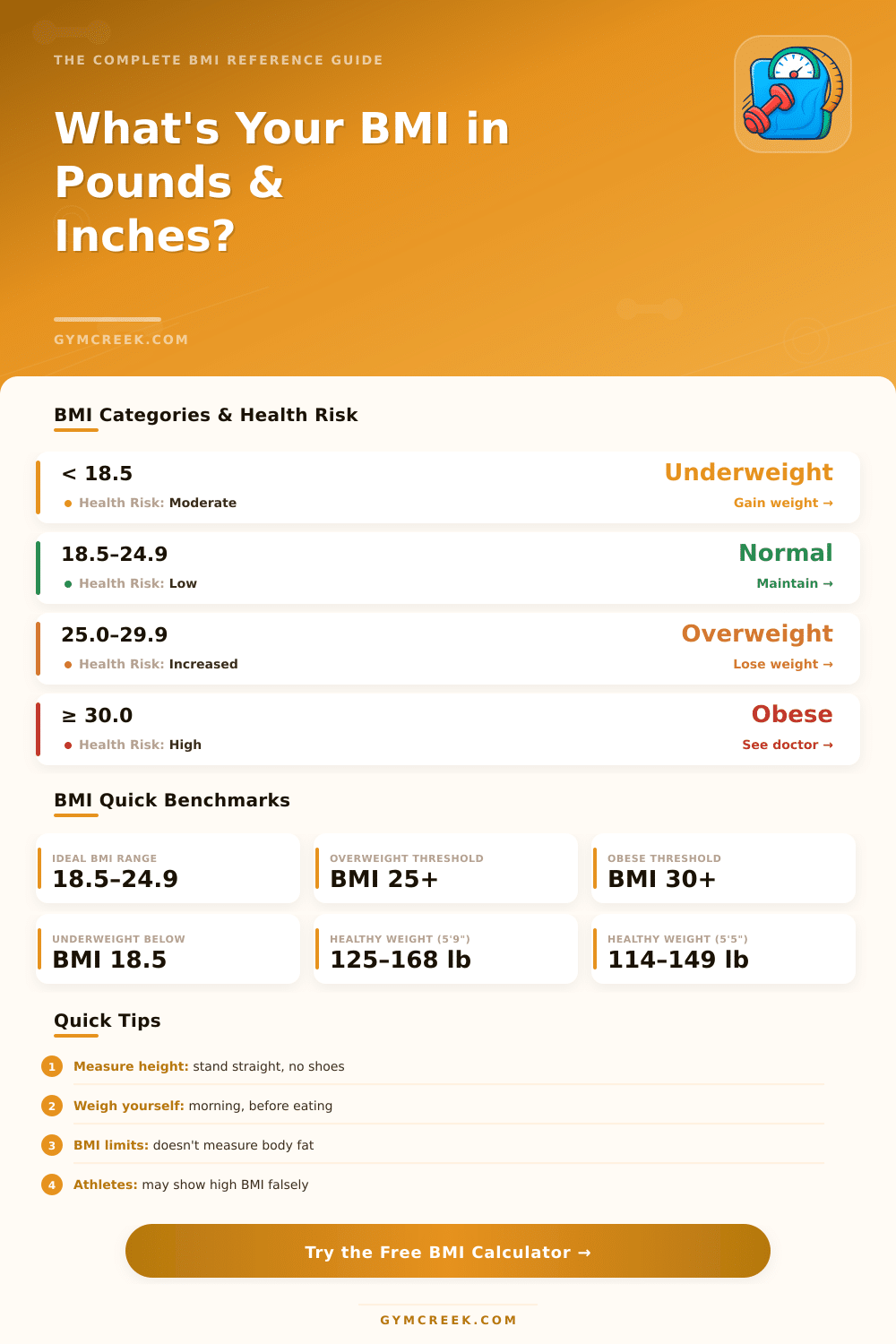
| BMI Range | Category | Health Risk Level | Recommended Action |
|---|---|---|---|
| Below 18.5 | Underweight | Moderate | Increase caloric intake; consult doctor |
| 18.5 – 24.9 | Normal Weight | Low | Maintain healthy habits |
| 25.0 – 29.9 | Overweight | Increased | Lifestyle modifications |
| 30.0 – 34.9 | Obese Class I | High | Medical consultation advised |
| 35.0 – 39.9 | Obese Class II | Very High | Medical treatment recommended |
| 40.0 & above | Obese Class III | Extremely High | Urgent medical consultation |
| Height | Min Healthy (lb) | Max Healthy (lb) | Midpoint (lb) |
|---|---|---|---|
| 5'0" | 97 | 128 | 113 |
| 5'2" | 104 | 135 | 120 |
| 5'4" | 110 | 144 | 127 |
| 5'5" | 114 | 149 | 132 |
| 5'6" | 118 | 154 | 136 |
| 5'8" | 125 | 163 | 144 |
| 5'9" | 128 | 168 | 148 |
| 5'10" | 132 | 173 | 153 |
| 6'0" | 140 | 183 | 162 |
| 6'2" | 148 | 194 | 171 |
| Metric | What It Measures | Healthy Range (Male) | Healthy Range (Female) |
|---|---|---|---|
| BMI | Weight-to-height ratio | 18.5 – 24.9 | 18.5 – 24.9 |
| Body Fat % | Fat mass vs. total mass | 8 – 19% | 21 – 33% |
| Waist Circumference | Abdominal fat | Below 40 in | Below 35 in |
| Waist-to-Hip Ratio | Fat distribution | Below 0.90 | Below 0.85 |
| Waist-to-Height Ratio | Central adiposity | Below 0.5 | Below 0.5 |
Body Mass Index, or simply BMI, is calculated from the height and weight of people. That number helps to estimate how much fat builds up in the body. One gets it by dividing the weight in kilos by the square of the height in metres.
The value appears in kg./m². It works for adult men and women and works well as a simple tool for guessing which weight group someone belongs to.
What is Body Mass Index (BMI)?
Body Mass Index classifies adults as underweight, normal weight, overweight and obese. The obesity is split even more closely into three levels. If Body Mass Index is under 18.5, one is considered underweight.
Between 18.5 and 24.9 it matches a healthy range. A value of 30 or more marks an obese state. Here is the official explanation.
For children and youngsters of 2 to 18 years, the math also looks at age and gender.
The name “Body Mass Index” spread after an article of 1972 in the Journal of Chronic Diseases by Ancel Keys. That study found that Body Mass Index is the best measure for the percentage of body fat compared to other relations between weight and height. Interest in rating body fat level grew, because obesity became a clear challenge in wealthy western nations.
The basic formula itself comes from the 19th century, when one caleld it Quetelet-Index.
Even so Body Mass Index suffers from some serious gaps. It does not detect the fat amount directly. One can not ignore muscle volume, bone density or the spread of fat through the hole body.
Athletes and bodybuilders with lots of muscle commonly fall in the overweight or obese category, although their fat level stays low. In older adults normal Body Mass Index can mask bigger fat buildup, because they lost muscle. Pregnancy and breastfeeding change the body makeup, so that Body Mass Index does not work then truly.
The percentage of body fat shows a more reliable marker for health than only Body Mass Index. It is wrong for around 15 to 20 percent of the population. Also ethnic background can cause wrong grouping.
In African-Americans Body Mass Index commonly overstates the obese state, because bigger values commonly come from muscle mass instead of too much fat. The ratio of height to waist is suggested as a better sign for health. If it passes 0.5, that signals too much belly fat.
A new tool, called body roundness index, always more wins ground. It stresses the fat buildup around the belly, that relates more to cancer, heart disease and other serious diseases. Body Mass Index even so still serves as a good starting point.
A high value predicts bigger risk for death widely. The safest way to check Body Mass Index is during a trip to thedoctor. It works well as a screening tool, but not as a standalone diagnosis.