🏋 Hack Squat to Squat Calculator
Convert your hack squat machine weight to an estimated barbell back squat equivalent
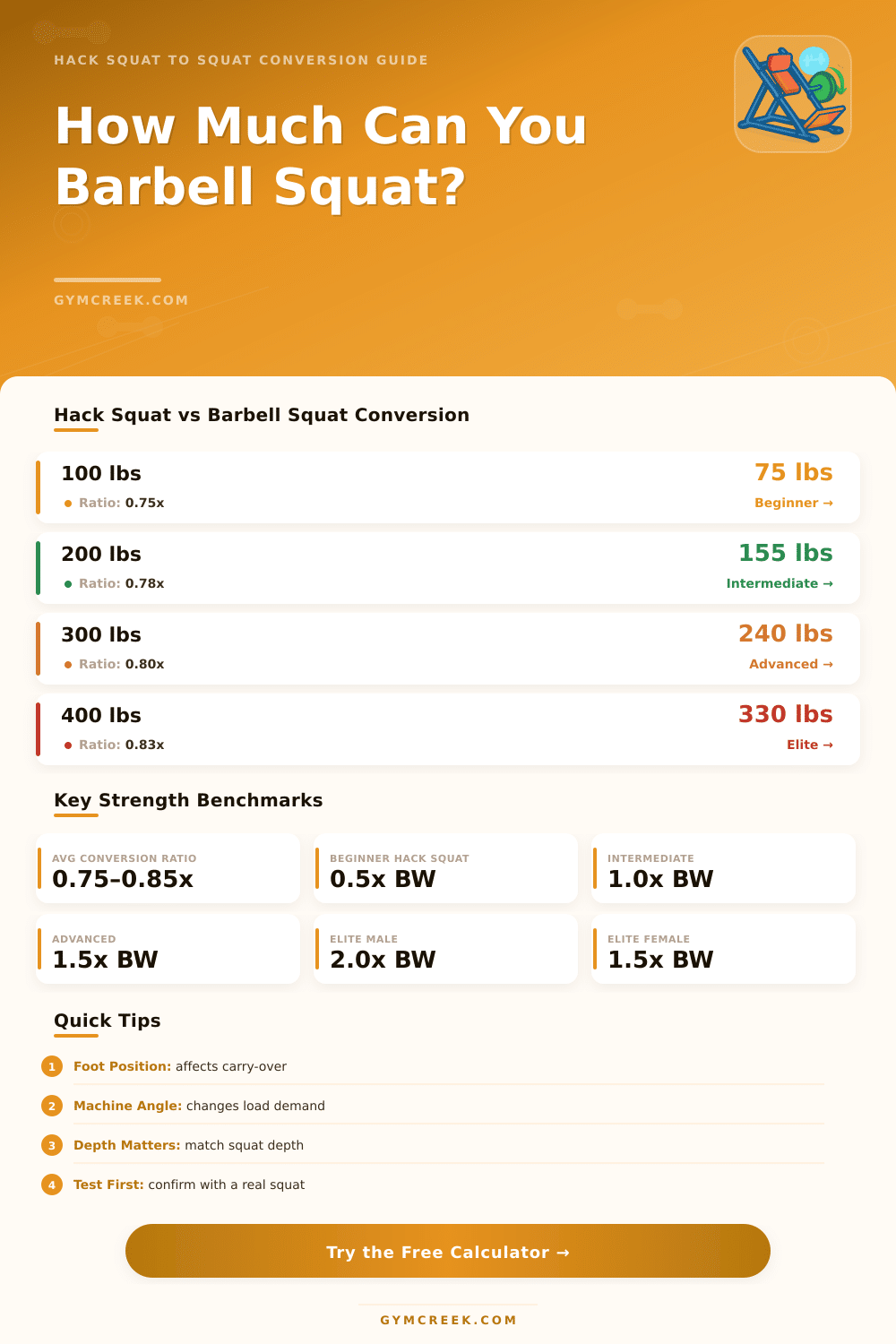
| Hack Squat Weight | Est. Barbell Squat (lbs) | Est. Barbell Squat (kg) | Ratio Used | Level |
|---|---|---|---|---|
| 100 lbs / 45 kg | ~75 lbs | ~34 kg | 0.75x | Beginner |
| 150 lbs / 68 kg | ~115 lbs | ~52 kg | 0.77x | Beginner+ |
| 200 lbs / 91 kg | ~155 lbs | ~70 kg | 0.78x | Intermediate |
| 250 lbs / 113 kg | ~197 lbs | ~89 kg | 0.79x | Intermediate |
| 300 lbs / 136 kg | ~240 lbs | ~109 kg | 0.80x | Advanced |
| 350 lbs / 159 kg | ~283 lbs | ~128 kg | 0.81x | Advanced |
| 400 lbs / 181 kg | ~328 lbs | ~149 kg | 0.82x | Elite |
| 450 lbs / 204 kg | ~374 lbs | ~170 kg | 0.83x | Elite |
| Foot Position | Primary Muscles | Carry-Over to Squat | Ratio Adjustment |
|---|---|---|---|
| Low (toe-forward) | Quads dominant | High quad carry-over | +2–3% |
| Mid (shoulder-width) | Quads + Glutes balanced | Most balanced carry-over | Baseline |
| High (heels raised) | Glutes + Hamstrings | Lower direct carry-over | –3–5% |
| Wide stance | Glutes + Adductors | Sumo squat carry-over | –2–4% |
| Angle | True Load vs Loaded Weight | Quad Demand | Back Squat Similarity |
|---|---|---|---|
| 30° (shallow) | ~52% of plate weight | Moderate | Lower |
| 45° (standard) | ~71% of plate weight | High | Moderate |
| 60° (steep) | ~87% of plate weight | Very High | Higher |
| 70° (near vertical) | ~94% of plate weight | Extremely High | Closest |
The hack squat exercise and the barbell back squat exercise are two of the most popular exercises for the lower-body among strength athletes around the world. The two exercises can feel significantly different from one another, which is why lifters is often able to squat more weight on the hack squat machines than with barbell squats. An understanding of the relationship between these two exercises is essential for lifters who wish to track their squat performance and strength goal.
Many athletes want to know the answer to a simple question: what does a heavy squat on a hack squat machine indicate about their barbell squat performance? Factors such as the placement of the feet, the angle of the hack squat machine, the experience level of the lifter, and the squat depth can all play critical role in the answer to this question. A hack squat to squat calculator can provide lifters with an idea of the answer to this question based on their individual factor.
Why the Hack Squat and Barbell Squat Differ
The squat machine differs from the barbell squat in that the lifter does not have to stabilize the squat movement. This factor alone allow lifters to perform significantly more sets with a barbell squat on a squat machine. Many lifters who train on squat machines can typically lift anywhere between 20 and 40 percent more weight on the squat machine than on a barbell squat. Because of the squat machine’s limitations in terms of stabilization, the muscle that are engaged in the squat are significantly different from those that are engaged in a barbell squat exercise. For instance, the muscles in the quadriceps are engaged more in a squat machine position with the feet positioned lower on the platform.
Conversely, a barbell squat allow for the engagement of more muscles in the body. The muscles of the core are required to maintain the body in an upright position with the barbell on the back. The upper back muscles must stabilize the barbell, and the gluteus maximus and hamstring muscle are engaged to produce the movement of the legs. Because of these difference, the strength demonstrated in a squat machine does not necessarily translate to strength with a barbell squat. A 400-pound squat on a squat machine does not necessarily indicate that an athlete can perform a barbell squat exercise of the same number of pounds.
Factors that influence strength include the positioning of the feet on the squat platform. A low foot placement allows for more emphasis on the quadriceps, whereas a high foot placement place more emphasis on the gluteus maximus and hamstrings. Additionally, the angle of the squat machines changes the angle of the resistance that the muscles experience. A steeper angle for the squat machines come closer to mimicking the squat movement required for a barbell squat. Shallower angle allow for heavier squat loads. The experience level of the lifter may also have an impact on the strength difference between squat machines and barbell squats. New lifter can often exhibit a much larger difference between squat machine strength and barbell squat strength than experienced athletes. This is likely due to the fact that experienced lifters has stronger muscles that provide the additional stabilization necessary for a barbell squat exercise. Additionally, the depth of the squat may influence squat machine and barbell squat strength. Many lifter perform squat machine exercises to a shallower depth than a barbell squat. Body weight may also play a role in squatting strength. Generally, an athlete who weigh more pounds will be able to squat a lower multiple of their body weight than a lighter athlete. Finally, gender may play a role in squat performance, though for different reasons than body weight; the muscles of males are generally larger and stronger than those of females.
Each of these factor may influence an athlete’s squat machine strength to squat strength relationship. However, estimates can be made as to the average relationship between the two types of squat exercises. For instance, most lifter will find that their barbell back squat strength falls somewhere between 75 and 85 percent of the weight that they can squat on a hack squat machine. Depending upon the factors noted above, this percentage may be higher or lower. Using a hack squat to squat calculator, as is depicted in the calculator above, allows an athlete to account for these factor regarding their individual strength.
Understanding the relationship between squat machine strength and squat strength is helpful for a variety of reason. First, lifters who wish to shift their training routine from squat machines to barbell squats can use this information to start their program with a more realistic understanding of their capabilities. Second, for those who are rehabilitating an injury to a squat movement, understanding their strength with a barbell squat without the use of a squat machine may allow for them to better incorporate that strength into their training programs to ensure they do not re-injure the area.
To determine an athlete’s true squatting strength, the best method is to simply attempt to perform the squats with the estimated weight of the barbell squat. Warm up the muscles, perform the squat movements with pristine technique, and determine the weight that allow the lifter to perform the same number of repetition as they performed with the squat machine. This determination is the best way to accurately calculate the strength difference between a squat machine and a barbell squat movement. However, the use of a hack squat to squat calculator is a helpful starting point for lifters to understand their capability.
Despite the ability of a hack squat to squat calculator to help lifters determine their relationship between squat machine and barbell strength, the most important factor in any squatting routine is focused training on both squat movements with consistency. While a hack squat to squat calculator helps provide an understanding of the relationship between squat movements, it is not the most important factor in strength gain. Training, recovery, and proper technique matter more than any calculation of strength relationship between squat movements.
Yet, the ability of an athlete to use this calculation in their training programs may be of great benefit. As noted, it helps athletes who are shifting training programs or who are rehabilitating from squat machine injuries to more appropriately and safely incorporate squatting into their training programs. Therefore, while the hack squat and the barbell back squat may be two different exercises with notably different benefits to the body, they are both exercises that deserve to be included in any athlete’s training program. The squat machine allows for greater loading with less strain on the back, whereas the barbell squat develop strength in the body as a whole and allows athletes more confidence in their squatting movement. An understanding of the differences between the two squat movements and their relationship to one another, as indicated by a hack squat to squat calculator, allows athletes to make more informed decision about their training programs and to set goals that accurately reflect their strength with these exercises.
Strength with both exercises is individually variable; levers, mobility, and previous injuries to those muscles may impact the relationship between squat machine and squat strength on any given day. As such, lifters should use the information from a hack squat to squat calculator as a general guide to strength capabilities rather than as a rule for the individual athlete. Focus on consistently improving squatting ability in both instances, maintain good form when performing the exercises, and allow the bodys performance in the gym to tell the story of the strength gain that are being made.