🌺 PCOS Calorie Deficit Calculator
Calculate a safe, hormone-friendly calorie deficit tailored for PCOS weight management
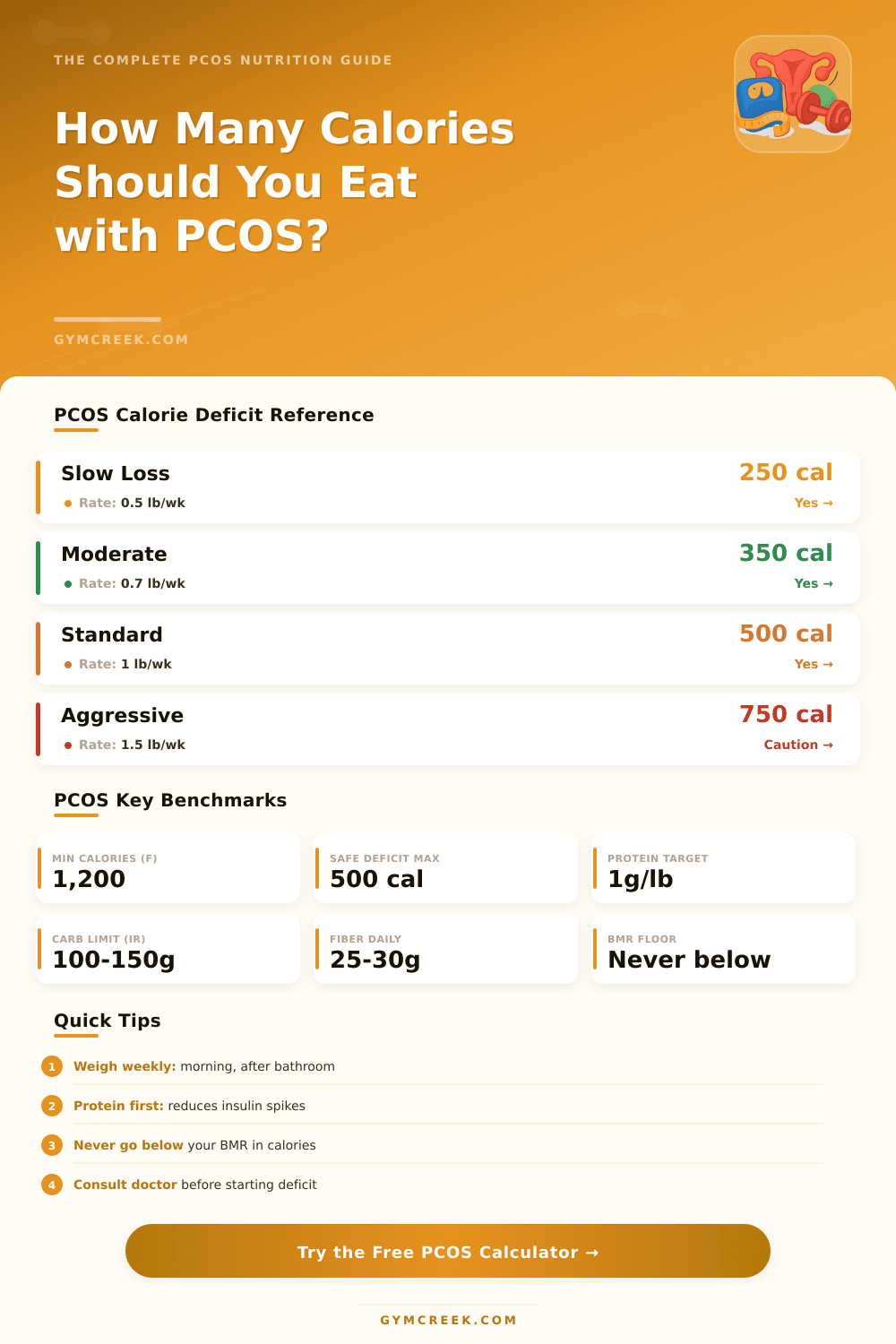
| Deficit Size | Cal/Day Cut | Weekly Loss | PCOS Safety | Best For |
|---|---|---|---|---|
| Gentle | 250 cal | ~0.5 lb (0.23 kg) | ✅ Optimal | Insulin resistant, lean PCOS |
| Moderate | 350 cal | ~0.7 lb (0.32 kg) | ✅ Recommended | Most PCOS presentations |
| Standard | 500 cal | ~1 lb (0.45 kg) | ✅ Acceptable | Higher body weight, active |
| Aggressive | 750 cal | ~1.5 lb (0.68 kg) | ⚠ Caution | Only with medical supervision |
| Very Aggressive | 1000+ cal | ~2+ lb (0.9+ kg) | ❌ Not recommended | Avoid — worsens hormones |
| PCOS Type | Carbs | Protein | Fat | Fiber/Day |
|---|---|---|---|---|
| Insulin Resistant | 30–35% | 30–35% | 30–35% | 30–35g |
| Standard PCOS | 40–45% | 25–30% | 25–30% | 25–30g |
| Lean PCOS | 45–50% | 25–30% | 25–30% | 25–30g |
| Inflammatory | 35–40% | 25–30% | 30–35% | 30–35g |
| Adrenal | 40–45% | 25–30% | 25–30% | 25–30g |
| Age Range | Avg BMR (kcal) | Sedentary TDEE | Moderate TDEE | Active TDEE |
|---|---|---|---|---|
| 18–25 | 1,450–1,600 | 1,740–1,920 | 2,248–2,480 | 2,500–2,760 |
| 26–35 | 1,380–1,520 | 1,656–1,824 | 2,139–2,356 | 2,380–2,622 |
| 36–45 | 1,300–1,450 | 1,560–1,740 | 2,015–2,248 | 2,243–2,500 |
| 46–55 | 1,250–1,380 | 1,500–1,656 | 1,938–2,139 | 2,156–2,380 |
| 56–65 | 1,200–1,320 | 1,440–1,584 | 1,860–2,046 | 2,070–2,277 |
| BMI Category | BMI Range | PCOS Note |
|---|---|---|
| Underweight | Below 18.5 | May worsen hormonal imbalance |
| Normal Weight | 18.5–24.9 | Lean PCOS still possible |
| Overweight | 25.0–29.9 | Increased insulin resistance risk |
| Obese Class I | 30.0–34.9 | Moderate PCOS symptom worsening |
| Obese Class II+ | 35.0+ | Significant hormonal disruption |
Waist measurement: Measure at the narrowest point between your ribs and hip bones, usually just above the navel. Waist above 35 in (88 cm) in women is linked to higher insulin resistance risk.
Activity level honesty: Most people overestimate activity level. If unsure, choose one level lower than you think — this prevents over-eating on estimated burn and stalling weight loss.
PCOS can make the loss of weight feel really frustrating. The disease commonly lowers the base metabolic rate compared to women without PCOS. Those with resistance to insulin can have even lower BMR.
Calculators online could predict bigger burning of calories than what really happens in the body which creates confusion when the weight does not change on the scales.
How to Lose Weight Safely with PCOS
Even so, deficit of calories stays the main reason for losing weight, even when dealing with PCOS. Women that start with very high weight commonly lose a lot simply by moving to deficit. One way that works is tracking the current eating of foods and slowly lowering calories until one reaches deficit.
After two weeks without progress, removing an extra 100 calories can be useful. If the weight grows, adding 200 calories is a good fix.
Guidelines worldwide for treatment of PCOS suggest eating around 1 500 calories daily to lose weight. Even so going too low is really dangerous. Eating only 600 to 1 000 calories is too little for almost anyone.
It slows the metabolism over time and affects changes in hormonal ways. Because of that, do not go under 1 200 Calorie a day.
Diet with low sugar index and deficit of 500 calories showed itself very helpful. It lowered the levels of total testosterone, improved the regularity of periods in 80% of women with PCOS and reduced acne. In other research, restriction of calories too 1 000 per day during four weeks raised levels of SHBG and lowered free testosterone and insulin, which helped against symptoms of PCOS.
Compared to gentle restrictions, severe deficit gave bigger loss of weight and better state of hormones, although gentle methods are safer for long time.
There is not one single diet for PCOS. The main point is not harsh restrictions, but balance and sticking with it. In every meal include protein to help control the hunger and support the mass of muscles.
Women with PCOS that are not overweight and have regular periods can eat balanced with around 50% of calories from carbohydrates, choosing complex unrefined carbohydrates instead of fancy. An approach with fewer carbohydrates works well for many, but more important is keeping the deficit than choosing a precise diet.
Exercises help by means of raising the daily burning of calories. Training of strength together with deficit of calories and enough protein can lead to real results. Eating carbohydrates around the workouts is another tactic that works.
Intermittent restriction of calories deserves a try; eat with deficit during five days in a week and maintain for two days, with more carbohydrates in the days with high calories to fuel moredifficult exercises.
Eating disorders are surprisingly common between women with PCOS. Harsh cutting of calories is not the solution. Supporting hormones and metabolism is just as important as the numbers in apps for tracking foods.