🏋 Bench Press Pyramid Calculator
Enter your one-rep max (or estimate it) to generate a full ascending, descending, or triangle pyramid plan
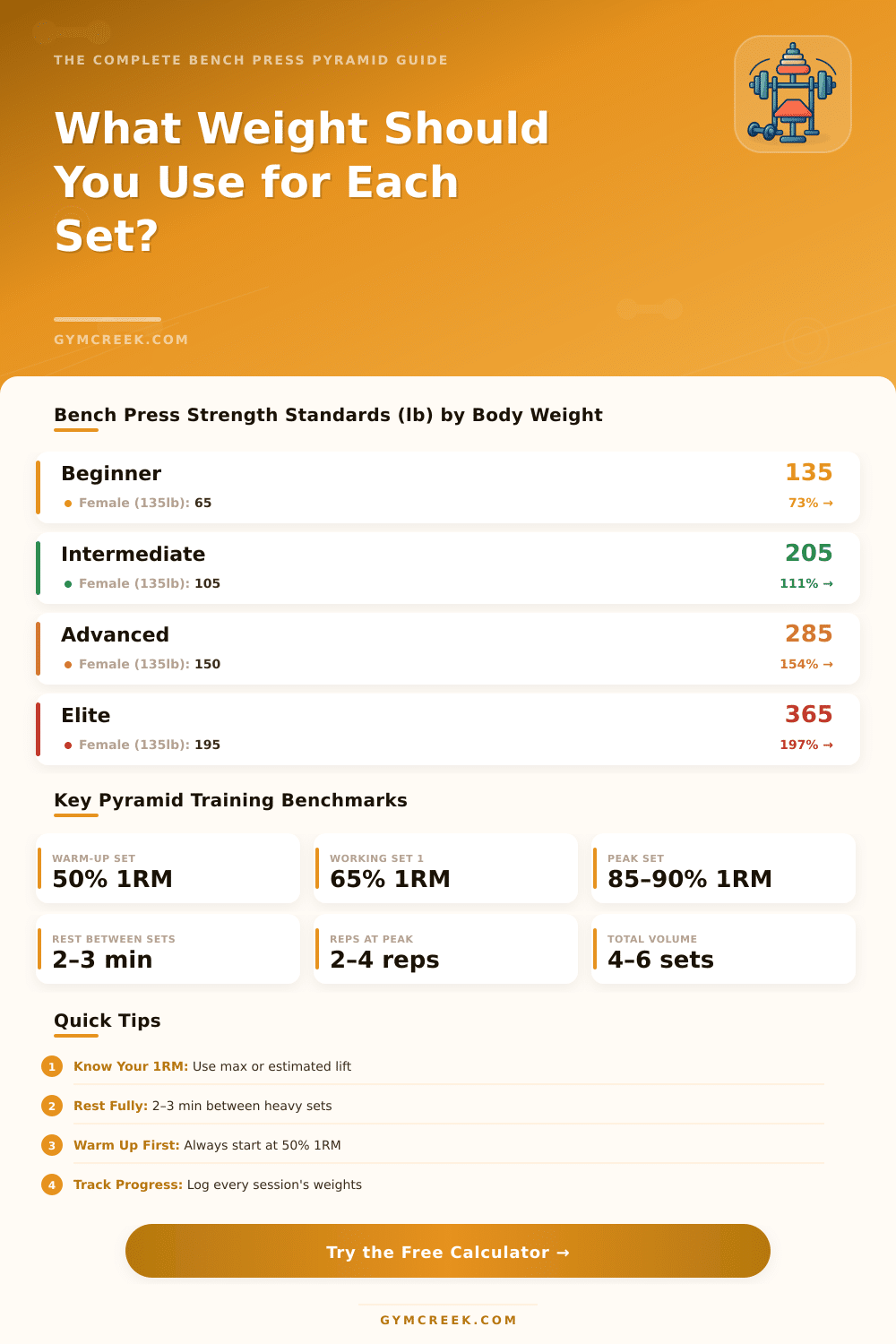
| Level | Male 1RM (lb) | Male % BW | Female 1RM (lb) | Female % BW |
|---|---|---|---|---|
| Beginner | 95 – 135 | ~70% | 45 – 65 | ~50% |
| Novice | 135 – 175 | ~90% | 65 – 90 | ~65% |
| Intermediate | 175 – 225 | ~115% | 90 – 120 | ~85% |
| Advanced | 225 – 310 | ~150% | 120 – 160 | ~115% |
| Elite | 310+ | ~200%+ | 160+ | ~150%+ |
| Set Role | % of 1RM | Rep Range | Purpose | Rest |
|---|---|---|---|---|
| Warm-up | 40 – 55% | 10 – 15 | Joint prep, motor pattern activation | 60 sec |
| Working Set 1 | 60 – 70% | 8 – 12 | Volume accumulation, hypertrophy stimulus | 90 sec |
| Working Set 2 | 70 – 80% | 5 – 8 | Strength-hypertrophy crossover | 2 min |
| Working Set 3 | 80 – 87% | 3 – 5 | Neural drive, maximal tension | 3 min |
| Peak Set | 88 – 95% | 1 – 3 | Max strength expression, CNS adaptation | 3–5 min |
| Reps Performed | % of 1RM | Example (225 lb 1RM) | Goal Range |
|---|---|---|---|
| 1 rep | 100% | 225 lb | Max Strength Test |
| 2 reps | 97% | 218 lb | Powerlifting Peak |
| 3 reps | 94% | 211 lb | Strength |
| 5 reps | 87% | 196 lb | Strength / Power |
| 6 reps | 85% | 191 lb | Strength-Hypertrophy |
| 8 reps | 80% | 180 lb | Hypertrophy |
| 10 reps | 75% | 169 lb | Hypertrophy / Volume |
| 12 reps | 70% | 158 lb | Hypertrophy / Endurance |
| 15 reps | 65% | 146 lb | Muscular Endurance |
| 20 reps | 60% | 135 lb | Metabolic / Conditioning |
The bench press exercise is one of the most popular upper-body exercises used by strength training enthusiast of all levels. Whether an individual train to increase there one-rep max for the movement or to develop more muscle, using a pyramid structure to their bench press workouts can be of great benefit. Using a bench press pyramid calculator makes it easier to include such training into an upper-body routine.
Bodybuilders, powerlifters, and those looking to incorporate more strength training into their fitness routine have all utilized pyramid training schemes for the benefits that it offer to their strength programs. By alternating the weight and the number of reps for the sets included in a workout routine, athletes can allow their muscle and joints to recover from the increasing weights, while also giving their nervous system time to adjust to the demand of the exercise.
What Is a Bench Press Pyramid and Why Use One?
A bench press pyramid can gradually reduce the amount of weight lifted while increasing the number of repetitions, or it can performs the opposite plan. Such a pyramid can be created with a variety of structures. An ascending pyramid will include the lightest weights for a set with the highest number of repetitions for the sets, while gradually decreasing the number of repetitions and increasing the weight lift. A descending pyramid will perform the opposite of this structure. Finally, the most common pyramid structure for strength training routines is the triangle pyramid, or a double pyramid structure, which climbs to the heaviest bench press sets for a muscle group and then descends back down to incorporate more volume into the exercise while the muscles is fatigued.
The benefits for performing pyramids with the bench press include the ability for early sets to warm up the muscles of the upper body, increasing the blood flow to those muscles, and activating the fast-twitch muscle fiber in the chest and upper-body. The later, heaviest sets will recruit the remaining muscle fibers of the upper body and require the nervous system to activate to perform the bench press at these weight. Finally, the descending phase of a pyramid allows for additional muscle volume to be created for muscle hypertrophy, which develop larger muscles.
One benefit of pyramid training plans is the built-in autoregulation of the body with each bench press set. Since each load of the barbell for the bench press is represented as a percentage of an individual’s one-rep max (1RM), the loads will always be appropriate for the energy level that the individual can produce. This is beneficial for individuals who have vary amounts of energy each training session. Therefore, pyramid training is beneficial for upper-body strength training enthusiasts of all experience level.
Many individuals dont understand the importance of loading their muscles correctly for their bench press routines. Performing too heavy of a load for too many sets will place additional stress on the upper-body joints. A loading schedule that is too light will not allow enough stimulus for muscle development. The pyramid strength training exercise plan allows for the muscles to be loaded with the perfect amount of weight. In resistance training studies, performing sets of varying weights within a single training session allows for the development of both strength and muscle size more effective than loading the same amount of weight for each set within a routine.
A variety of factors influence the structure of the pyramid training for an individual’s bench press routine. Factors such as the strength of the individual’s upper-body muscles, their endurance, and their specific goal with their strength training all plays a role in creating the best training plan for that