❤️ Zone 2 Heart Rate Calculator
Find your optimal fat-burning heart rate zone and all 5 training zones by age
| Age | Est. Max HR (Tanaka) | Zone 2 Lower (60%) | Zone 2 Upper (70%) | Zone 2 Range (bpm) |
|---|---|---|---|---|
| 20 | 206 bpm | 124 bpm | 144 bpm | 124–144 |
| 25 | 203 bpm | 122 bpm | 142 bpm | 122–142 |
| 30 | 199 bpm | 119 bpm | 139 bpm | 119–139 |
| 35 | 196 bpm | 117 bpm | 137 bpm | 117–137 |
| 40 | 192 bpm | 115 bpm | 134 bpm | 115–134 |
| 45 | 189 bpm | 113 bpm | 132 bpm | 113–132 |
| 50 | 185 bpm | 111 bpm | 130 bpm | 111–130 |
| 55 | 182 bpm | 109 bpm | 127 bpm | 109–127 |
| 60 | 178 bpm | 107 bpm | 125 bpm | 107–125 |
| 65 | 175 bpm | 105 bpm | 122 bpm | 105–122 |
| 70 | 171 bpm | 103 bpm | 120 bpm | 103–120 |
ℹ️ Based on Tanaka Formula: Max HR = 208 – (0.7 × Age). Zone 2 = 60–70% of Max HR.
| Zone | % Max HR | Perceived Effort | Primary Fuel | Main Benefit | Duration |
|---|---|---|---|---|---|
| Zone 1 | 50–60% | Very Easy | Fat (95%) | Active Recovery | Any duration |
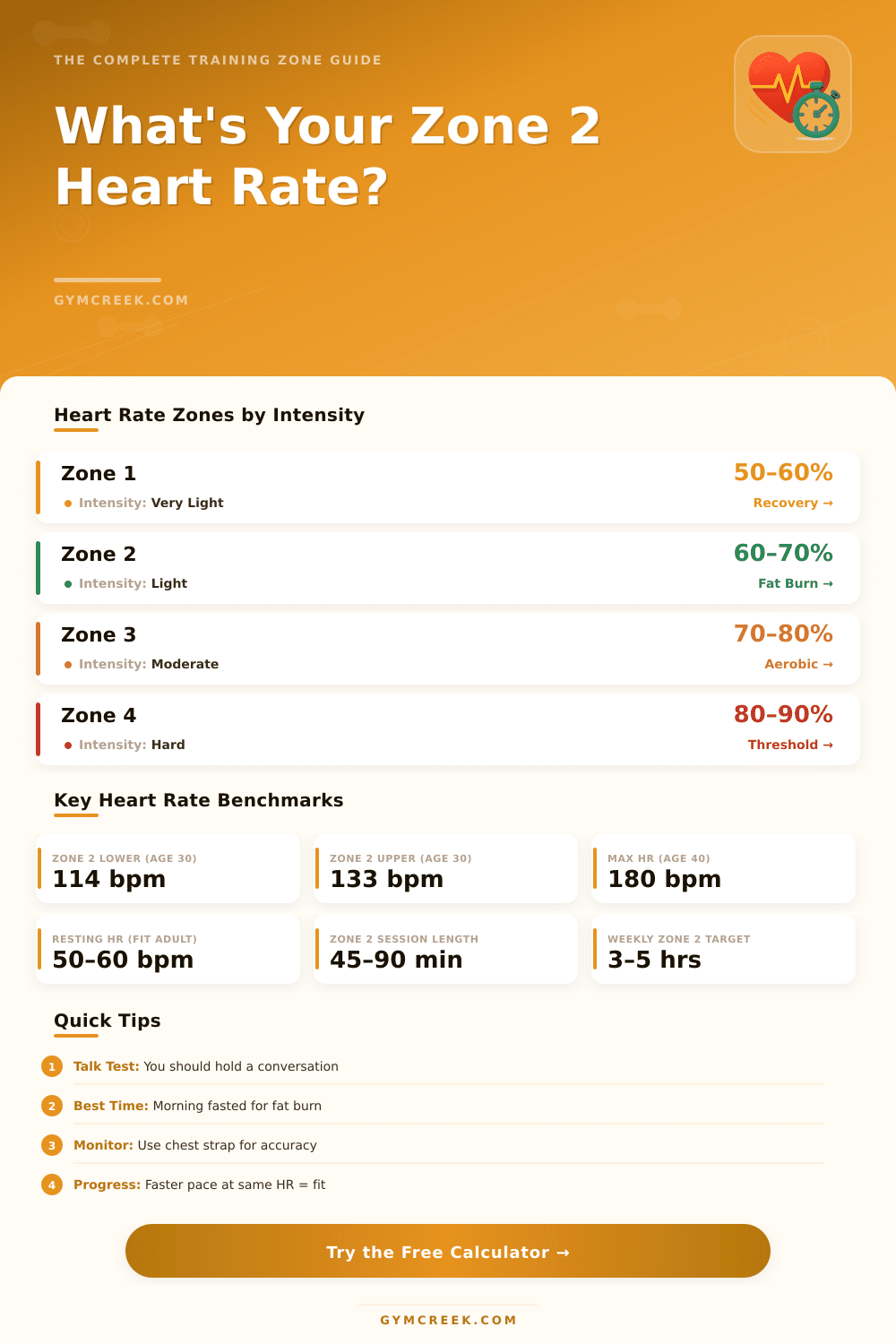
| Zone 2 ⭐ | 60–70% | Light / Conversational | Fat (85%) | Fat Burn, Aerobic Base | 45–180 min |
| Zone 3 | 70–80% | Moderate | Mixed (50/50) | Aerobic Efficiency | 20–60 min |
| Zone 4 | 80–90% | Hard / Uncomfortable | Carbs (75%) | Lactate Threshold | 10–30 min |
| Zone 5 | 90–100% | Maximum Effort | Carbs (95%) | Speed, VO2 Max | 1–8 min |
⭐ Zone 2 is highlighted as the optimal zone for metabolic health, fat burning, and aerobic base building.
| Category | Resting HR (bpm) | Fitness Level | Notes |
|---|---|---|---|
| Athletes | 40–55 | Elite / Competitive | Highly trained heart |
| Excellent | 55–62 | Very Active | Well-conditioned |
| Good | 62–68 | Active | Above average |
| Average | 68–75 | Moderate | Normal healthy range |
| Below Avg | 75–84 | Lightly Active | Room to improve |
| Concern | 85+ | Sedentary | Consult a physician |
ℹ️ Measure resting HR first thing in the morning, before getting out of bed, for 60 seconds.
Use a chest strap heart rate monitor for the most accurate readings during exercise. Wrist-based monitors (smartwatches) can be off by 10–20 bpm during high-intensity activity. For Zone 2 training, a chest strap or optical arm band is recommended. You can also use the Talk Test: if you can speak in full sentences but feel moderately breathless, you are likely in Zone 2.
The Karvonen (Heart Rate Reserve) method accounts for your resting heart rate, making it more individualized. Formula: Target HR = Resting HR + (% intensity × (Max HR – Resting HR)). Enter your resting HR above to get a more personalized Zone 2 range.
Zone 2 of the Heart Rate Zone forms the second grade on a scale from 1 to 5 zones. They show the intensity of the work of the heart during exercise. Here the heart rate reaches between 60% and 70% of the maximum ability.
Gentle walks result in less stress than full run and the Heart Rate Zone zones well explain that difference.
What Is Zone 2 Heart Rate?
To estimate the maximum heart rate without testing, use a simple rule. Simply from 220 subtract your age. This way a thirty-year-old has around 190 beats per minute.
Then zone 2 means 60% to 70% of that value. For folk with 190 maximum, that gives around 114 to 133 beats per minute.
Zone 2 works for basic aerobic activity. Activities of middle intensity, as brisk walks, fit here. Runners apply trianing according to Heart Rate Zone for long time.
Zone 1 serves for warming, zone 5 for maximum run, while zone 2 sits near the bottom end as stable, slow action. Runners sometimes call it “easy pace”.
Online there is confusion about training in zone 2, together with many silly ideas. One real cause to know is, that the Heart Rate Zone zones range according to kind of activity. During cycling the pulse usually stays more low than during run, because the body moves less.
This way zone 2 four run could match zone 3 or 4 on a bike.
To track the heart during activity, it is fairly simple. Wrist devices for tracking work well. Without such tools, you can take the pulse by hand at the inside of the wrist with two fingers.
Measure during 30 seconds and double the result.
The talk test forms another practical way. If you can talk comfortably during the work, that shows that the intensity is around zone 2 or more below. Being able to say at least three phrases without changing your breath is good sign about the right zone.
Zone 2 helps to burn more fat than the higher levels. In aerobic areas the body uses more fats and fewer carbs. Weight loss however depends on calorie gap over time.
A good method is to spend 80 to 90 percent of the training time in zone 2 or 3.
Training in zone 2 forms the base to build stamina. Without it some athletes feel fast increase of the pulse only after moments in heavy exercises. Those with strong aerobic base recover more soon.
When normal work, that keeps the heart in zone 2, sharply brings breathing in zone 4, that marks need of more rest. At first it does not surprise to run at a pace almost equal to hiking. Stay here forsome months commonly brings improvements in the pace at same pulse.