🚗 Anti Squat Calculator
Calculate your suspension's anti squat percentage for optimal traction & handling geometry
✅ Anti Squat Results
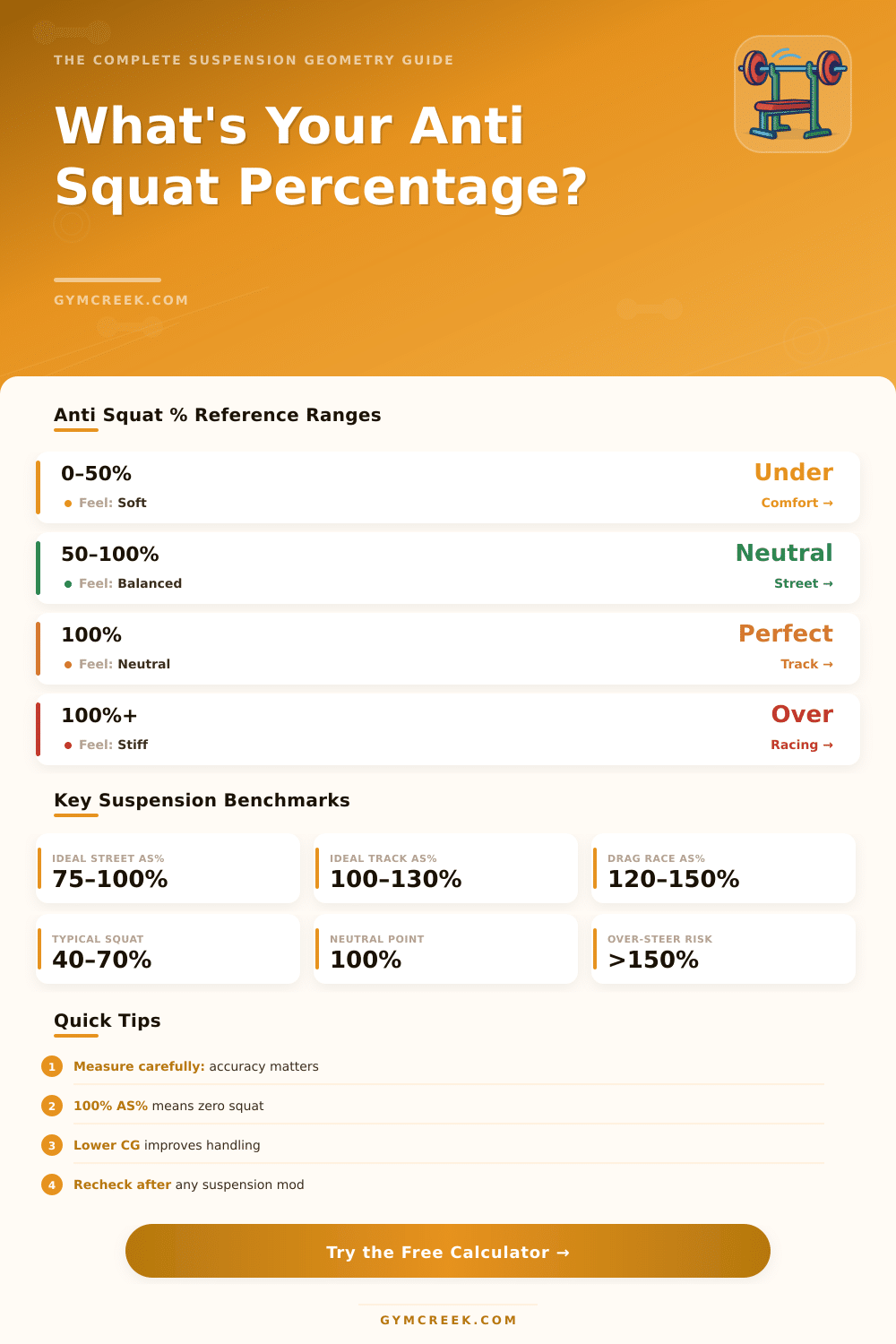
| Anti Squat % | Behavior | Handling Feel | Typical Use Case | Notes |
|---|---|---|---|---|
| < 0% | Pro-Squat | Very soft rear, excessive dive | Not recommended | Rear suspension compresses hard under acceleration; reduces traction |
| 0 – 50% | Under Anti Squat | Soft, weight transfer rearward | Comfort / Luxury | Some squat under acceleration; acceptable for comfort builds |
| 50 – 75% | Moderate Anti Squat | Balanced, mild squat | Daily Driver | Most factory street cars fall in this range |
| 75 – 100% | High Anti Squat | Stable, minimal squat | Performance Street | Good traction with comfortable ride quality |
| 100% | Perfect Anti Squat | Zero body movement (neutral) | Track / Competition | All acceleration forces cancel body roll; ideal geometry point |
| 100 – 130% | Over Anti Squat | Slight front lift under accel | Track / Drag | Improves rear traction; can induce understeer |
| 130 – 150% | High Over Anti Squat | Notable front rise | Drag Racing | Maximum rear traction; harsh ride; not street appropriate |
| > 150% | Extreme Over Anti Squat | Aggressive front lift | Specialized Racing | Risk of instability; oversteer tendency; expert tuning required |
| IC Height | IC Distance (from rear axle) | Approx. AS% | Application |
|---|---|---|---|
| -10 in / -254 mm | 100 in / 2540 mm | ≈ 40–55% | Soft comfort / luxury |
| -5 in / -127 mm | 110 in / 2794 mm | ≈ 60–75% | Daily driver / OEM |
| 0 in / 0 mm | 120 in / 3048 mm | ≈ 80–90% | Performance street |
| +5 in / +127 mm | 130 in / 3302 mm | ≈ 95–105% | Track day / autocross |
| +10 in / +254 mm | 140 in / 3556 mm | ≈ 110–125% | Road racing |
| +15 in / +381 mm | 150 in / 3810 mm | ≈ 130–145% | Drag racing |
| Vehicle Type | Typical F/R Split | CG Height (in) | Recommended AS% |
|---|---|---|---|
| Sports Car (RWD) | 50/50 – 48/52 | 16–18 | 90–110% |
| Sedan / Coupe (FWD) | 60/40 – 65/35 | 17–20 | 70–90% |
| Muscle Car (RWD) | 52/48 – 58/42 | 18–22 | 85–105% |
| Pickup Truck (4WD) | 55/45 – 60/40 | 24–30 | 60–80% |
| Formula / Open Wheel | 42/58 – 45/55 | 10–13 | 100–130% |
| Drag Car (RWD) | 40/60 – 35/65 | 14–18 | 120–150% |
| Rally / Off-Road | 50/50 – 55/45 | 22–28 | 65–85% |
| AWD Performance | 50/50 | 16–19 | 90–115% |
Suspension geometries has a critical role in how a vehicle will behave under acceleration. One of the most important yet misunderstood aspect of suspension geometry is anti-squat. By properly engineering the suspension systems, vehicles gain better traction and handling. The anti squat calculator make it easier for car enthusiasts to understand these aspects of suspension.
From street car to drag monsters, it is important to understand the role of anti-squat in a car. The percentage of anti-squat help with the handling of the car under different conditions.
Anti Squat Calculator
What Is Anti-Squat and Why Does It Matter?
Anti-squat is the suspension systems ability to resist the compressing of the rear of the car when it is accelerating. When the car accelerate, the weight shift to the rear of the car. This cause the suspension systems rear end to squat. Anti-squat geometry use the forces created by the car’s drive train and suspension system to lift the rear of the car, negating the squat of the suspension under acceleration.
The concept of anti-squat relate to the instant center of the suspension system. The intersection of the lines create by the control arms (or torque arms) of the suspension system creates the instant center. The height of the instant center relative to the car’s center of gravity determine the amount of anti-squat created by the car. A suspension system with a perfectly balanced instant center at 100% anti-squat will keep the body of the car level as it accelerate.
Anti-squat percentages has a dramatic effect on the driving characteristic of a car. Lower percentages allows the car to squat to some degree. This can offer a more comfort driving experience for those who drive the car daily. Higher percentages allow the suspension system to resist squat to a greater degree. This is beneficial for performance driving though it can make for a harsher driving experience. Too much anti-squat, however, can cause the car’s front end to lift excessively off the ground when accelerating.
The anti squat calculator above help engineers and car enthusiasts understand the impact of the angles of the control arms of a car’s suspension system on the percent of anti-squat the car will exhibit. The variables that impact the anti-squat percentage of a car include the car’s wheelbase, the height of its center of gravity, and its weight distribution. As such, it is difficult for car owners to calculate these without a digital anti squat calculator. The anti-squat percentage impact the performance of both rear-wheel drive and front-wheel drive cars. Four-wheel-drive cars has the same considerations for anti-squat as rear-wheel drive cars though they exhibit more complex performance characteristics due to the split power provide to each of the car’s axle.
Car manufacturer often design their cars to exhibit a percentage of anti-squat between 50% and 75%. Performance cars and those that are modified to exhibit enhanced performance feature an anti-squat percentage between 90% and 110%. Drag racing cars has a high percentage of anti-squat, though the exact percentage can exceed 130%. However, the high percentage sacrifice some of the handling of the car on public roads.
Anti-squat works in conjunction with anti-dive and roll center height. The adjustment of one impact the other, which is why a suspension system that feature a holistic approach to its engineering will feature the best driving experience for the car’s occupants. The goal is not to have the highest possible anti-squat for the car, but rather the right amount for the car’s make, model, and use.
Many performance cars feature adjustable control arms that allow the car owners to adjust the percentage of anti-squat exhibit by the car’s suspension. If the car is lowered without adjusting the suspension systems geometry, it will lose its anti-squat dramaticly. The same is true of cars that have been lifted above there standard height.
Understanding the role of anti-squat in a car help to explain the different driving experience that cars from different make and models provide to their drivers. Although professional racing team use sophisticated computer software suite to model the forces that a car will exhibit, most car enthusiasts and hobbyists will not have access to these packages. Thus, the anti squat calculator can provide some insight into the performance that a car with certain suspension system modification will exhibit.
While the mathematics of anti-squat is relatively easy to learn, it is more complex to understand what those calculation mean for a specific car. Additional variables that impact the anti-squat percentage of a car include the compliance of the suspension systems bushes, the stiffness of the tire, and the angularity of the drive train.
By understanding these aspect of a suspension system, car owner can gain a better understanding of why some cars exhibit better performance than others while they are accelerating. Regardless of the goal for a car’s performance, understanding these aspect of suspension system engineering is a significant step towards properly engineering the suspension system of a car. The difference between a good suspension setup and a great one is often create through these small yet important aspect of the suspension system engineering process. You should of looked at teh math more closely.