Rowing Drag Factor Calculator
Estimate a practical indoor rowing drag factor target from athlete size, workout type, current damper reading, split, stroke rate, and training context.
📌Presets
Presets load different rower profiles and calculate target drag, damper movement, rowing watts, and pacing context instantly.
⚙Calculator
Rowing drag factor snapshot
Enter your rower, body size, workout, and split data to estimate a practical target.
📊Rowing Metrics
📑Reference Tables
| Use case | Light rower | Middleweight | Heavy or high power |
|---|---|---|---|
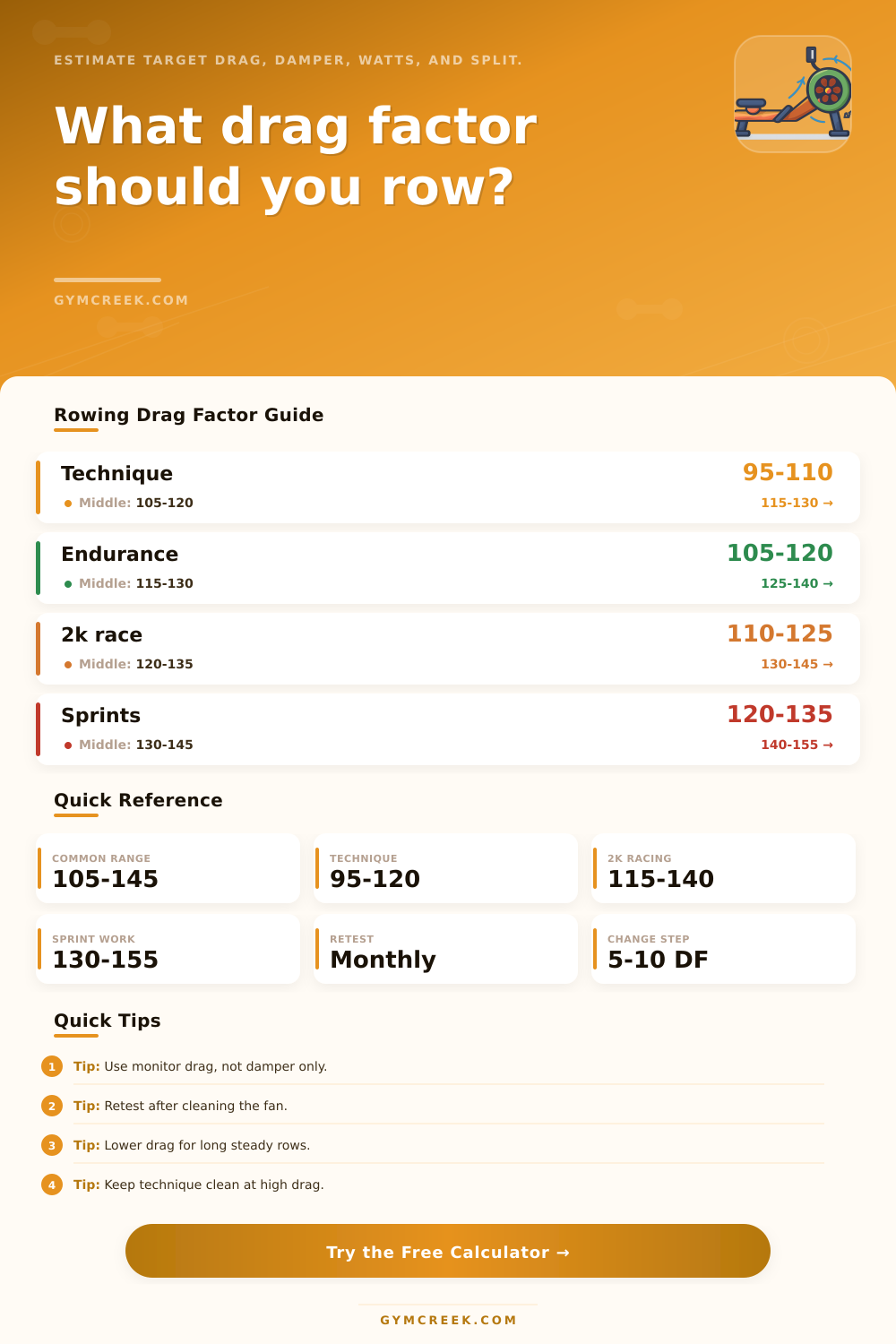
| Technique and skill | 95-110 | 105-120 | 115-130 |
| Long endurance | 105-120 | 115-130 | 125-140 |
| 2k race or test | 110-125 | 120-135 | 130-145 |
| Sprint intervals | 120-135 | 130-145 | 140-155 |
| Term | What it means | Why it changes | How to use it |
|---|---|---|---|
| Damper | Air intake lever | Lever position only | Adjust to find drag |
| Drag factor | Flywheel slowdown | Air, dust, machine | Use monitor value |
| High drag | Heavier stroke feel | More load per stroke | Good for power, not all rows |
| Low drag | Lighter stroke feel | Faster pickup | Good for technique and volume |
| Formula | Input | Output | Use |
|---|---|---|---|
| Rowing watts | Split seconds | Power | 2.8 / pace cubed |
| Watts/kg | Power and mass | Relative power | Size context |
| Damper slope | DF and damper | Lever estimate | Find target setup |
| Mifflin BMR | Size, age, sex | Calories/day | Training context |
| Signal | Likely issue | Adjustment | Retest cue |
|---|---|---|---|
| Stuck catch | Too much load | Lower 5-10 DF | Split holds smoother |
| Slipping drive | Too light or rushed | Raise 3-8 DF | Connection improves |
| High rate fade | Too much drag | Lower ceiling | Rate stays stable |
| Dusty fan | False setting match | Use monitor DF | Clean then retest |
💡Tips
The drag factor on an indoor rowing machines is a measurement of the resistance that a person feel while rowing. The drag factor on rowing machines determine the amount of resistance that is felt at the catch of the stroke, as well as the speed at which the flywheel slow down between rowing strokes. Although many people believe that the damper lever position is the only way to control the resistance that the rowing machine provide, this lever only controls the opening or closing of an air intake on the rowing machine.
Factors such as the amount of dust within the rowing machine, the temperature of the room in which the rowing machine is present, the altitude of the individual, and the condition of the fan on the rowing machine can all impact the position of the damper lever. Thus, the drag factor that is displayed on the monitor is the most accurately measurement of the resistance for that particular rowing machine. The drag factor calculator for indoor rowing machines ask for a few different inputs from the individual rower before displaying a recommendation for the drag factor that should be set on the rowing machine.
How to set the right drag factor on your rowing machine
The rower must input their current drag factor, damper setting, split, stroke rate, and goal for their workout into the drag factor calculator. The calculator performs these mathematical calculations so that the individual do not have to perform these calculations themselfs. Therefore, the user can avoid guesswork in determining the drag factor that they should use during their workouts.
Not all rowers requires the same drag factor on their indoor rowing machines. An individual that weighs more or intends to row short distances and use power intervals may have a higher drag factor than an individual that weigh less or that intends to row longer distances at a more moderate pace. The individual that weighs more can handle more drag factor than an individual that weighs less.
An individual’s body size and goals informs the drag factor calculator as to what drag factor the individual may require during their workouts. An individual’s split and stroke rate can also impact the drag factor that they should set on their indoor rowing machine. By entering the split that the individual intends to row, the drag factor calculator can automatically calculate the number of watts that the individual will produce during their workouts.
The drag factor calculator also uses that wattage per kilogram to calculate the drag factor that the individual should use during their workouts. If the individual produce less watts per kilogram than others, the calculator will recommend a lower drag factor for the individual. The calculation will indicate a higher drag factor for individuals that can produce more watts per kilogram during their workouts.
The stroke rate that the individual sets for themselves will also change the amount of load that they feel with each stroke. At stroke rates of 28 strokes per minute, small adjustments in drag factor will be easy for the individual to accommodate into their workouts. At stroke rates of 36 strokes per minute, the same amount of drag factor adjustment will result in an increased load for each stroke.
To account for this, the drag factor calculator will adjust for stroke rate so that the drag factor recommendation does not become too high if the individual intends to include intervals at high stroke rates in their workout. The length of the individual’s workout can also impact the drag factor that they use during their workouts. The longer the workout, the lower the drag factor that the individual should use.
Using a lower drag factor with indoor rowing machines will allow the individual to row for longer periods of time without becoming fatigued. Using a heavy drag factor will quickly lead to fatigue after forty or sixty minutes of rowing on an indoor rowing machine. In addition to the drag factor calculator, an individual can use the feel of the catch to determine if their drag factor is correct.
If the handle slips on the front portion of the stroke, the drag factor is too low for that individual. If the handle feels stuck to the initial few inches of the stroke, the drag factor is too high for that individual. These sensations during each stroke can be noted in the drag factor calculator so that the drag factor recommendation for that individual will indicate whether their drag factor should be increased or decrease.
A few different environmental factor can also impact the drag factor that is displayed on the indoor rowing machine. If the indoor rowing machine is especially dirty, the drag factor that is displayed on the indoor rowing machine may be lower than the actual drag factor of the indoor rowing machine. At high altitudes, the drag factor may be lower due to the less dense air.
Cold air will result in a lower drag factor recommendation because the air is more denser than warm air. Because these factors may impact the drag factor that is displayed on the indoor rowing machine, the drag factor calculator also asks for the individual’s indication of the condition of their indoor rowing machine. Once the individual has determined the drag factor that they will use for their indoor rowing machine, the drag factor must be set on the indoor rowing machine.
The individual can set the drag factor by first selecting the drag factor on the indoor rowing machine’s monitor. After selecting the drag factor, the individual should perform a few firm strokes on the rowing machine. After performing these strokes, the individual should note the drag factor that is displayed on the indoor rowing machine’s monitor.
The individual should then move the damper lever to the desired drag factor, and the process of rowing and noting the drag factor should be repeated until the drag factor noted on the indoor rowing machine monitor matches the drag factor that the drag factor calculator calculated. Small adjustments of five or ten points on the indoor rowing machine’s drag factor selector is often all that is required to adjust to the desired drag factor. By utilizing the drag factor calculator and adjusting the drag factor according to the different factors mentioned above, each individual can ensure that the drag factor is correctly set to ensure that there strokes remain connected during their workouts.