Rowing Rigging Calculator
Estimate oar gearing, span or spread, overlap, work angle, and rigging load from a sculling or sweep setup before you adjust the boat.
📌Presets
Each preset loads a real rowing setup pattern, then calculates the mechanical effect of span, spread, inboard, outboard, and work angle.
⚙Calculator
Rigging snapshot
Enter the boat setup to compare the current rig with typical rowing ranges.
📊Plan Metrics
📑Reference Tables
| Rig | Common oar length | Inboard | Span or spread | Overlap or crossover |
|---|---|---|---|---|
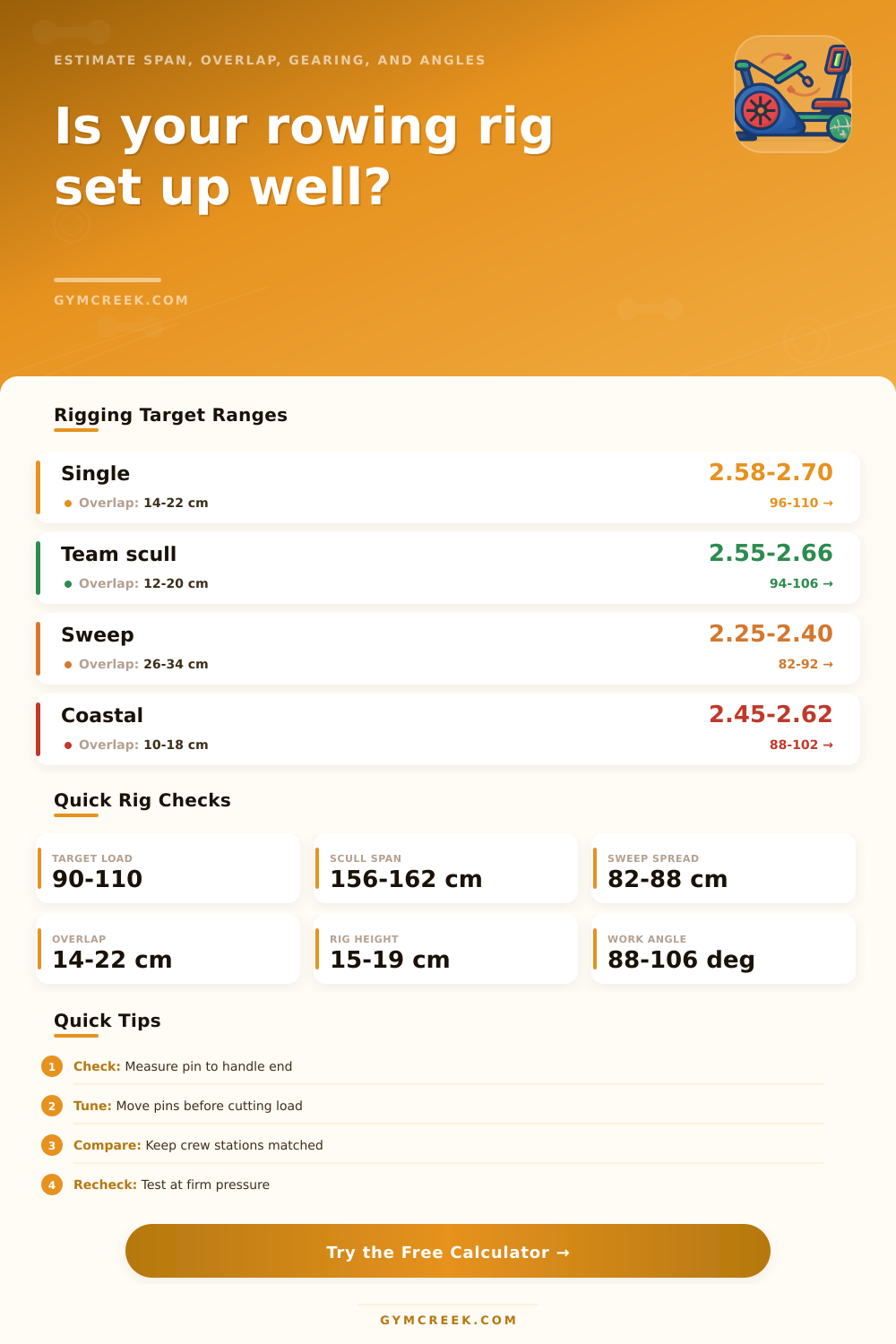
| Single scull | 286-292 cm | 86-90 cm | 157-161 cm span | 14-22 cm overlap |
| Team scull | 287-291 cm | 87-89 cm | 158-162 cm span | 12-20 cm overlap |
| Sweep four or eight | 370-376 cm | 112-116 cm | 82-88 cm spread | 26-34 cm crossover |
| Coastal scull | 284-289 cm | 86-89 cm | 160-164 cm span | 10-18 cm overlap |
| Score | Feel | Likely effect | Common adjustment |
|---|---|---|---|
| Under 88 | Light | Quick hands, less drive load | Lengthen outboard or narrow spread |
| 88-96 | Manageable | Good for skill work and longer rows | Keep crew stations consistent |
| 97-110 | Firm | Strong race feel when timing holds | Watch fatigue and rate control |
| Over 110 | Heavy | Can slow catches and finishes | Shorten outboard or widen spread |
| Rig | Catch angle | Finish angle | Total work angle | Note |
|---|---|---|---|---|
| Single scull | 64-70 deg | 32-38 deg | 96-108 deg | Long arc if posture is stable |
| Team scull | 62-68 deg | 31-37 deg | 94-106 deg | Match stations first |
| Sweep | 53-59 deg | 29-35 deg | 82-92 deg | Side and seat can vary |
| Coastal | 58-66 deg | 30-36 deg | 88-102 deg | Stability usually matters more |
| Output | Formula | Units | Use |
|---|---|---|---|
| Outboard | oar length - inboard | cm | Blade-side lever length |
| Gearing | outboard / inboard | ratio | Mechanical load estimate |
| Scull overlap | 2 x inboard - span | cm | Handle overlap at center |
| Sweep crossover | inboard - spread | cm | Handle past centerline |
| Handle travel | inboard x angle radians | cm | Arc swept by the handle |
💡Tips
Rigging a boat involve making specific measurement that will determine how the boat feel and how the crew perform. The decisions that a rigger make will determine whether the boat feel light or heavy to the crew members. By making the correct decision with rigging, the boat will feel light to the crews as they will not experience fatigue easy.
By making the incorrect decision in rigging a boat, the boat will feel heavy to the crews, and the crews will experience fatigue easy. The measurement that are made for rigging a boat will change the leverage that a rower feel with the handle of the oar. The rigging calculator require certain input to provide the proper output to the users.
How Rigging Changes How a Boat Feels
The length of the oar is one of the inputs because the length of the oar will determine the total length of the lever that is create. The inboard measurement is one of the inputs because the inboard will help to determine how much of the lever is within the boat. The span of the oar is a input because the span will determine how far the blade of the oar is from the centerline of the boat.
The catch and finish angle are two measurement that determine the arc that the blade of the oar will travel through the water. The gate height will determine for the rowers where to place their hands on the oar relative to their bodies. Each of these measurement will change the leverage that a rower will feel while grip the handle of the rowing oar.
The outboard length of the boat is another measurement that can change the load on the blade of the rowing oar. If the outboard length is longer, the blade will apply more load to the water. This is beneficial for strong crew who can maintain a high stroke rate.
If the outboard length is too long, though, it can slow the rowers’ hands if the crew does not have precise timing. Shorter outboards will lighten the feel of the rowing oar. This is beneficial for tired rower or crews who row in choppy water.
The rigging calculator will take the inboard and outboard length measurement and form a gearing ratio. This gearing ratio is a single number that will represent the spread between the outboard and inboard length of the boat. Overlap is another measurement that shows how far the rowers’ handle will travel across the boat’s centerline.
In sculling, the handle will cross the centerline. For sweep boats, the inside handle will travel past the centerline of the boat. If the rigger does not provide enough overlap, the rower will feel like they are losing connection with the boat during the middle of the stroke.
Providing too much overlap will cause the rowers’ hands to fight with each other, creating tension in the shoulders and elbows. Using the inboard and span measurement, the rigging calculator will determine the overlap of the rowers’ handle. The calculator will also indicate for the user if the overlap is in a comfortable range for the boat.
The work angle is another output of the calculator. The work angle use the measurement of the catch and finish angle of the rowing oar. The work angle is the arc that the blade will travel through the water.
Providing a larger work angle will allow the blade to spend more time in the water. This can help rowing boat travel further in the boat. The issue with a larger work angle, though, is that the rowers will need to have more mobility when performing the rowing stroke.
To determine the work angle, the calculator will add the catch and finish angle of the rowing oar and compare the result to typical work angle for the type of rigging that is being used. The load score is another output of the calculator. This score combine the gearing ratio of the boat, the work angle of the rowing blade, the type of blade that is being used, the condition of the water in which the boat row, and the skill level of the boat’s crews.
This score is not in any unit of force in newton. Instead, this score will show the crew member how the boat will feel to each individual rower. A masters rower can use this score to determine how change to the spread of the oar or the blade will impact the load that each rower feel.
A racing crew can use this to determine if the current stroke rate and angle will reach their target firmness for the boat. Both skill level and water condition are required as the rowers may not row under the same condition and with the same individual each session. Novice rower need to feel the boat is lighter to help them learn more precise stroke.
Elite rower can take on more load. Depending on the skill of the rower, the water condition in which they will be rowing can change the load on the oars. These two variable help to create the appropriate load score for that session on the rowing machine.
The rigger should not treat each rower in the boat the same. By using the calculator, each rigger can determine the measurement for one seat in the boat. By comparing the output of these two variable, the rigger can determine if the other rower in the boat are falling within the same range of measurement.
Rowers may need to focus on the timing in which they perform their stroke if all of the rower land in the same place in the boat. If one rower fall outside the parameter of the other rower, their spread or inboard can be adjusted. The rigger should not change multiple component of the boat at the same time.
Using the calculator will allow the rigger to determine the impact of one component on another. For instance, changing the spread of the boat or the inboard is easier than changing the length of the entire oar. The calculator will not show which component will feel better to the rower but will help the rigger understand if the adjustment to the component will create the desired change in feel of the boat.
Gate height is one of the measurement that will impact the comfort of the rower and the angle at which the rowers’ blade enter and exit the water. If the blade enter the water too high, the rower will need to stretch their arm upward when they begin their stroke. If it is too low, their upper back may feel tense.
The calculator will let the rigger know if the height of the gate is within the recommended range for that type of boat. The stroke rate and gearing ratio have a relationship that the rigging master should consider. High stroke rate will require a gearing ratio that is lighter than a boat with low stroke rate.
This is because the rower will need to develop more force with a low stroke rate. Using this relationship, the calculator will shift the gearing ratio when the stroke rate is changed from the standard stroke rate. Body weight and height are two input for the calculator because the amount of leverage that each rower can pull is based on each individual rower.
If a rigger know the body weight and height of the rower, they can make an adjustment to the gearing ratio. Taller rower will have a longer inboard with less effect on the boats overlap. For lighter rower, a lower load score will be desired.
These two input will not change the gearing and load score of the boat. However, they can be used to determine what gearing ratio and load score will be the best for that boat. By using the rigging calculator before the rower enter the water, the rower can remove the guesswork in their discussion on the dock.
The calculator will provide an understanding of whether the boat will feel heavy or light to the crews. It will not replace the importance of the water test to determine how well each crew member row, but it can provide a great starting point for the crews’ discussion. By recording the output of the calculator before making a change to the boat and by recording the output of the calculator after making a change to the boat will allow the crew to understand what change will create the desired feel for the boat over the rowing season.