Triathlon Bike Size Calculator
Estimate triathlon frame size, saddle height, aerobar pad stack, pad reach, cockpit length, crank length, and fit caution notes from rider measurements and race position goals.
📌Fit Presets
Presets load complete rider profiles and recalculate frame, saddle, cockpit, and aerobar targets immediately.
⚙Rider And Fit Inputs
Your tri bike fit range is ready
Review frame size, pad coordinates, saddle height, and caution notes before comparing bikes.
📊Fit Benchmarks
📘Reference Tables
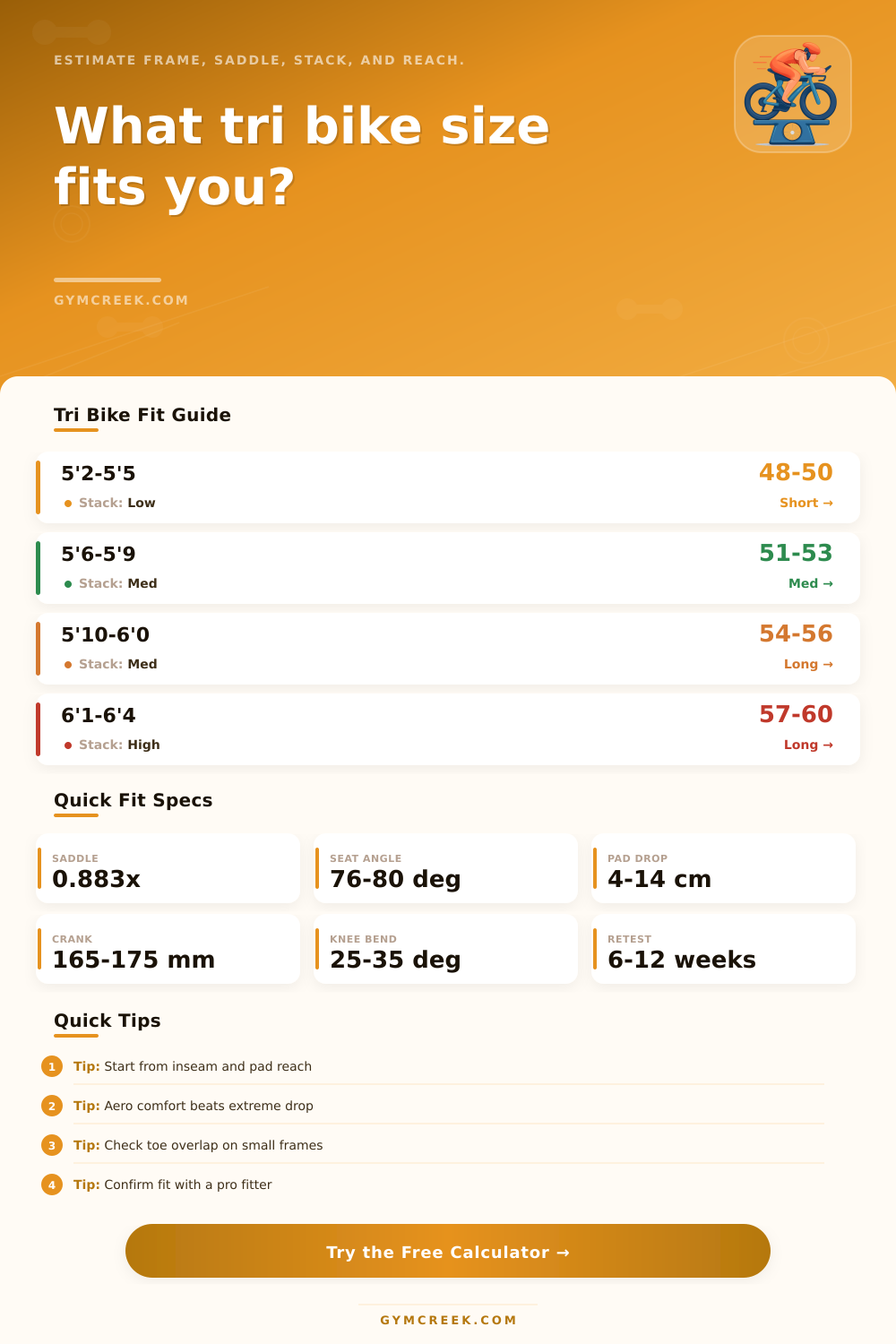
| Rider height | Typical tri frame | Fit priority | Watch point |
|---|---|---|---|
| 5 ft 0 in to 5 ft 3 in / 152 to 160 cm | 47 to 49 cm | Short reach, toe clearance | Small frames may need short cranks |
| 5 ft 4 in to 5 ft 7 in / 163 to 170 cm | 49 to 51 cm | Pad reach and saddle setback | Confirm stand-over and front-center |
| 5 ft 8 in to 5 ft 11 in / 173 to 180 cm | 52 to 55 cm | Balanced stack and reach | Choose by pad coordinates first |
| 6 ft 0 in to 6 ft 3 in / 183 to 191 cm | 56 to 59 cm | Stack, base-bar height | Avoid too much exposed extension |
| 6 ft 4 in plus / 193 cm plus | 60 cm plus | Reach and stability | Check manufacturer max spacers |
| Fit style | Pad drop target | Reach target | Best use |
|---|---|---|---|
| New triathlete | 4 to 7 cm | Short to neutral | Learning aero control |
| Balanced aero | 7 to 10 cm | Neutral | Sprint and Olympic racing |
| Long course | 5 to 9 cm | Neutral to short | Half and full distance comfort |
| Aggressive TT | 10 to 14 cm | Long | Experienced riders only |
| Measurement | Formula used | Output | Why it matters |
|---|---|---|---|
| Cycling inseam | Inseam x 0.67 | Base frame size | Sets starting frame class |
| Cycling inseam | Inseam x 0.883 | Saddle height | Classic LeMond starting point |
| Torso plus arm | Weighted cockpit model | Pad reach | Controls aero support |
| Height and drop | Body stack minus drop | Pad stack | Controls hip angle and comfort |
| Weight, height, age | Mifflin-St Jeor | BMR and TDEE | Energy context only |
✅Fit Notes
When selecting a triathlon bike, you must consider the affect that your bodys position on the bike will have upon your ability to run after completing the cycling portion of the race. Your bike position must work for your body, yet it must also work in support of your performance when running. Bikes with the same frame size dont necessarily have the same measurements that will work for all rider; the measurements of your torso, your arms, and your inseam will help to determine the proper fit for your body upon riding the bike.
Saddle height is one of the first measurements that you should consider in creating your proper bike fit; saddle height will impact your comfort and power while cycling. You can use a formula to calculate your starting saddle height, but your total height and the type of race that you are racing can impact your proper saddle height. For instance, those racing in sprint event may have different saddle heights then those racing over long distances.
How to Fit Your Triathlon Bike
Changes in the saddle height will impact the way in which your hips moves while cycling, which can impact the way in which you run after completing the cycling portion of the race. Reach and stack measurements will impact the distance that you must travel while cycling while seated upon the bike. Your torso length and arm length will help determine the distance that you will travel while cycling.
Two individuals of the same height could have different reach measurements if one individual has a short torso length while the other individual have a long torso length. Furthermore, the frame size will not necessarily provide accurate measurements of the bike when the aerobars are mounted upon the bike. Flexibility will play a role in your desired measurements for your bike.
Individuals with low flexibility may require an open hip angle on their bikes; an open hip angle requires both a shorter reach measurement for the bike and a less aggressive pad drop. Individual with high flexibility may have the ability to utilize a more aggressive pad drop setting on their bike; however, those with low flexibility may have difficulty utilize such settings. Furthermore, flexibility can improve over time while cycling; therefore, an individual should find settings that allow flexibility to change over time.
Shorter cranks can help an individual to maintain their proper hip angle while cycling in an aggressive aerodynamic position; those with long femurs may find it beneficial to incorporate shorter cranks into their bikes. You can determine a suggested crank length based off the inseam of the cyclist. Thus, it is recommended that individuals test different crank lengths to find the most comfortabley position for their hips.
The seat-tube angle will impact the reach that an individual has to the pads upon the bike. Steeper seat-tube angles will move an individual’s hips forward on the bike, shortening the distance that they travel to reach the pads. By setting a target angle for the seat-tube angle on the calculator, the recommendations for reach will take into account the target seat-tube angle.
Both the seat-tube angle and pad position may differ based upon the individual angle. The calculator will provide recommendations for individual measurements, but the individual should also consider the specification for each bike themselves. Furthermore, those recommendations can change over time, especially with changes in flexibility and strength.
Thus, it is recommended for each individual to retest their bikes every few month to ensure that there body is still able to accommodate the same bikes that they used at the beginning of the season. Additionally, any change to flexibility or strength can alter the correct bike fit for each individual over time.