Amino Acid Intake Calculator
Estimate how daily protein quality and meal spacing shape your EAA, BCAA, and leucine coverage before the next training block starts.
📌Presets
Each preset loads a different daily protein pattern so you can see how amino acid coverage shifts with body weight, source quality, and meal timing.
⚙Calculator
Amino acid coverage snapshot
Enter your intake pattern to compare it against body-weight targets.
📊Plan Metrics
📑Reference Tables
| Goal | Protein/kg | EAA/kg | BCAA/kg | Leu/kg |
|---|---|---|---|---|
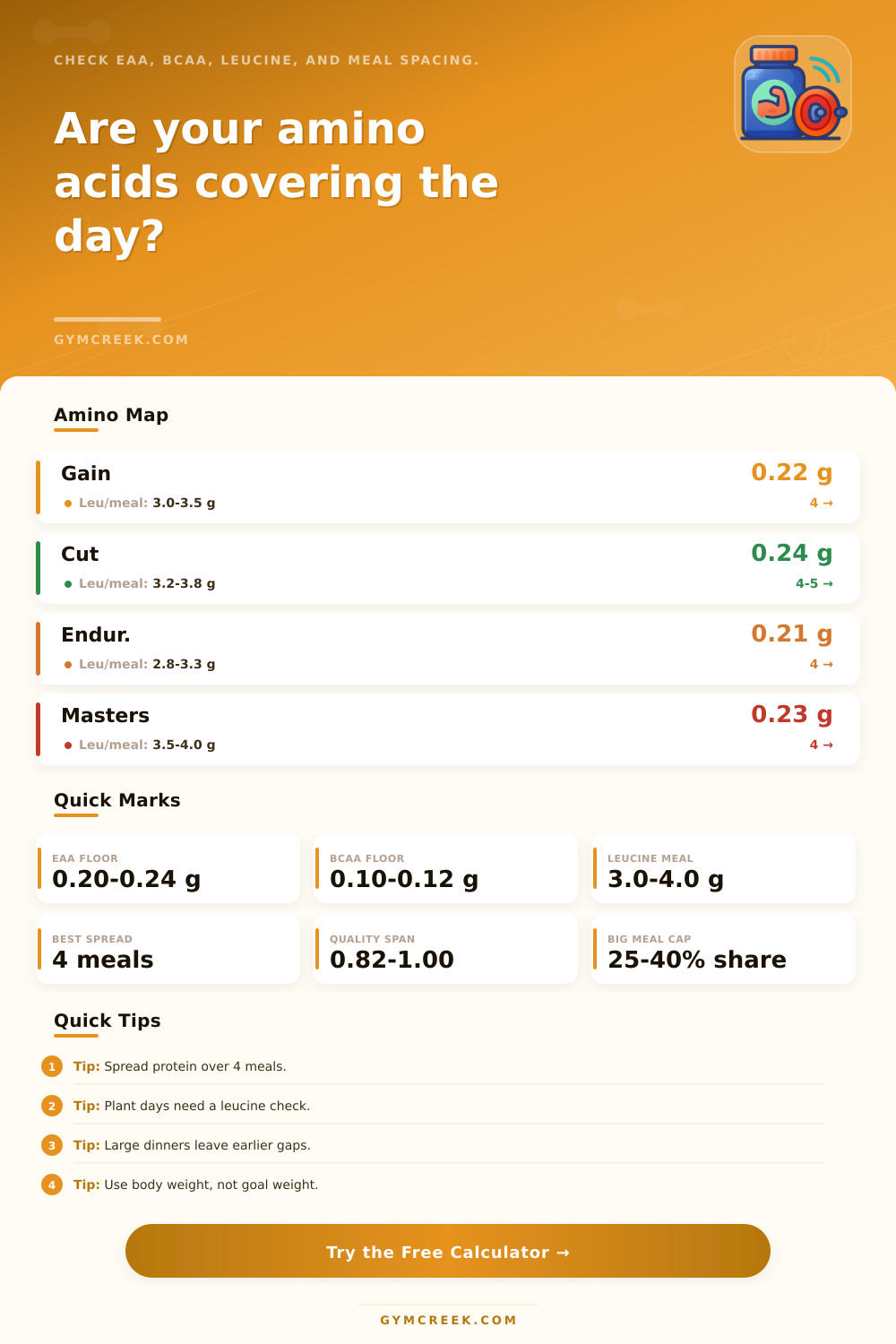
| Gain | 1.8 g | 0.22 g | 0.11 g | 0.036 g |
| Cut | 2.0 g | 0.24 g | 0.12 g | 0.039 g |
| Maintain | 1.6 g | 0.20 g | 0.10 g | 0.033 g |
| Endurance | 1.7 g | 0.21 g | 0.105 g | 0.034 g |
| Recovery | 1.9 g | 0.23 g | 0.115 g | 0.040 g |
| Source | Factor | EAA % | BCAA % | Leu % |
|---|---|---|---|---|
| Animal mix | 1.00 | 46% | 24% | 11% |
| Mixed food | 0.93 | 41% | 20% | 9% |
| Dairy-egg | 0.96 | 42% | 21% | 9.5% |
| Soy-legume | 0.88 | 37% | 18% | 8% |
| Plant-heavy | 0.82 | 34% | 16% | 6.7% |
| Split | Largest Meal | Small Meals | Signal |
|---|---|---|---|
| Even 4 | 25-30% | 23-25% | Steady |
| Even 5 | 20-25% | 19-20% | Frequent |
| 3 meals | 33-40% | 30-33% | Works well |
| Heavy dinner | 50%+ | 25%- | Front gap |
| Add-on | Leucine | EAA | Best Use |
|---|---|---|---|
| None | 0 g | 0 g | Food only |
| Whey | 0.7 g | 3 g | Low meals |
| EAA blend | 0.9 g | 5 g | Plant days |
| Leucine | 1.5 g | 0 g | Trigger lift |
💡Tips
Amino acids is necessary for muscle repair and muscle growths. There are nine essential amino acids that the body cannot produce on its own. These essential amino acids must come from the foods that we eat.
Out of the essential amino acids, there are three branched-chain amino acids and leucine that play a primary role in signaling the body to rebuild muscle tissues. Leucine is the specific amino acid that trigger muscle protein synthesis. This muscle protein synthesis is what leads to muscle repair.
How Protein and Leucine Help Muscle Repair
If a person does not consume enough leucine, or if they do not consume leucine at regular intervals, then the body will not be able to maximize muscle protein synthesis in the body. Many peoples focus on the total amount of protein that they consume in a day. However, the total amount of protein that they consume is not the only factor in muscle recovery.
If the protein that is consumed dont contain enough essential amino acids, then the body will not be able to repair its muscles effective. For example, proteins like whey protein contain all of the essential amino acids that the body needs. However, plant-based proteins may require greater portions of that protein to provide the same amount of leucine as animal-based proteins.
The body cannot store amino acids, so amino acids must be consumed in pulses throughout the day for the body to recover its muscle effectiveley. The spacing in which the individual consumes the protein is critical to how the body will utilize that protein. Experts recommends that individuals consume protein in four even meals throughout the day.
By distributing the protein that is consumed across four meals, the body will maintain enough leucine to trigger muscle protein synthesis. A person should consume at least 3 gram of leucine per meal. If an individual consumes one large meal that contains the bulk of their protein for the day, they will not be triggering muscle protein synthesis for the other meals of the day.
By consuming protein in smaller portions across the day, the body will trigger muscle protein synthesis more effective than if one large meal is consumed. An individual’s body weight is the most important number to use when calculating protein needs. The number that you should use is the actual body weight of the individual, not their target weight.
Based off an individual’s body weight, they can calculate their daily protein grams, where they will find their protein sources, and the frequency with which they should consume their protein. By utilizing a calculation tool to determine the protein that an individual should consume, that tool will display how their essential amino acids compare with their target. Additionally, the tool will display whether or not their leucine levels per meal are sufficient to trigger muscle protein synthesis.
Finally, the tool will display whether or not their protein distribution throughout the day is balanced, or whether any meal contains too much of their total protein intake. There are some mistake that may occur in the management of protein intake. One of the most common is not consuming enough leucine due to the diet that vegetarians and vegans follow.
Because some proteins are plant-based, their leucine concentration is lower than others. A vegan must consume more leucine supplements to ensure that the body has enough leucine to perform muscle protein synthesis. Another mistake is consuming too much protein in one meal.
To fix this issue, leucine and essential amino acid supplements could be taken so that the body gets the necessary amino acids without increasing total calorie intake. Depending on the lifestyle and goals of an individual, their protein needs will change. For example, an endurance athlete will require protein distributed in many small doses throughout the day.
However, athletes in a calorie deficit will require more protein in each meal. As individuals age, there is anabolic resistance. Anabolic resistance is when older individuals require more leucine to trigger the same amount of muscle protein synthesis as younger individuals.
By logging meals for a week, an individual can find the effectiveness of their current protein pattern. If an individual finds that their protein intake is not up to what they need, they should of adjusted their meal timing or protein sources for that particular individual.