Leucine Threshold Calculator
Estimate a realistic leucine trigger for each protein feeding, convert that target into grams from your chosen source, and map meal windows that fit waking hours and training time.
📌Protein Timing Presets
Each scenario loads body size, schedule, goal phase, and protein source so you can compare how much a food choice changes the serving needed to clear the same leucine trigger.
⚙Leucine Inputs
Dial in your leucine trigger
Choose body size, protein source, and meal spacing to see what one solid protein feeding really looks like.
📊Leucine Snapshot
⏰Meal Timing Windows
| Meal slot | Window | Role | Target |
|---|---|---|---|
| Meal 1 | --- | Wake anchor | Calculate to load your plan. |
| Meal 2 | --- | Bridge meal | Spacing changes with meal count. |
| Meal 3 | --- | Training link | Pre-lift or post-lift note appears here. |
| Meal 4 | --- | Late feed | Last anchor sits before bed. |
📑Reference Tables
| Source | Leucine % | Buffer | Reading |
|---|---|---|---|
| Whey isolate | 12.0% | 1.00x | Fastest path to the trigger. |
| Whey concentrate | 11.0% | 1.00x | Still dense with a slightly larger scoop. |
| Chicken breast | 8.5% | 1.00x | Lean whole-food anchor. |
| Lean beef | 8.0% | 1.00x | Solid leucine hit with more satiety. |
| Whole eggs | 8.6% | 1.02x | Reliable, but total grams climb quickly. |
| Greek yogurt | 9.0% | 1.03x | Useful for breakfast or a late feed. |
| Cottage cheese | 10.0% | 1.02x | Casein-heavy and efficient. |
| Soy isolate | 8.0% | 1.05x | Plant option that stays competitive. |
| Tofu or tempeh | 7.5% | 1.10x | Expect larger plate-sized portions. |
| Mixed plant blend | 7.0% | 1.12x | Good blend choice when variety matters. |
| Body weight | Age 18-39 | Age 40-59 | Age 60+ |
|---|---|---|---|
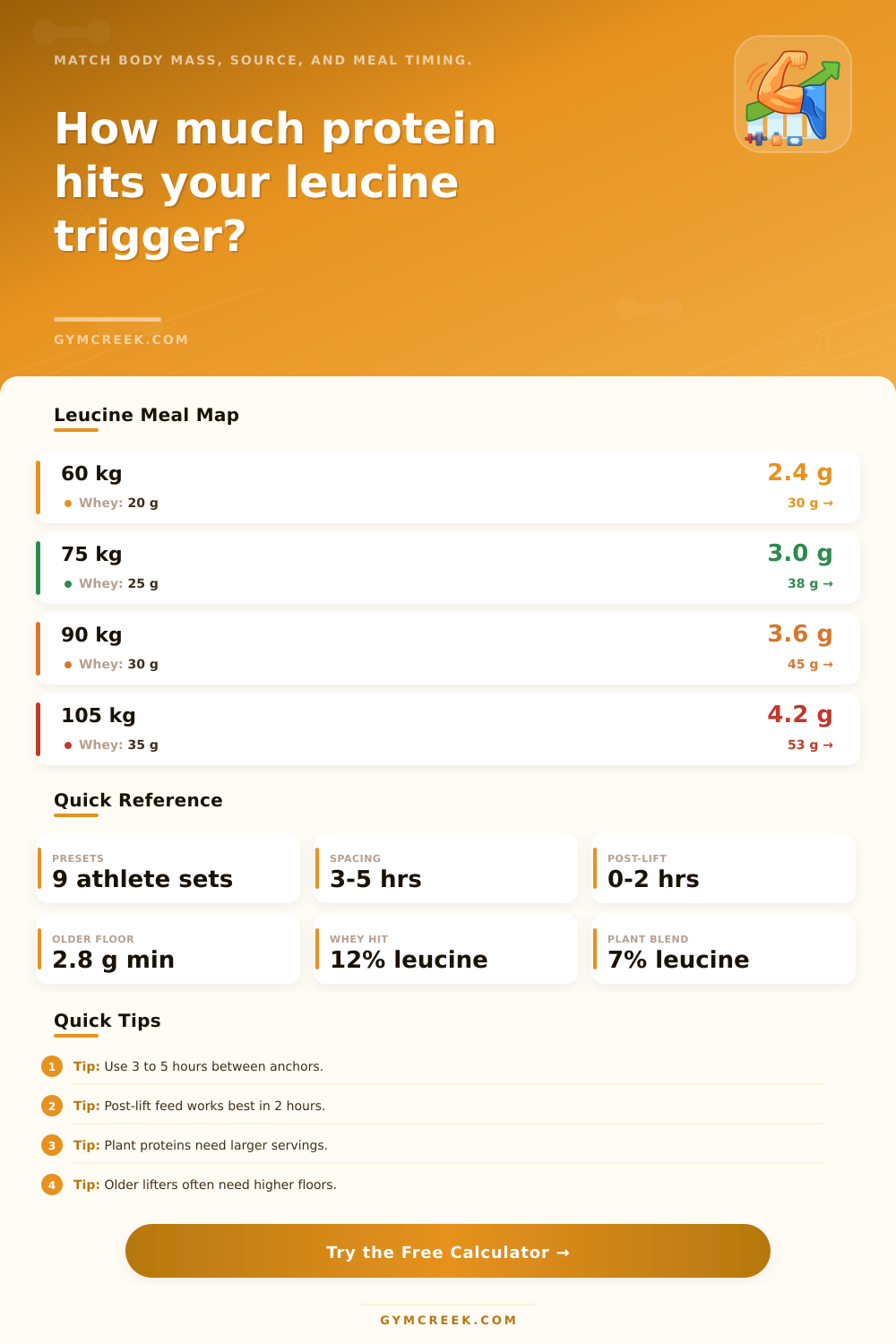
| 60 kg / 132 lb | 2.4 g | 2.7 g | 3.3 g |
| 75 kg / 165 lb | 3.0 g | 3.4 g | 4.1 g |
| 90 kg / 198 lb | 3.6 g | 4.1 g | 5.0 g |
| 105 kg / 231 lb | 4.2 g | 4.7 g | 5.8 g |
| 120 kg / 265 lb | 4.8 g | 5.4 g | 6.6 g |
| Rule | Window | Why it matters | Adjustment cue |
|---|---|---|---|
| First anchor | 1 hr after wake | Sets the first muscle-protein pulse. | Move earlier if you train fasted. |
| Meal spacing | 3-5 hrs | Prevents tiny back-to-back protein hits. | Add a snack if gaps exceed 5 hrs. |
| Pre-lift meal | 1.5-3 hrs pre | Supports training without a heavy gut. | Use easier foods if session intensity is high. |
| Post-lift meal | 0-2 hrs post | Helps recover when the prior meal was distant. | Make this the closest full threshold meal. |
| Late feed | 1.5-2.5 hrs pre-bed | Limits the overnight gap. | Casein-rich foods fit well here. |
| Layer | Formula | Needed | Use here |
|---|---|---|---|
| Age floor | 0.040-0.055 g/kg | Age and body mass | Builds the base leucine threshold. |
| Training bump | Base x demand factor | Activity profile | Raises the threshold for harder blocks. |
| Goal bump | Base x phase factor | Diet phase | Protects retention during cuts or recomp work. |
| Protein need | Leucine / density x buffer | Source profile | Converts grams of leucine into grams of food. |
| Lean context | Boer equation | Sex, height, weight | Adds body-composition context without changing the main target. |
💡Practical Notes
The best-looking leucine number on paper is not useful if the serving is too big for your appetite or timing. Choose anchors you can repeat on workdays, rest days, and travel days.
Whey, dairy, soy isolate, eggs, and mixed meals can all work, but leucine density changes the grams required. Sometimes the easier fix is a denser source, not a bigger schedule.
Leucine is an essential amino acid that plays a critical role in muscle protein synthesis. Muscle protein synthesis is the process that repairs and builds muscle tissue after exercises. While many individuals may focus on consuming enough protein on a daily basis, the amount of leucine consumed with every meal is the most important factor for muscle growth.
Leucine act as a trigger for muscle protein synthesis. To activate this process, individuals must consume enough leucine with every meal. To activate muscle protein synthesis, individuals must consume a specific amount of leucine with one meal.
How Much Leucine You Need Per Meal to Build Muscle
The recommended amount of leucine to activate muscle protein synthesis is between 2.5 and 3 grams of leucine per meal. Consuming less than 2.5 grams of leucine will result in a diminished muscle protein synthesis response. Consuming between 2.5 and 3 grams of leucine will result in the maximum muscle protein synthesis response for a few hours after the meal.
Because the body require a threshold of leucine to trigger muscle protein synthesis, individuals who consume many small meals with insufficient leucine will not derive the same benefits than individuals who consume fewer meals with enough leucine to trigger muscle protein synthesis. An individuals age plays a role in the amount of leucine required to trigger muscle protein synthesis. Younger individuals have more sensitivity to leucine than older individuals.
Therefore, younger individuals will reach the threshold of leucine required to trigger muscle protein synthesis with fewer grams of leucine than an older individual will need. Older individuals will need to consume 10 to 20 percent more leucine with each meal to achieve the same response from their muscles as younger individuals. An individuals training regime can also play a role in the leucine needs for muscle protein synthesis.
An individual who performs high-volume training will require more leucine to support muscle protein synthesis than an individual who performs little or no training. The source of the protein will play a role in the amount of grams of protein that must be consumed to reach the threshold of leucine necessary for muscle protein synthesis. The percentage of leucine in protein sources vary.
For instance, whey protein isolate contains approximately 12 percent leucine. Therefore, an individual would need to consume 25 grams of whey protein isolate to consume 3 grams of leucine. Plant-based proteins contain approximately 7 percent leucine.
An individual would have to consume 40 grams of plant protein to reach 3 grams of leucine. Sources of protein like chicken and eggs contain between 8 and 9 percent leucine. Therefore, an individual would have to consume a moderate amount of these whole foods to reach the threshold of leucine required for muscle protein synthesis.
These examples indicate that the percentage of leucine in protein sources affects the amount of grams of protein that must be consumed for muscle protein synthesis to be triggered. To effectively provide the body with the protein required for muscle protein synthesis throughout the day, the timing of meals is important. The meals that contain protein should be spaced approximately 3 to 5 hours apart.
For example, an individual might eat the first meal with protein around the one hour mark after waking up. Thereafter, the meals should be every few hours. The meals with protein should be consumed near the individuals training sessions.
Furthermore, protein should be consumed within a two hour window after lifting weights to take advantage of the increased sensitivity of the muscles to protein after exercise. Finally, consuming a source of protein that takes longer to digest, such as dairy products, before going to sleep will ensure that the body receives the leucine required to trigger muscle protein synthesis during the sleep cycle. An individuals body size can influence the amount of protein that they need to consume.
Individually larger individuals have more muscle mass. More muscle mass indicate the need for more protein to support muscle protein synthesis. While the weight of an individual is one factor, there height and sex can help to indicate their muscle mass.
However, perhaps the most important factor for the general population is ensuring that individuals set up a protein routine that will hit the leucine threshold every single day. Individuals dont have to consume the correct amount of protein in every meal to gain the benefit of properly timed protein consumption. Consuming three meals that contain the threshold amount of leucine will provide the body with approximately 80 percent of the benefit that can be gained from proper protein timing.
Many individuals who focus on protein timing make the mistake of consuming the majority of their protein early in the day and consuming very little after. Protein synthesis requires regular meals with protein to ensure the body continues to benefit. An individual should find a way to time the protein consumption in a manner that is sustainable with their lifestyle.
Whether they travel alot, work in the office, or train in the evenings, a routine that includes the consumption of leucine will ensure that muscle protein synthesis continues to occur. As the essential amino acid that triggers muscle protein synthesis, leucine is the factor that individuals should focus on with regards to the benefits of protein. Ensuring that the body consumes the threshold of leucine with several meals each day will provide the benefits from their exercise routine.