Saturated Fat Intake Calculator
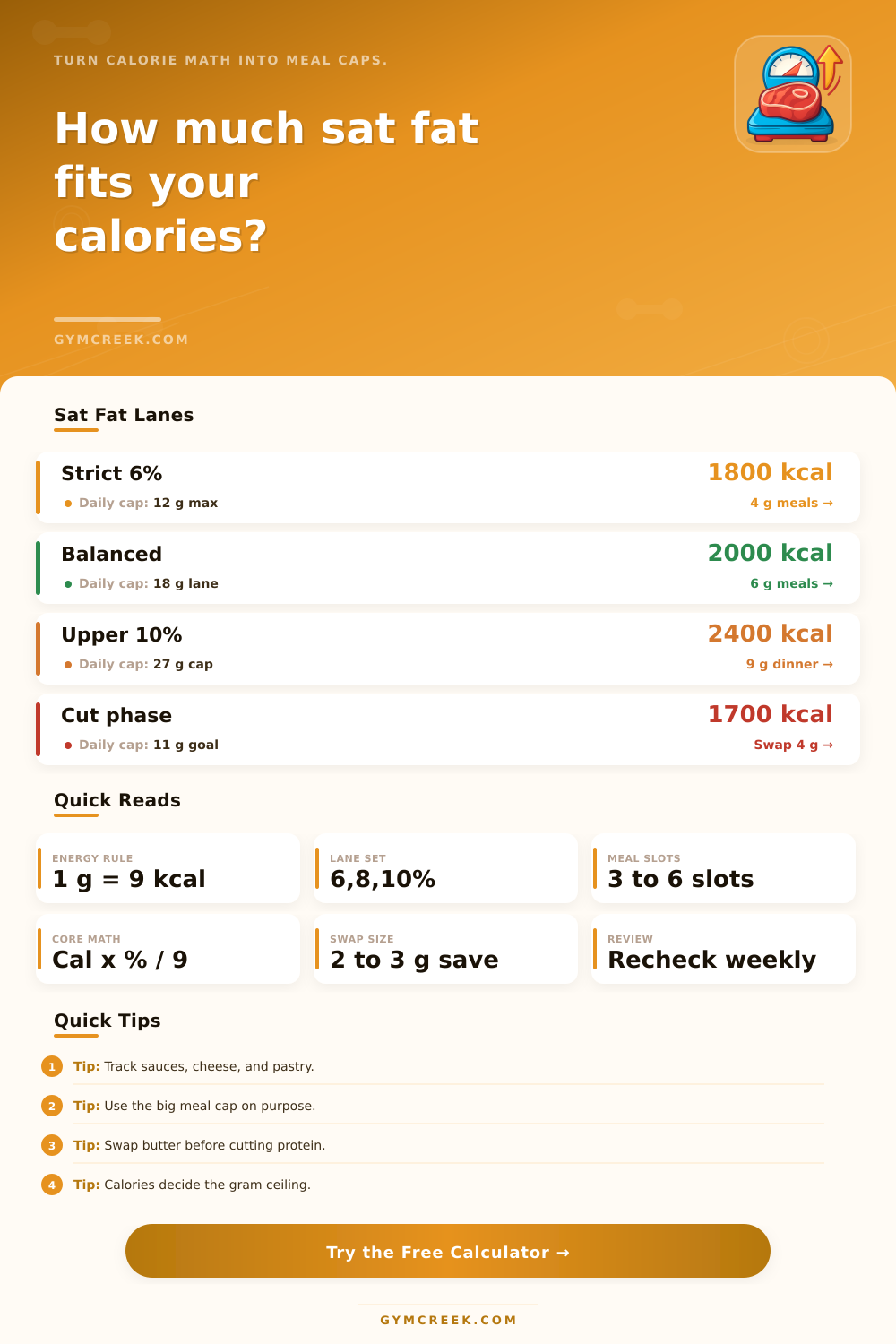
Turn daily calories into a practical saturated fat ceiling, then see how that cap breaks across meals, snacks, and simple swap decisions before richer foods quietly eat the whole day.
📌Scenario Presets
Each preset loads a believable calorie target, eating rhythm, and current saturated fat estimate so the calculator can show both your cap and how much rich-food room the day really leaves.
⚙Limit Inputs
Build your saturated fat cap
Enter calories, pick a guideline lane, and compare the result with your current intake.
| Window | Share | Cap | Practical cue |
|---|---|---|---|
| Meal 1 | --- | --- | Calculate to build the split. |
| Meal 2 | --- | --- | Use the chosen pattern to shape richer meals. |
| Meal 3 | --- | --- | Snack slots can stay lighter than dinner. |
| Total | --- | --- | Your full-day ceiling lands here. |
The split table shows where richer foods fit best so one meal does not quietly burn the entire day.
📉Lane Metrics
📑Reference Tables
| Calories | 6% lane | 8% lane | 10% cap |
|---|---|---|---|
| 1600 | 11 g | 14 g | 18 g |
| 1800 | 12 g | 16 g | 20 g |
| 2000 | 13 g | 18 g | 22 g |
| 2400 | 16 g | 21 g | 27 g |
| 3000 | 20 g | 27 g | 33 g |
| Swap out | Swap in | Save | Why it helps |
|---|---|---|---|
| 1 tbsp butter | Olive oil | About 7 g | Cooking fat is a fast win because it touches the whole meal. |
| Sausage patty | Lean turkey | 3 to 5 g | Breakfast can shrink quickly without cutting total protein. |
| 2 oz full cheese | 1 oz plus fruit | 3 to 4 g | Portion trimming often works better than a total ban. |
| Creamy dressing | Vinaigrette | 2 to 4 g | Sauces are easy to miss when tracking daily totals. |
| Ice cream cup | Greek yogurt | 4 to 6 g | Dessert swaps protect the richest meal of the day. |
| Situation | Calories | Lane | What it means |
|---|---|---|---|
| Heart reset | 1800 to 2200 | 6% | Most days land near 12 g to 15 g, so sauces and cheese matter fast. |
| Steady cut | 1600 to 2300 | 6% or 8% | Lower calories tighten the saturated fat cap even before the lane changes. |
| Maintenance | 2000 to 2800 | 8% | A balanced lane usually leaves room for one richer meal if breakfast stays lighter. |
| Lean gain | 2400 to 3200 | 8% or 10% | More calories raise the gram ceiling, but the percentage rule still keeps structure. |
| Restaurant weekend | Varies | Any lane | Use the largest meal cap on purpose, then keep earlier meals cleaner. |
| Formula step | Math | Output | Use |
|---|---|---|---|
| Mifflin-St Jeor | Weight, height, age, sex | BMR | Builds a calorie estimate when no custom target is entered. |
| Activity multiplier | BMR x activity | TDEE | Moves base energy up to a maintenance-level estimate. |
| Goal adjustment | TDEE x bias | Target calories | Lets the lane reflect cutting, maintenance, or gain phases. |
| Percent to grams | Calories x % / 9 | Sat fat limit | Turns guideline percentages into a usable daily cap. |
| Window split | Limit x share | Meal caps | Shows where a richer meal fits without losing the whole day. |
💡Practical Notes
Saturated fat are found in foods like cheese, butter, fatty meats, and pastries. While these types of fats can provide flavor to foods, they can also take up too much calories from a person’s diet if consume in excess. Due to the caloric content of saturated fat, individuals need to set a limit to the amount of this fat that they consume each day to ensure that it dont replace other nutrients in there diet.
Limits to the amount of saturated fat that individuals should consume each day can be established based off the total number of calories that a person should consume each day. Most health organization recommend that individuals consume a certain amount of saturated fat each day. The American Heart Association, for instance, recommend that individuals limit their saturated fat to less than 6% of the total number of calories that they consume each day.
How Much Saturated Fat to Eat Each Day
In contrast, some organizations state that an individual can consume up to 10% of the total number of calories each day from saturated fat if those individuals are very active throughout the day or if they are attempting to balance the macronutrients within their diet. The amount of saturated fat that an individual should consume each day will depend upon the total amount of calories that an individual consumes. For instance, if an individual consumes 2,000 calories each day, the recommendation of saturated fat of 6% of those total calories would mean that the individual should consume approximately 13 grams of saturated fat each day.
If that same individual consumes 2,400 calories each day, the limit for saturated fat would increase as well. To calculate the number of grams of saturated fat that an individual should consume daily, an individual should multiply the total number of calories that an individual should consume each day by the target percentage of saturated fat and then divide the result by 9. Since saturated fat contains nine calories per gram, this calculation would provide the number of grams of saturated fat that should be consume each day.
A person’s activity level, health goals, and other factors impact the amount of saturated fat that they should consume each day. For example, individuals who are very sedentary may require fewer calories each day than active individuals; as such, the limit to the amount of saturated fat that they should consume would be lower than those who are very active. Individuals who are attempting to lose weight may have a lower limit to the number of calories that they consume each day; with 1,800 calories as an example, there would be a limit to the number of grams of saturated fat that they should consume.
In contrast, athletes who are attempting to gain muscle may consume more calories each day; those athletes may require 3,000 calories per day, for instance, which would establish a limit of approximately 33 grams of saturated fat for that athlete to consume each day. Thus, each individual must understand the number of calories that they need to consume each day before they can establish their target for the amount of saturated fat that they should consume each day. Individuals can manage the amount of saturated fat that they consume by either distributing the saturated fat throughout the day or by limiting the consumption of saturated fat to specific meals.
For instance, individuals who eat three meals each day may choose to consume an equal amount of saturated fat during each meal. Alternatively, individuals may consume very little saturated fat during breakfast and snacks and consume the majority of their daily saturated fat during dinner. Examples of saturated fat include fats like butter, mayonnaise, saucy foods, cheese, and pastries.
Thus, individuals should track the consumption of these types of foods to ensure that they do not consume too much saturated fat each day. If an individual finds that they consume too much saturated fat each day, they can reduce the saturated fat content in their diet by making food swaps. For instance, an individual can replace butter with olive oil in cooking or baking recipes; full-fat salad dressing can be replaced by vinaigrette.
Each of these changes may allow for that individual to save some grams of saturated fat in their diet, which can provide more room for other food groups. To manage the amount of saturated fat that an individual consumes each day, it is necessary for those individuals to track the number of grams of saturated fat that they are currently consuming. By tracking the food that an individual consumes each day for one week, they can determine the grams of saturated fat that they are currently consuming.
For instance, if an individual calculates that they consume 28 grams of saturated fat each day but their goal is to consume 13 grams of saturated fat each day, then they can determine that they need to significantly reduce the amount of saturated fat that they consume each day. Presets can help to make this tracking easier; they can load the information regarding the number of calories that an individual consumes each day to simulate their diet, as well as any gaps in the consumption of saturated fat. By mapping out how many grams of saturated fat that an individual consumes each day, they can ensure that the saturated fat that they consume is within both their daily calorie budget and their daily schedule.